
 ES
ES  EN
EN  FR
FR  RU
RU 

 Entrega rápida


 Obtener precios
Choosing between an automatic machine and a semi-automatic block machine changes more than the pace of production. The decision affects how many workers handle materials and pallets, how consistently each cycle runs, and how much capital your business commits.
A fully automatic line suits sustained, high-volume production where lower manual handling supports predictable output. Semi-automatic equipment costs less initially and keeps operators involved, which may suit a growing business with moderate demand and available labor.
The right choice depends on your current order volume, local wage rates, production targets, and expansion plans. Comparing those operating conditions gives you a firmer basis than choosing the machine with the highest listed capacity.
What Separates Automatic From Semi-Automatic Block Machines?
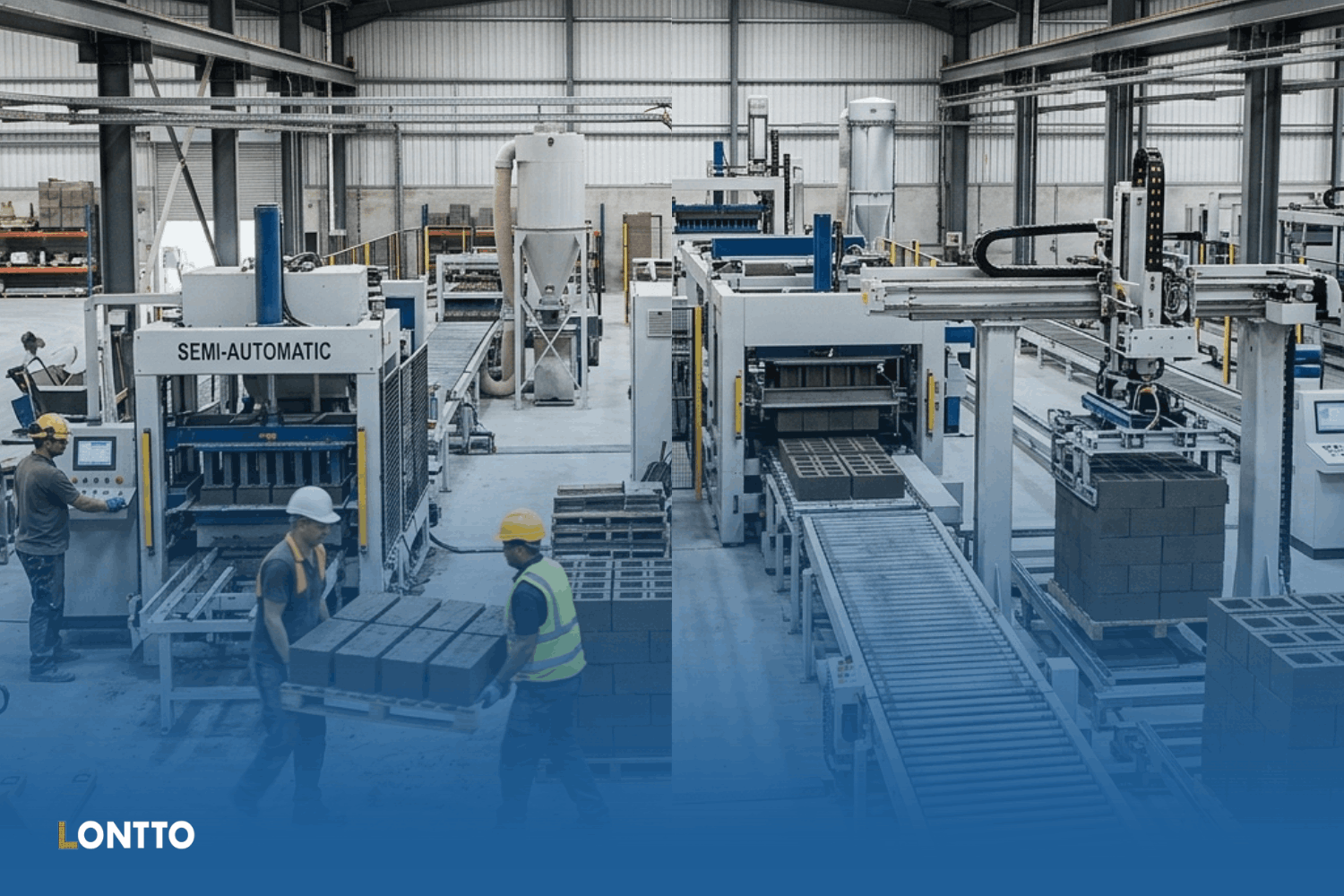
An automatic block machine connects forming to automated batching and product-handling equipment. A semi-automatic machine mechanizes the forming cycle but retains operator-controlled transfers at defined points in production.
How does a semi-automatic machine divide the work?
A semi-automatic block-making machine mechanizes selected production stages but leaves other steps to workers. The exact division varies by configuration, so the label alone doesn’t describe every included component.
For example, the LMT4-26 package includes a mixer, belt conveyor, and main machine. Its forming system adds material automatically, then uses vibration to compact the mix. Operators still move newly formed blocks to the curing yard with manual carts. The LMT4-26 equipment specifications list two to three workers and a 20-26-second forming cycle.
What does a fully automatic line control?
A fully automatic line connects the forming machine to upstream and downstream equipment. Depending on the configuration, that equipment can include automatic batching, mixing, transmission, and pallet-return systems. Stacking equipment and central controls extend automation beyond the press itself.
One línea de producción automática de bloques combines batching and mixing equipment with conveyors, a pallet feeder, and a block-forming machine. Its downstream system includes elevators, a finger car, a pallet warehouse, and a cuber. A programmable logic controller (PLC) screen coordinates the connected equipment from a central control point.
Where do the operating workflows differ?
Semi-automatic production pauses for operator-managed steps such as pallet movement or transfer to the curing area. The forming cycle can remain mechanically controlled, but workers influence how quickly the next pallet or material batch reaches the machine.
Automatic production replaces more transfer points with synchronized equipment. This arrangement supports continuous flow when material supply, power, and maintenance remain stable, although it also requires a stronger supporting setup than one stand-alone machine.
Labor Cost Implications
Automatic lines replace more manual handling positions with technical monitoring roles. Semi-automatic production retains more operators, but its simpler equipment scope can require less specialized support.
How does staffing change with automation?
Semi-automatic operations retain workers for material preparation, control monitoring, and pallet movement. The LMT4-26 uses two to three workers, although staffing can rise when a site separates mixing, curing-yard movement, and material loading.
On a fully automatic line, the remaining employees monitor production, maintain material supply, and respond to operating faults. Required roles still depend on the selected configuration and yard layout.
When can automation reduce labor costs?
Higher automation carries greater value where wages are high or dependable production workers are difficult to retain. Calculate the difference with your own loaded labor cost, including wages, benefits, overtime, and required shift coverage.
Begin with the number of workers each proposed configuration needs per shift. Multiply that figure by scheduled hours and local employment costs, then compare the annual totals. Add the cost of technical training and any extra maintenance support required for the automatic line. This calculation keeps the comparison grounded in your operating country rather than a generic savings claim.
In lower-wage markets, labor savings may take longer to offset the additional equipment cost. A semi-automatic setup can then preserve capital without limiting a business whose production team already meets current demand.
Need to Produce Blocks at Scale?
Our block making machines are built for commercial and industrial production. Get expert advice and a custom price quote — we respond within 24 hours.
How do operator skills affect staffing?
Semi-automatic operators need to understand machine controls and safe handling procedures. They must also coordinate manual transfers with the forming cycle to maintain the planned production rhythm.
Automatic lines shift responsibility toward PLC monitoring, sensor checks, and hydraulic fault diagnosis. Any payroll comparison should include technical recruitment or training, not only the reduction in manual roles.
Output Consistency and Quality Control
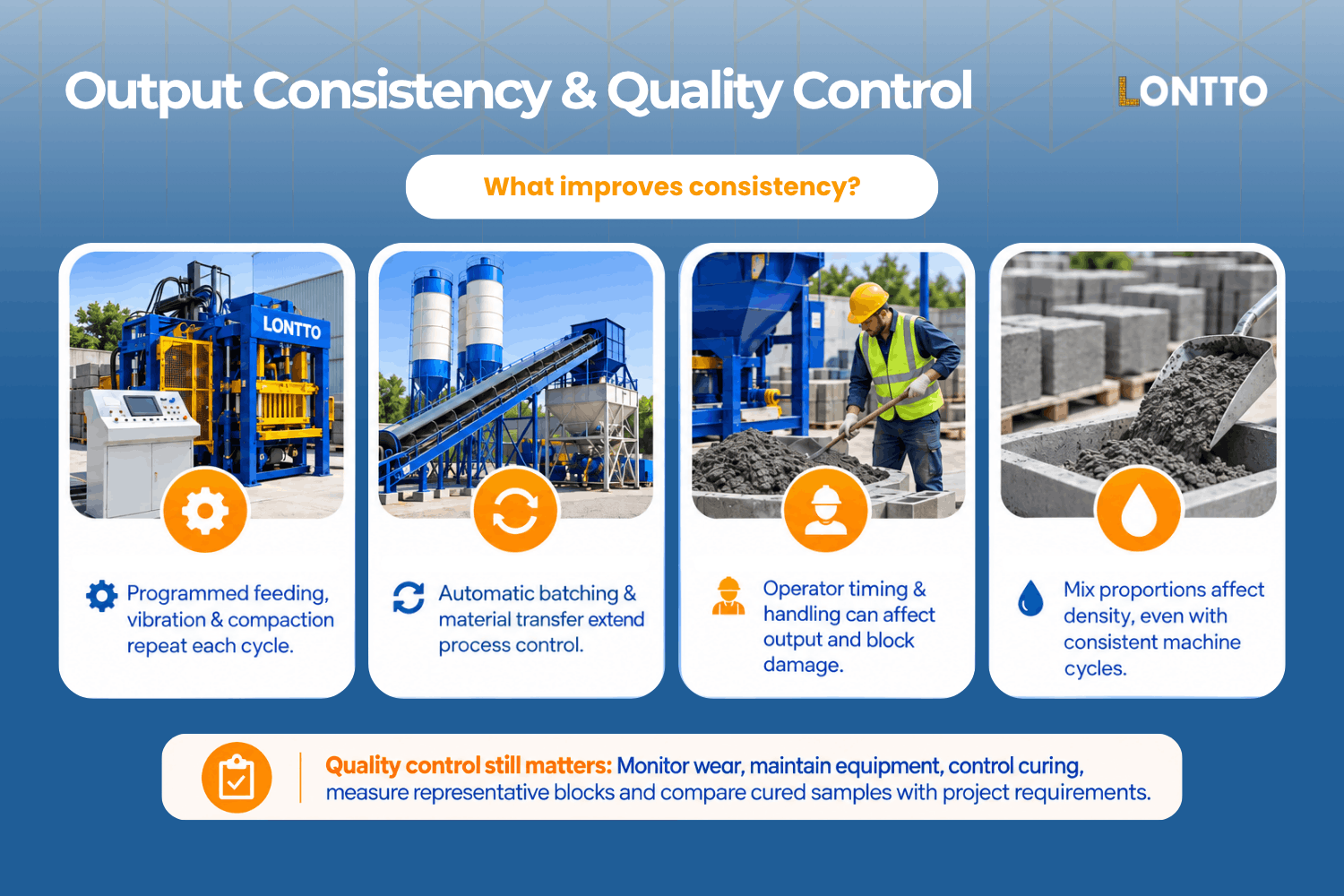
Fully automatic lines control more of the sequence that affects output consistency, including batching and pallet transfer. Semi-automatic machines repeat the forming cycle but leave more timing and handling decisions with operators.
Which automated steps improve repeatability?
Programmed feeding, vibration, and compaction repeat the same actions during each forming cycle. A semi-automatic concrete block-making machine can produce more repeatable results than equipment that relies on manual force for every press.
Fully automatic lines extend programmed control to batching and material transfer. In the cited production-line configuration, the electronic batching system works to a listed precision of plus or minus 2%. Central controls then coordinate pallet feeding, block movement, and cubing. This synchronization helps the line repeat more than the press cycle alone.
Where can operator input affect consistency?
In semi-automatic production, workers influence cycle timing and the movement of fresh blocks. Delayed pallet replacement can lower realized output even when the press maintains the same cycle time. Rough handling during transfer can also damage blocks before curing.
Material preparation creates another control point. Changes in water, cement, or aggregate proportions can alter density even when the machine repeats its programmed vibration. Operators need defined mix procedures and routine checks rather than relying on the machine to correct unsuitable material.
Does automation guarantee block quality?
No automation level guarantees a finished block that meets the buyer’s required specification. Machine settings must match the material, mold, and selected block dimensions. Operators also need to monitor wear, clean the equipment, and maintain a controlled curing process.
Quality control should include checks at planned intervals, not visual review alone. Measure representative blocks, record batch conditions, and compare cured samples with the applicable project requirements. Automatic equipment can make the process more repeatable, but the plant still needs documented acceptance limits.
Capital Cost and Growth Stage Fit
Automatic lines carry a higher capital cost because the quotation can cover batching, forming, pallet transfer, and cubing as one connected system. Semi-automatic quotations cover fewer automated stages, leaving the buyer to fund labor for the remaining handling work.
What increases an automatic line’s capital cost?
Every mechanized handoff adds equipment, controls, and installation work to the project scope. Site preparation and electrical capacity can expand the budget beyond the machinery quotation, particularly when the line includes automated curing-yard transfers or cubing.
Configuration directly affects fully automatic machine pricing, so an equipment label cannot provide a dependable final cost. Block dimensions, molding capacity, and supporting systems change the quotation. Freight, import duties, and local site work add country-specific costs.
When does semi-automatic equipment fit growth?
A growing business can use semi-automatic equipment when its orders exceed manual output but remain within a volume that workers can support. The LMT4-26 equipment package includes the main machine, mixer, and belt conveyor, so its quotation covers more than the press alone.
Compare the semi-automatic block-making machine price with the complete package required at your site. Final pricing varies with the selected mold, destination, and quantity.
Different molds also change what one configuration can produce. The LMT4-26 can operate as a semi-automatic hollow block machine with the appropriate mold. A different mold configures the same equipment as a semi-automatic paver block machine. Published capacity changes with the block dimensions, which makes one general output figure misleading.
When does full automation fit demand?
Established businesses can consider full automation when recurring orders already require long production runs. The strongest case appears when manual transfers prevent the current forming process from meeting those orders.
Utilization matters more than the largest capacity shown in a catalog. A line that runs well below its planned volume ties up capital without using its main advantage. Before investing, compare realistic monthly orders with available shift hours, maintenance time, and expected product changes.
Comparison Table: Automatic vs. Semi-Automatic at a Glance
Automatic block machines provide higher capacity with fewer manual transfers, but they require more capital and technical support. Semi-automatic machines retain more handling work for a lower capital tier. Published capacity ranges remain illustrative because mold layout, block dimensions, and shift conditions change actual output.
| Comparison Point | Automatic Block Machine | Semi-Automatic Block Machine |
|---|---|---|
| Automation level | Connects forming with automated batching, transfer and pallet-handling systems, depending on line configuration. | Automates selected stages such as feeding, vibration, and compaction, but retains manual handling steps. |
| Typical capacity | Often selected for sustained, high-volume production. Some fully automatic block lines are listed at 10,000-30,000-plus blocks per eight-hour shift. | Fits moderate production. Listed ranges run about 3,000-8,000 blocks per eight-hour shift, depending on the configuration. |
| Labor requirement | Uses fewer manual handlers but needs employees who can monitor controls and diagnose technical issues. | Uses more hands for material or pallet movement, but needs less specialized control-system knowledge. |
| Capital cost tier | Higher, reflecting the larger equipment scope and supporting infrastructure. | Lower to mid-tier, with the final cost determined by model, mold, and included auxiliary equipment. |
| Lo mejor para | Established plants with sustained demand, suitable infrastructure, and a workforce prepared for technical oversight. | Growing businesses with moderate demand, available labor, and a need to preserve capital. |
Which One Does Your Business Need?
Choose semi-automatic equipment when moderate production can support your orders and local labor can manage the remaining transfers. Choose an automatic line when sustained volume uses the added capacity and the site can support integrated equipment.
Choose semi-automatic production for controlled growth
A semi-automatic block machine fits when planned shift output matches its capacity and workers can move pallets without delaying the press. Compare the required output using the exact block dimensions because mold capacity changes with unit size. For the LMT4-26, confirm that the quotation includes the published standard package of one mold and two manual carts alongside the mixer and conveyor.
Choose automatic production for sustained volume
An automatic line fits when recurring orders require more output than manual transfers can support. Compare the proposed line’s capacity with sellable monthly volume after allowing for product changes and planned maintenance. Confirm that the site has stable power, adequate material supply, and technicians who can monitor the PLC and hydraulic systems.
Base expansion plans on current demand
Use the current production bottleneck to determine what an expansion must change. If workers cannot replace pallets quickly enough, automated transfer may unlock more of the forming machine’s available cycles. If the machine already sits idle between orders, additional automation would add capacity without addressing the demand constraint.
Compare an average month with your busiest repeatable month, then identify orders lost specifically because the plant lacked capacity. Use that volume to size the next automation level. This approach separates a documented production need from a forecast that has not yet produced orders.
Request a Block Machine Quote From Lontto
Máquina de bloques Lontto supplies both semi-automatic and fully automatic block-making equipment, so the right starting point is your production target and how much of the line you need automated.
On the semi-automatic side, the LMT4-26 includes a mixer, belt conveyor, and main forming machine; operators handle pallet movement and transfer to the curing yard, while the forming cycle runs mechanically. For buyers ready to move to a fully automatic line, Lontto's QT-series configurations connect batching, forming, pallet feeding, and downstream handling under PLC control, reducing the manual transfer points that limit throughput on semi-automatic setups.
Every purchase includes one free mold set and a one-year warranty on materials and craftsmanship. Lontto's ISO 9001-certified factory has over 30 years of manufacturing experience, exports to over 100 countries, and provides installation support, operator training, and door-to-door shipping.
Share your required block dimensions, daily output target, local labor conditions, and available budget so the team can recommend a configuration that fits your production stage.
Automatic vs. Semi-Automatic Block Machines FAQs
How many workers does each machine require?
Semi-automatic configurations require more manual handlers than fully automatic lines. The LMT4-26 uses two to three workers, but the total depends on how your plant assigns mixing and curing-yard movement. Automatic plants replace more handling roles with technical monitoring.
Which machine provides more consistent output?
A fully automatic line provides more consistent flow because it synchronizes more production steps. Semi-automatic equipment repeats its mechanized forming cycle, but operator timing still affects the pace between cycles.
Is a semi-automatic machine suitable for a growing business?
Yes, semi-automatic equipment can fit a growing business whose confirmed orders support moderate production. Select capacity from current sales and a supportable near-term increase rather than an untested long-range forecast.
When does an automatic line justify its higher cost?
An automatic line becomes more practical when sustained demand uses its capacity and recurring operating savings support the added investment. A site-specific model should include local wages, electricity, financing, and planned shift hours.
Can a semi-automatic setup be upgraded later?
Some production setups can accept auxiliary equipment, but adding one conveyor doesn’t create a fully integrated line. Ask the supplier which existing components and controls can support later expansion before including an upgrade in the purchase case.
Volver arriba: Automatic vs. Semi-Automatic Block Machines: Which One Does Your Business Need?

Hable con nuestro Experto en máquinas de ladrillos
Póngase en contacto con nuestro agradable equipo hoy mismo para obtener una estimación del precio de una máquina bloquera.

Soy Chao Zhang, llevo más de 10 años trabajando en la industria de la fabricación de ladrillos. Tengo un profundo conocimiento e investigación sobre varios modelos de máquinas de fabricación de bloques, especialmente máquinas automáticas de ladrillos, máquinas de bloques de hormigón, máquinas de bloques de tierra comprimida, máquinas de ladrillos de arcilla, máquinas de ladrillos de cemento. Tengo un conocimiento especial de esta industria. Puedo ayudar a mis clientes a elegir la máquina de ladrillos adecuada y ayudarles a diseñar y construir una fábrica de producción de ladrillos. Si desea saberlo todo sobre las máquinas para fabricar ladrillos, póngase en contacto conmigo. Estaré encantado de ayudarle.
 Presupuesto
 Llámenos