
 RU
RU  EN
EN  FR
FR  ES
ES 

 Экспресс


 Получить цену
Automatic block machines can differ in rated output, operator involvement, vibration method, mold format, and installed power, even when suppliers place them in the same equipment category. One quotation may cover a semi-automatic setup that relies on manual material and pallet handling, and another may cover a fully automatic line with coordinated feeding, forming, and discharge equipment.
A startup block-making business reviewing an automatic block-making machine for sale needs to define expected orders, required block sizes, available workers, site power, and total investment before comparing models. An operator upgrading an existing line must also identify the production stage that restricts current output.
A complete purchase comparison connects those operating requirements with machine cost, mold customization, installation, training, spare parts, warranty coverage, and delivery terms.
Производственные мощности
Production capacity is the first selection criterion because it determines whether a machine can cover planned orders within the available shifts. Compare output for the exact block dimensions you intend to sell, since a mold produces different quantities of different block sizes during each cycle.
How much output does the operation need?
Required output should be calculated as saleable blocks per day for each intended block size. Convert monthly demand into daily output, allow for setup and routine stoppages, then compare models using the same dimensions and shift length.
The following published figures show how output varies by model for 400 × 200 × 200-millimeter hollow blocks:
| Модель | Автоматизация | Published Output | Shift Basis |
|---|---|---|---|
| LMT4-26 block machine specifications | Полуавтоматический | 3,200 blocks | Eight hours |
| QT4-15 block production data | Fully automatic | 7,680–11,520 blocks | Eight hours |
| QT8-15 block capacity table | Fully automatic | 15,360–23,040 blocks | Eight hours |
Quoted output remains a planning figure until the supplier confirms the mold, cycle time, material feed, and shift length used in the calculation. Ask for these assumptions in writing so competing quotations use the same basis.
How much growth should capacity cover?
Current demand establishes the minimum useful capacity, and documented sales growth establishes a reasonable margin above it. A startup serving irregular orders may gain more from a smaller line running regularly.
For an existing operation, identify whether forming capacity actually limits output before buying a faster machine. Mixing, material delivery, pallet supply, curing space, or finished-block handling may set the line’s practical ceiling. Capacity supports the operating model only when every connected stage can keep pace.
Automation Level: Fully Automatic vs. Semi-Automatic
Automation level determines which production stages require workers and which stages the control system coordinates. Compare the complete line because automatic forming can still depend on manual batching, pallet movement, or finished-block handling.
What work remains manual?
A semi-automatic block-making machine leaves more material handling and cycle decisions to operators. By comparison, a fully automatic block making machine coordinates more stages using a programmable logic controller (PLC). The quotation should identify every manual action from raw-material loading to transfer into the curing area.
| Comparison Point | Semi-Automatic Configuration | Fully Automatic Configuration |
|---|---|---|
| Material handling | Workers may load materials or manage mixer feeding | Feeders and conveyors may coordinate material movement |
| Pallet movement | Operators may place, remove, or transport pallets | Pallet feeding and transfer may form part of the line |
| Forming sequence | Operators control more cycle actions | PLC controls coordinate more cycle actions |
| Finished-block transfer | Workers may move blocks toward curing | Conveyors or stackers may handle transfers |
| Staffing | More hands-on labor may be required | Fewer workers may be needed, with greater technical oversight |
Automation doesn’t replace control of materials, machine settings, or maintenance, which still affect cycle stability and finished-block consistency.
Which automation level fits the operation?
Startups with available labor and limited capital may prefer a semi-automatic system because the smaller equipment scope can reduce the initial commitment. The operating plan must still include enough trained workers to maintain cycle timing, handle pallets safely, and keep material moving.
An established producer may benefit from automated feeding, transfer, and stacking when manual handling already interrupts production. Full automation also demands technicians who can monitor PLC controls, identify alarms, and coordinate maintenance.
Compare additional equipment costs with the labor and operating hours the line can use. Full automation offers limited value for occasional production, and semi-automatic equipment can restrict growth when staffing already limits output.
Hydraulic vs. Electric Vibration Systems
The vibration system affects how material settles inside the mold before demolding. Buyers need to separate the source of vibration from hydraulic functions, since many machines combine electric vibration motors with hydraulic pressure or hydraulic movement.
Need to Produce Blocks at Scale?
Our block making machines are built for commercial and industrial production. Get expert advice and a custom price quote — we respond within 24 hours.
What functions use hydraulic power?
Hydraulic power may operate mold-head pressure, demolding, or component movement, and electric motors may generate vibration in the same machine. The QT4-15 combines a hydraulic station with electric vibration motors and table vibration.
Use the following questions to separate the functions in each quotation:
- Vibration source: Which motors or mechanisms create vibration at the mold or table?
- Pressure application: Does hydraulic pressure contribute to forming, mold-head movement, or another function?
- Demolding method: Which system releases the formed blocks from the mold?
- Cycle adjustment: Which controls change vibration frequency, duration, or pressure for another block type?
A hydraulic block machine and an electric vibration system are not mutually exclusive categories. Compare the full operating arrangement rather than choosing between two labels that may describe different functions.
How does vibration affect cost and block quality?
Stable compaction depends on the vibration pattern, mold filling, material moisture, and applied pressure working together. A stronger or more complex system doesn’t automatically produce a better block when the material recipe or cycle settings remain unsuitable.
Machine cost rises when a configuration adds hydraulic stations, controls, cooling equipment, or high-capacity vibration components.
Compare block requirements with the added scope, then use sample production with the planned mix and mold to check quality.
Maintenance planning differs because electric motors require inspections of mounts, connections, and wear, whereas hydraulic equipment adds oil, seals, hoses, and valves.
Mould System and Customization
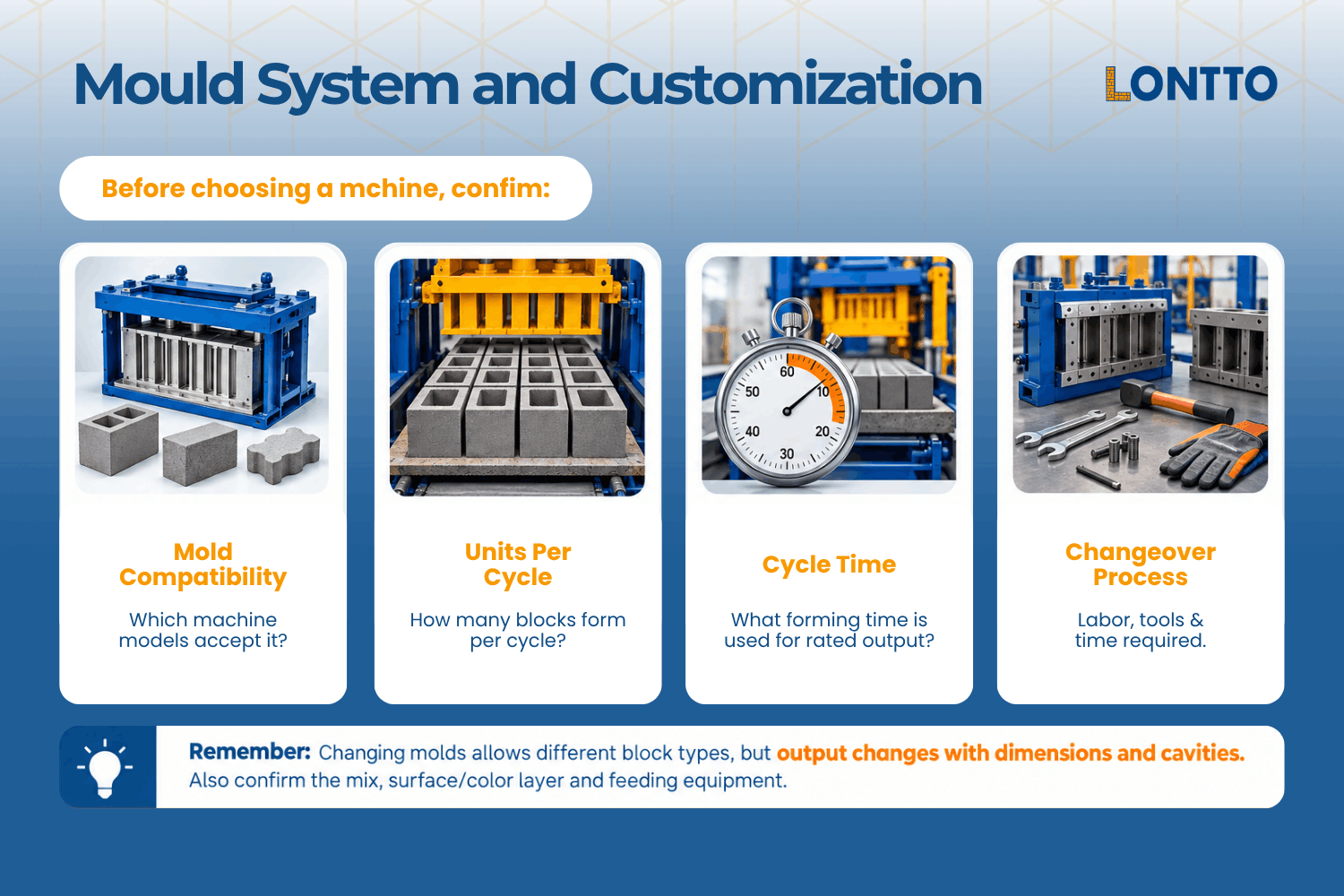
The mold determines which block dimensions, profiles, and quantities the machine can form during each cycle. Machine selection should begin with a written product schedule rather than a general request for hollow, solid or paving blocks.
Which blocks must the mold produce?
The mold schedule should list every block’s finished dimensions, profile, and expected daily volume. Include drawings or samples when local market dimensions differ from the supplier’s standard catalog.
Ask the supplier to confirm the following information for each required block:
- Mold compatibility: Identify which machine models accept the required mold.
- Units per cycle: State how many blocks the mold forms during one cycle.
- Cycle time: Provide the forming time used to calculate rated output.
- Changeover process: Explain the labor, tools, and time required to replace the mold.
An automatic concrete block making machine may produce several block types by changing molds, but output changes with each mold’s dimensions and cavities. The QT8-15 has different mold-specific output figures for hollow blocks, porous blocks, and paving units.
For an automatic cement block making machine, the same review should cover the planned cement-based mix, product dimensions, and required surface or color layer. Confirm whether optional feeding equipment forms part of the quoted configuration.
What customization belongs in the quote?
A customized automatic block making machine may require a nonstandard mold, altered pallet dimensions, added material feeding, or a different handling arrangement. Provide these requirements before pricing so that the quotation reflects the machine, mold, and connected equipment needed for the intended products.
Lontto includes one free mold set with every purchase. Buyers requiring several products should request separate prices, manufacturing times, and changeover instructions for additional molds.
Power Requirement and Site Infrastructure
Power requirement is a site constraint rather than a specification to check after ordering. The available electrical supply must support every component included in the complete line.
Can the site supply the required power?
The supplier needs the site voltage, frequency, phase, and available connected load before confirming a compatible machine. Request written identification of any transformers, control changes, or electrical work required before installation.
Don’t compare main-machine power with another supplier’s total-line power. A product sheet may state the forming machine’s demand separately from mixers and handling equipment, which can produce a misleading comparison. Request one equipment schedule showing the rated power of every supplied component and the proposed total connected load.
Сайт complete LMT4-26 equipment package contains the main machine, mixer, and conveyor, whereas larger automatic lines include additional equipment. Equipment scope must accompany every power figure when buyers compare those configurations.
What site work is required?
Site work should be based on the supplier’s layout and installation drawings rather than the main machine’s footprint alone. Confirm the following site requirements against those drawings before ordering:
- Equipment area: Allow space for the main machine and every mixer, conveyor, feeder, or stacker in the package.
- Production flow: Reserve routes for materials, pallets, newly formed blocks, and access to the curing area.
- Civil work: Obtain foundation loads, dimensions, anchor points, and floor requirements before construction begins.
- Installation access: Confirm unloading space, lifting equipment, and door or gate clearances for the largest component.
- Service access: Leave enough room for cleaning, inspection, adjustment, and component replacement.
Budget Tier: What’s Realistic
An automatic block making machine price reflects the supplied configuration rather than a single market rate. Capacity, automation, vibration equipment, mold requirements, and customization determine the machine scope, and destination costs determine the delivered investment.
What does each budget tier buy?
Each budget tier buys a different equipment scope, so the comparison should connect spending with the production functions included in the quotation.
| Budget Tier | Typical Equipment Scope | Suitable Operating Basis |
|---|---|---|
| Entry | Smaller semi-automatic configuration with more manual handling | Modest demand, available labor, and limited initial capital |
| Middle | Hydraulic functions, PLC control, mixing equipment, or conveyors | Growing output with one or more identified manual constraints |
| Higher | Coordinated batching, feeding, molding, transfer, and stacking | Steady higher-volume production with suitable power and site preparation |
Optional equipment belongs in the selected tier only when it supports the planned output or removes a documented production constraint.
Which costs belong in the comparison?
Use the same cost boundary when comparing equipment quotations and destination expenses. Include the machine, additional molds, mixer, conveyors, batching equipment, pallets, spare parts, shipping, insurance, import charges, unloading, foundations, electrical work, installation, and training when applicable.
Labor rates, electricity prices, local materials, maintenance, and planned shifts vary by country and change over time. State the location, block schedule, and operating hours when requesting indicative projections.
An automatic block making machine manufacturer controls production of the equipment, whereas an automatic block making machine supplier may manufacture, resell, or coordinate the package. Ask who builds the machine, who supplies each line component, and which company carries the warranty before comparing quotations. Commercial responsibility matters when a mixer, control panel, or conveyor requires support after installation.
Послепродажная поддержка
After-sales support determines how the machine moves from delivery into production and how the buyer obtains help after commissioning. Compare written service terms with the destination, staffing plan, and maintenance capability of the operation.
What installation, training, and warranty support are included?
Lontto provides full installation and training support, although each quotation needs a defined service scope. Before ordering, confirm whether the price includes travel, accommodation, local transport, lifting equipment, and site labor for the installation team.
The company provides a one-year warranty on materials and craftsmanship. Request the warranty document before payment and check its start date, covered parts, exclusions, claim process, and freight responsibility.
Training should cover the purchased configuration, including normal production, mold changes, and daily checks for operators. Maintenance personnel also need procedures for adjustments, fault identification, and planned servicing.
How will spare parts and delivery work?
Ask for a recommended startup spares list, prices, and dispatch times. Wear parts and model-specific electrical or hydraulic components require separate planning.
Lontto offers door-to-door delivery or CIF shipping from Qingdao, with marine insurance included under cost, insurance and freight (CIF) terms. Port schedules, customs processing, inland transport, and order timing can change those estimates, so confirm the route and current delivery basis in the quotation.
Which credentials apply to the quoted machine?
Supplier scale provides context for production capacity and export experience, but documentation remains more useful than general quality language.
Lontto holds ISO 9001 certification covering its manufacturing facility and holds CE certification for its block-making machines. ISO 9001 confirms that the factory operates a documented quality management system; CE marking confirms the machines meet applicable European health, safety, and environmental requirements and is often required for import across EU and EEA markets.
Buyers should request the specific ISO 9001 certificate and the CE declaration of conformity for the quoted model, then verify whether the destination country requires CE marking, a local standard, or separate import certification. Requirements vary by country and product category, so checking the applicable regulation before finalizing the order avoids delays at customs or during commissioning.
Lontto has over 30 years of manufacturing experience, more than 1,000 employees, and exports to over 100 countries, producing approximately 200 block-making machines and up to 7,000 construction machines annually. These figures indicate export familiarity and production scale but do not substitute for the documentation above.
To request a machine-specific quotation, send the intended block dimensions, required daily output, site electrical details, and destination country. Include any additional molds, line components, installation services, and spare-parts packages so that these can be reflected in the commercial offer.
How to Choose the Right Automatic Block Machine FAQs
What should I check before buying an automatic block making machine?
Check required output for each block size, the manual work remaining in the quoted line, and the functions assigned to hydraulic or electric systems. Confirm compatible molds, site voltage, total connected power, delivered cost, installation, training, warranty coverage, and spare-parts access. Use the same product dimensions, shift length, and equipment scope when comparing supplier figures.
Is a fully automatic block making machine better than a semi-automatic machine?
Neither automation level is universally better because each serves a different operating model. A fully automatic option may suit steady, high-volume demand and limited manual labor, provided the business can fund and support the complete line. A semi-automatic option may suit a startup with lower output requirements, available workers, and a smaller initial budget. Use staffing, line scope, usable output, and total operating cost to determine which automation level fits the operation.
How does a hydraulic block machine compare to an electric vibration system?
A hydraulic block machine may use hydraulic power for pressure, demolding, or machine movement, and electric motors may still generate the vibration. An electric vibration system describes how vibration reaches the mold or table rather than the machine’s entire power system. Compare the functions, controls, maintenance needs, and sample-block results for each proposed configuration.
Can I order a customized automatic block making machine?
Yes, customization can cover mold dimensions, pallet requirements, material feeding, and connected handling equipment, subject to the selected model. Provide drawings or samples for every required block type and ask the supplier to confirm units per cycle. Lontto includes one free mold set with each purchase, and additional molds require machine-specific pricing and lead times.
What affects automatic block making machine price?
Capacity, automation level, vibration equipment, mold requirements, customization, and included support determine the quoted price. Shipping, insurance, import charges, local labor, electricity, materials, and site work also change the total investment by country and date. Treat published prices as indicative, then request a written quotation based on the complete equipment scope and delivery destination.
Вернуться к началу: How to Choose the Right Automatic Block Machine: A Buyer's Checklist (2026)

Обращайтесь к нашим Эксперт по кирпичным машинам
Свяжитесь с нашей приятной командой сегодня, чтобы получить оценку стоимости машины для производства блоков.

Меня зовут Чао Чжан, я работаю в сфере производства кирпича уже более 10 лет. У меня есть глубокое понимание и исследования различных моделей машин для производства блоков, особенно автоматических машин для производства кирпича, машин для производства бетонных блоков, машин для производства блоков из прессованной земли, машин для производства глиняного кирпича, машин для производства цементного кирпича. У меня есть особое понимание этой отрасли. Я могу помочь своим клиентам выбрать подходящую машину для производства кирпича и помочь им в проектировании и строительстве завода по производству кирпича. Если вы хотите узнать все о машинах для производства кирпича, пожалуйста, свяжитесь со мной. Я буду рад помочь вам.
 Цена котировки
 Позвоните нам