
 RU
RU  EN
EN  FR
FR  ES
ES 

 Экспресс


 Получить цену
Fly ash bricks are lower-cost masonry units with a reduced carbon footprint compared to fired clay bricks. Builders use fly ash bricks for walls, pavements, tanks, canal linings, and dams. Demand for fly ash bricks is rising as construction markets seek high-quality, low-cost bricks.
Что такое кирпичи из летучей золы?
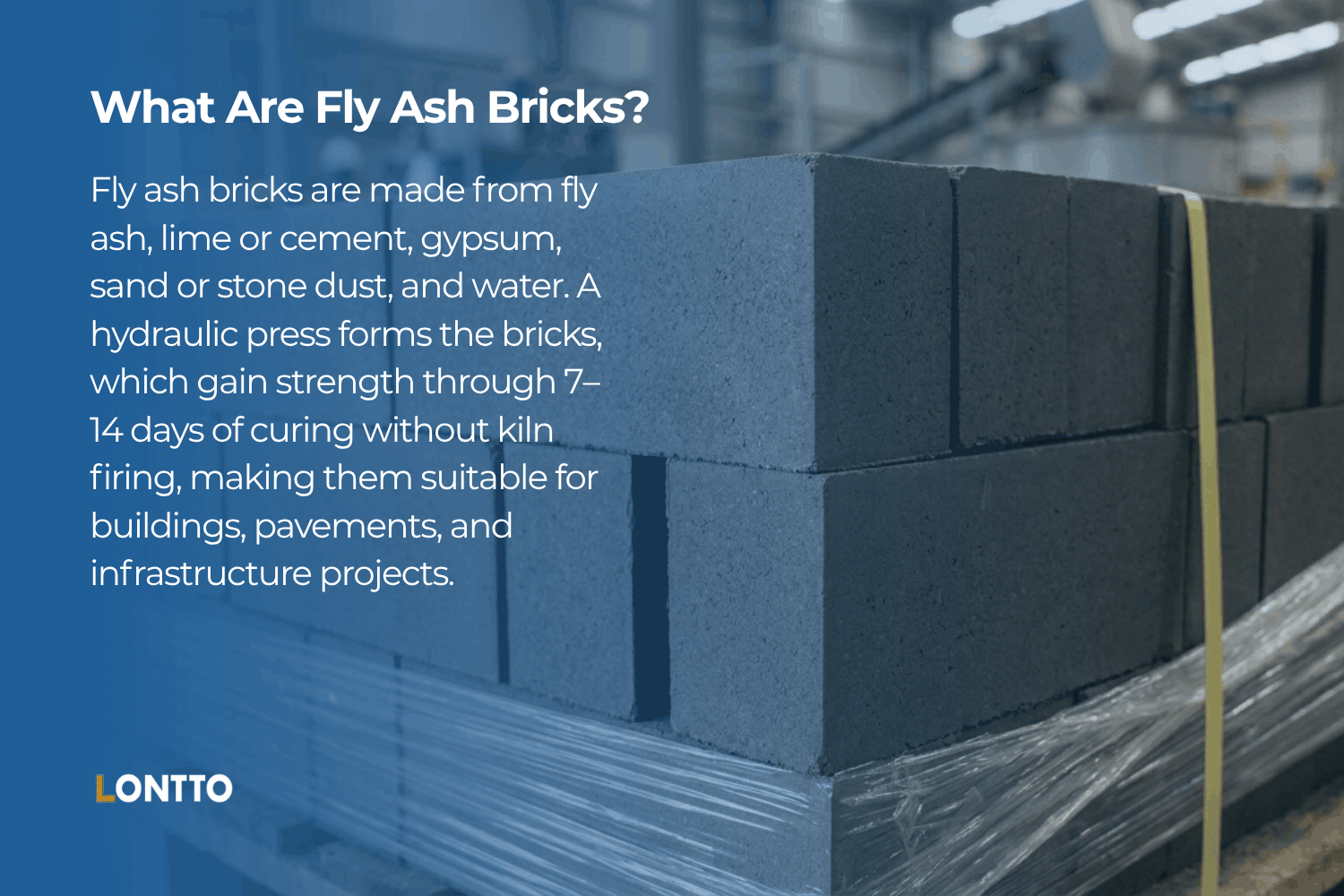
Fly ash bricks are sustainable masonry bricks manufactured primarily from fly ash, a byproduct of coal combustion. Thermal power plants capture fly ash before it reaches the atmosphere. Manufacturers blend it with lime or cement as a binder, gypsum to control setting and strength, and sand or stone dust for stability.
The key ingredients are:
- Летучая зола: The primary material, sourced from thermal power plants as a fine captured powder.
- Lime or cement: Binds the mix together and drives compressive strength.
- Gypsum: Controls setting time and strengthens the finished brick.
- Sand or stone dust: Adds stability and improves surface texture.
- Вода: Activates the mix before pressing.
A fly ash brick-making machine presses the blended mix into uniform, load-bearing bricks. No kiln is required. Strength develops through hydraulic pressing and a 7- to 14-day curing period.
Fly ash bricks are used for walls in homes and commercial buildings, pavements, tanks, canal linings, dams, and irrigation works. Using fly ash as a primary construction material converts an industrial waste stream into a durable product, reducing dependence on conventional red clay bricks.
Fly Ash Brick Specifications
Buyers and structural engineers evaluate fly ash bricks on strength, water absorption, dimensions, and thermal performance. Each property directly affects structural safety, on-site productivity, and long-term durability.
| Property | Typical Value / Range | Reference / Notes |
|---|---|---|
| Standard dimensions | 230 x 115 x 80 mm (4.5") and 230 x 115 x 90 mm (4.5"). | Two standard modular sizes are produced with consistent, even surfaces. |
| Average gross weight | 2.75 kg (230 x 115 x 80 mm) and 3.1 kg (230 x 115 x 90 mm). | Lightweight compared to conventional clay bricks, reducing dead load on foundations. |
| Average gross density | 1,250-1,350 kg/m². | Higher density than conventional clay bricks, supporting better load-bearing performance. |
| Compressive strength | Greater than 7.5 N/mm². | Suitable for load-bearing walls when mix ratios and curing are controlled correctly. |
| Water absorption | Less than 20% by mass. | Reduces damp patches, efflorescence, and moisture-induced cracking compared to most clay bricks. |
| Surface finish | Smooth, even exterior with uniform edges. | Reduces the required plaster thickness and minimizes cutting waste during brick masonry work. |
| Теплоизоляция | Low thermal conductivity with high thermal performance. | Keeps buildings cooler in summer and warmer in winter, supporting energy savings on heating and cooling. |
| Sound insulation | Good sound insulation suitable for low-noise-transfer applications. | Suited for residential complexes, commercial buildings, and institutional structures. |
| Огнестойкость | Strong fire resistance. Rated among the best brick types for fire-resistant construction. | Improves structural safety and performance in high-risk and fire-prone zones. |
| Vermin resistance | Resistant to vermin and rodents. | Reduces pest-related structural damage over the building's service life. |
Advantages of Fly Ash Bricks
The advantages of fly ash bricks include cost, performance, and sustainability. Each benefit below matters to builders and plant operators when making sourcing decisions.
- Dimensional accuracy: Uniform shape, even exterior, and modular sizing make fly ash bricks straightforward to align on site, reducing plaster thickness and cutting waste.
- Strength and durability: Correct mix ratios and controlled curing deliver high compressive strength and a long service life, with less shrinkage and moisture-related cracking than red bricks.
- Low water absorption: Fly ash bricks absorb very little water, lowering the risk of damp and moisture-induced cracking, particularly in humid climates.
- Thermal insulation: Low thermal conductivity reduces energy used for heating and cooling. Using fly ash bricks is a practical choice for builders targeting green building certification.
- Звукоизоляция: Good acoustic performance suits noise-sensitive buildings, including residential complexes, offices, and schools.
- Lighter weight: Lighter than conventional red clay bricks, fly ash bricks reduce dead loads on foundations and improve worker productivity on high-volume projects.
- Environmental benefits: Production eliminates clay mining and avoids kiln firing, cutting carbon emissions and reducing pressure on landfills from fly ash disposal.
Need to Produce Bricks at Scale?
Our brick making machines are built for commercial and industrial production. Get expert advice and a custom price quote — we respond within 24 hours.
Fly Ash Bricks vs. Concrete Blocks vs. Clay Bricks
Builders compare fly ash bricks, concrete blocks, and red clay bricks on cost, construction speed, and environmental impact. Compared to traditional clay bricks, fly ash bricks deliver better dimensional accuracy, lower water absorption, and a reduced environmental impact.
The table below covers the key parameters.
| Parameter | Кирпичи из летучей золы | Concrete Blocks (Solid/Hollow) | Clay Bricks (Burned Red) |
|---|---|---|---|
| Плотность | 1,700-1,850 kg/m³ | 1,800-2,100 kg/m³ | 1,600-1,700 kg/m³ |
| Compressive strength | 90-100 kg/cm² (greater than 7.5 N/mm²) | 50-150 kg/cm² depending on mix and block type | 30-35 kg/cm² |
| Water absorption | 10-14% | 5-10%. | 15-25%. |
| Dimensional stability | High tolerance—saves up to 25% in mortar consumption | High tolerance – consistent mold-formed shapes | Very low tolerance—higher mortar consumption |
| Wastage during transit | Less than 2% – saves up to 8% in material cost | Less than 2% | Up to 10% |
| Plastering | Even on both sides – saves up to 15% in plaster consumption | Even on both sides | Thickness varies on both sides of the wall |
| Main materials | Fly ash, lime or cement, gypsum, sand or stone dust, water | Cement, aggregates, sand, water | Clay, topsoil, water |
| Unit weight | Lightweight – 2.75 kg (80 mm unit) to 3.1 kg (90 mm unit) | Medium weight – lighter in hollow form, heavier in solid form | Heavier than fly ash bricks |
| Теплоизоляция | High thermal performance, low conductivity | Adequate for structural and infill use | Varies with firing and clay quality |
| Dimensional accuracy | High, smooth, and consistent | Good, mold-formed | Often lower, more size variation |
| Water absorption | Very low | Умеренный | Often higher, it contributes to damp |
| Теплоизоляция | High thermal performance, low conductivity | Good in hollow blocks, moderate in solid blocks | Lower thermal performance—walls heat and cool faster |
| Sound insulation | Good soundproofing suited to noise-sensitive uses | Good, especially in hollow block configurations | Moderate – depends on wall thickness |
| Fire and vermin resistance | High fire resistance, strong vermin resistance | Good fire resistance and vermin resistance | Fire-resistant, more prone to pest penetration |
| Воздействие на окружающую среду | Uses industrial waste, conserves clay and topsoil, and eliminates kiln firing | Cement-intensive, avoids clay mining but uses high-energy binder | High environmental cost from clay mining and energy-intensive kiln firing |
| Production process | Hydraulic pressing and curing, no kiln firing required | Hydraulic pressing and curing, no kiln firing required | Shaping, drying, and firing in energy-intensive kilns |
| Raw material cost | Low – fly ash is near-zero cost near coal-fired power plants | Moderate – cement and aggregate prices drive the cost | Higher – fuel for firing and topsoil extraction drive costs |
| Best‑fit uses | Walls in residential, commercial, and institutional buildings | High‑rise infill, partitions, and larger wall panels | Low‑rise, rural, traditional builds |
Quality Standards: IS 12894, ASTM C618, and Others
Fly ash brick manufacturers design mixes to meet national standards for compressive strength, water absorption, efflorescence, and dimensional tolerances. Indian Standard IS 12894 specifically governs fly ash-lime bricks.
ASTM C618 defines limits for fly ash used as a construction material. The two main classifications are:
- Class F fly ash: Produced at coal-fired power plants burning anthracite or bituminous coal, with lower calcium content and strong pozzolanic properties.
- Class C fly ash: Produced from sub-bituminous or lignite coal, with higher calcium content and self-cementing properties.
Each class carries distinct reactivity profiles that affect brick performance. Producers sourcing raw materials for fly ash bricks should confirm that the material meets the relevant classification for their mix design. Buyers should verify that bricks conform to the national or project standard applicable in their region.
How Fly Ash Bricks are Made: Step‑by‑step Manufacturing Process
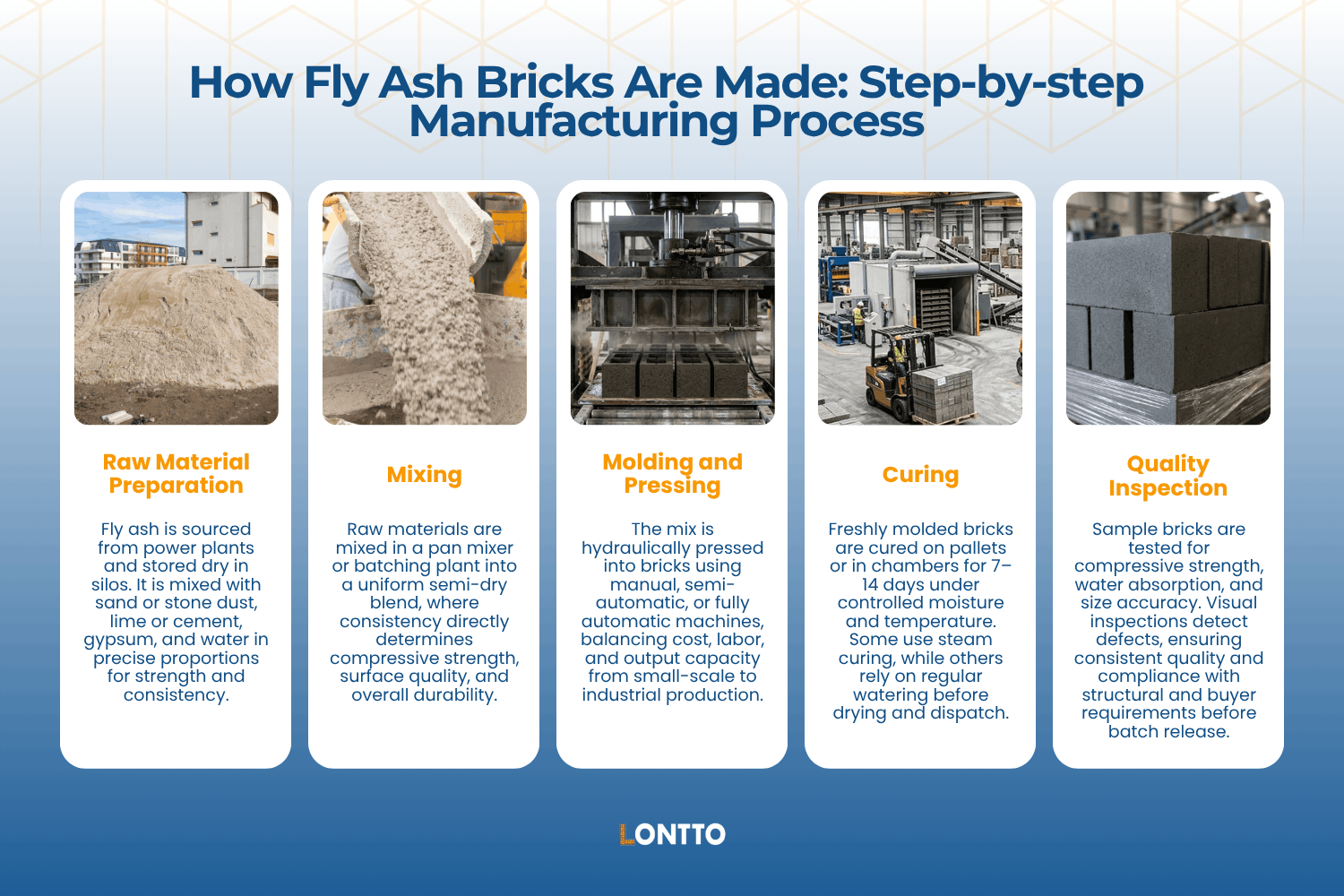
The fly ash brick manufacturing process replaces manual clay molding and kiln firing with batching, mixing, pressing, and curing.
The process of fly ash bricks moving from raw powder to finished units is controlled and mechanical. Combining fly ash with lime or cement, gypsum, and sand produces consistent, high-quality bricks that can be produced from small plants to large industrial facilities.
Step 1: Raw material preparation
Producers source fly ash from nearby coal-fired power plants, where pollution control equipment captures it as a fine powder. Storage in covered silos keeps fly ash dry and consistent.
The raw materials for fly ash bricks are proportioned to the target strength and texture:
- Летучая зола: Stored in covered silos to maintain dryness and consistent quality.
- Sand or stone dust: Sourced locally and measured to target texture and strength.
- Sludge, lime, or cement: Selected as the binder based on the target strength grade.
- Gypsum: Added in small quantities to control setting time.
- Вода: Measured precisely to activate the mix without over-saturating it.
Шаг 2: Смешивание
Operators load all raw materials into a pan mixer or batching plant, where they blend into a uniform, semi-dry mixture. Consistent mixing directly affects compressive strength, surface finish, and long-term performance.
Step 3: Molding and pressing
The prepared mix feeds into a hydraulic fly ash brick-making machine, where it fills molds sized to the required brick dimensions. Hydraulic pressure, often combined with vibration, compacts the mix into dense, dimensionally accurate bricks each cycle. Plants choose from three levels of automation:
- Manual machines: Low capital cost, higher labor input, suited to small-scale fly ash brick operations.
- Semi-automatic machines: Balance of automation and affordability, the most popular choice for mid-size plants.
- Fully automatic machines: High output, minimal labor, suited to large-scale industrial manufacture of fly ash brick operations.
Step 4: Curing
Freshly molded bricks are placed on pallets or in curing chambers, where controlled moisture and temperature help them gain strength over seven to 14 days. Some operations use steam curing for faster strength gain. Others rely on ambient curing with regular watering before drying, stacking, and dispatch.
Step 5: Quality inspection
Producers check sample bricks for compressive strength, water absorption, and dimensional accuracy before releasing batches. Visual checks catch cracks and chips early. Consistent quality control ensures that fly ash brick production meets structural requirements and buyer specifications.
Equipment for Fly Ash Brick Production
A fly ash brick plant uses material-handling, mixing, pressing, and curing equipment, scaled to meet output goals and the capital budget. Here’s what a typical plant requires.
- Material handling and storage: Silos, bins, and conveyors move fly ash, sand, and binder from storage to the mixer in controlled quantities, keeping proportions accurate and moisture levels stable across batches.
- Mixing equipment: A pan mixer blends all raw materials into a homogeneous, semi-dry mix. Modern systems include automated batching controls that improve consistency and reduce operator error.
- Brick-making machine: The core automatic fly ash brick machine uses hydraulic pressure and vibration to compress the mix in molds. Plant scale determines whether manual, semi-automatic, or fully automatic equipment is most appropriate.
- Pallets, handling, and curing setup: Bricks move on wooden or steel pallets via trolleys or forklifts to curing areas. A well-planned curing yard provides bricks with sufficient moisture and time to reach target strength before drying and stacking.
- Controls and maintenance: Modern machines include programmable logic controllers (PLCs) and automatic error detection. Regular mold cleaning, lubrication, and hydraulic oil checks keep the line running reliably.
Production Cost Breakdown
Fly ash brick manufacturers track production costs per 1,000 bricks. Raw material cost, power, labor, and automation level drive the number. The table below shows indicative ranges based on 2026 planning figures converted to USD.
| Cost Component | Approx. Range (USD) | Примечания |
|---|---|---|
| Летучая зола | $0-$6 | Frequently, free or near-zero cost near coal-fired power plants, with handling and transport charges only. |
| Sand, stone dust, or crusher dust | $8-$18 | Enhances strength and surface texture. Prices vary by location and local availability. |
| Lime or cement (binder) | $12-$36 | The largest paid raw material line. Binder choice and target strength grade drive this cost. |
| Gypsum and minor additives | $2-$5 | Added in small quantities to control setting time and strengthen the finished brick. |
| Water and curing | $1-$3 | Includes curing water, pumping costs, and any required water treatment. |
| Power consumption | $6-$18 | Covers the mixer, fly ash brick-making machine, and handling systems. Sensitive to automation level and local electricity tariffs. |
| Labor | $12-$30 | Covers operators, helpers, and supervisors. Manual plants sit at the higher end per 1,000 bricks. Fully automatic plants reduce this significantly. |
| Land, utilities, overhead | $6-$24 | Covers rent, administration, and minor repairs. Varies by site location and business structure. |
| Total production cost | $55-$200 | Typical planning ranges across plant types. A small-scale fly ash brick operation near a power plant running a semi-automatic machine sits toward the lower end. |
Start Your Fly Ash Brick Operation
Lontto supplies manual, semi-automatic, hydraulic, fully automatic, and mobile fly ash brick machines engineered for commercial brick production across Africa, Asia, the Middle East, and Latin America.
Whether you’re setting up a small-scale plant or scaling a high-capacity production line, the right machine starts with your shift output target and raw material access.
Свяжитесь с Lontto сегодня to get a quote on the right fly ash brick machine for your operation.
Fly Ash Bricks FAQs
Are fly ash bricks safe and durable for residential buildings?
High compressive strength, low water absorption, fire resistance, and good thermal and sound performance make fly ash bricks a reliable choice for modern residential construction.
What are fly ash bricks used for?
Fly ash bricks are used for brick masonry across a range of construction applications:
- Residential and commercial buildings: Walls, partitions, and structural masonry in homes, offices, and industrial structures.
- Infrastructure: Pavements, dams, tanks, and canal linings where durable masonry is needed.
- Irrigation works: Canal linings and water management structures requiring low water absorption and high strength.
Are fly ash bricks environmentally friendly?
Fly ash recycling through brick manufacturing lowers the environmental impact of coal combustion. The byproduct of coal combustion gets put to productive use instead of filling landfills, conserving clay and topsoil.
Are fly ash bricks cheaper than clay bricks?
On a production-cost basis, fly ash is inexpensive or even free near power plants. No fuel is needed for firing, keeping raw material cost per 1,000 bricks lower compared to red bricks in most markets.
How many bricks can a fly ash brick machine produce per day?
Output depends on machine type. Manual machines produce around 1,000 bricks per hour at the upper end. Industrial-grade automatic fly ash brick machines can produce over 100,000 bricks per day across multiple shifts.
What does a fly ash brick-making machine cost?
Basic manual units start around $2,400. Semi-automatic machines fall between $12,000 and $36,000. Fully automatic plants start around $36,000, scaling above $240,000 for high-capacity industrial setups.
Is setting up a fly ash brick manufacturing business profitable?
The profitability of the fly ash brick manufacturing business depends on access to low-cost fly ash, machine efficiency, and local selling prices. Fly ash is a low-cost input, and demand for bricks is strong in most growing markets. A well-run fly ash brick business typically recovers investment within 12 to 24 months.
What is the global fly ash bricks market outlook from 2026 to 2034?
The global fly ash bricks market and industry are both projected to grow steadily from 2026 to 2034, driven by rising construction activity in Asia and increasing regulatory pressure on fly ash disposal.
Buyers and investors should verify current market research reports for the most recent projections, as price trends and regional demand shift with energy policy and construction cycles.
Вернуться к началу: Fly Ash Bricks: How They’re Made, Advantages & Production Cost (2026)

Обращайтесь к нашим Эксперт по кирпичным машинам
Свяжитесь с нашей приятной командой сегодня, чтобы получить оценку стоимости машины для производства блоков.

Меня зовут Чао Чжан, я работаю в сфере производства кирпича уже более 10 лет. У меня есть глубокое понимание и исследования различных моделей машин для производства блоков, особенно автоматических машин для производства кирпича, машин для производства бетонных блоков, машин для производства блоков из прессованной земли, машин для производства глиняного кирпича, машин для производства цементного кирпича. У меня есть особое понимание этой отрасли. Я могу помочь своим клиентам выбрать подходящую машину для производства кирпича и помочь им в проектировании и строительстве завода по производству кирпича. Если вы хотите узнать все о машинах для производства кирпича, пожалуйста, свяжитесь со мной. Я буду рад помочь вам.
 Цена котировки
 Позвоните нам