
 ES
ES  EN
EN  FR
FR  RU
RU 

 Entrega rápida


 Obtener precios
Brick making manufacturers are under growing pressure to produce more efficiently, use energy more carefully and adapt to new material and project requirements. Those demands are reshaping how brick-making equipment is evaluated across both factory and site-based production.
Market trends reflect how quickly production is evolving, from system-level upgrades to shifts in materials and deployment models. Understanding those changes helps manufacturers align investment, improve operational efficiency and stay competitive as production standards continue to rise.
Market Size and Growth Statistics
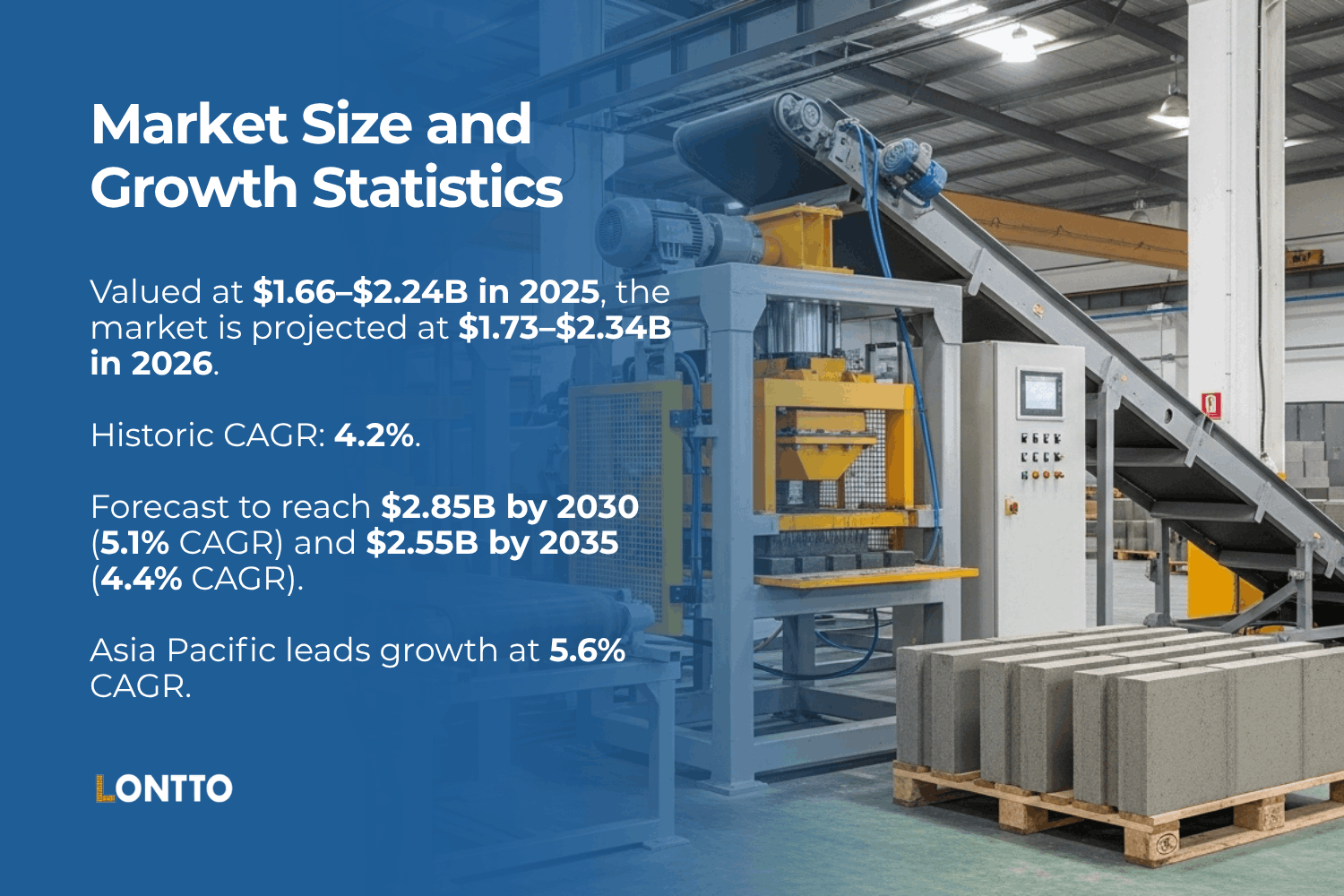
The brick-making machine market was valued at $1.66 to $2.24B in 2025. Brick-making machine market size projections place 2026 at $ 1.73 to $2.34B. Historic market growth averaged 4.2% CAGR. The global brick-making machine market is projected to reach $2.85B by 2030 at 5.1% CAGR.
A longer-term view puts it at $2.55B by 2035, with a 4.4% CAGR. Asia Pacific leads with a 5.6% CAGR, driven by infrastructure, and the brick-making machines market revenue follows the same pattern. The market is expected to sustain that direction and remain steady in line with those estimates.
As the market for brick-making machines continues to gain scale, brick making machine market reports confirm that momentum. The brick-making machine market is expected to grow. Market value stays solid and the current market size reflects demand.
Leading Segments in the Brick Making Machines Market
Commercial applications led with a 58.2% share because infrastructure demand supported volume. Automatic machines led with a 56.65% share as labor savings remained a major advantage. Fully automated brick-making machines surged and the adoption of fully automated brick-making machines accelerated.
Stationary machines led with a 63.05% share because fixed-capacity equipment suited factory output. Stationary brick production remained dominant and stationary brick-making machines led production lines. Fully automatic, stationary brick making performed well, but automatic stationary brick-making machines gained ground. Multi-functional stationary brick machines expanded the product range.
Fly ash brick gained ground under support for green policies, but concrete brick remained the core segment. Clay brick kept its traditional market position and interlocking brick expanded with modular demand. Concrete brick machines served strength-focused output. Interlocking brick machines increased build speed. Concrete block production overlapped with the same equipment base. Concrete block making accounted for a share of that demand.
Brick-making machines are categorized by material and operating mode. Machines are used across production scales. Brick-making machines perform tasks from raw input to stacking. Machines are compact in mobile formats. Portable hydraulic brick-making machines fit site-based work.
Future Trends (2026 to 2035)
Full Automation and Smart Manufacturing
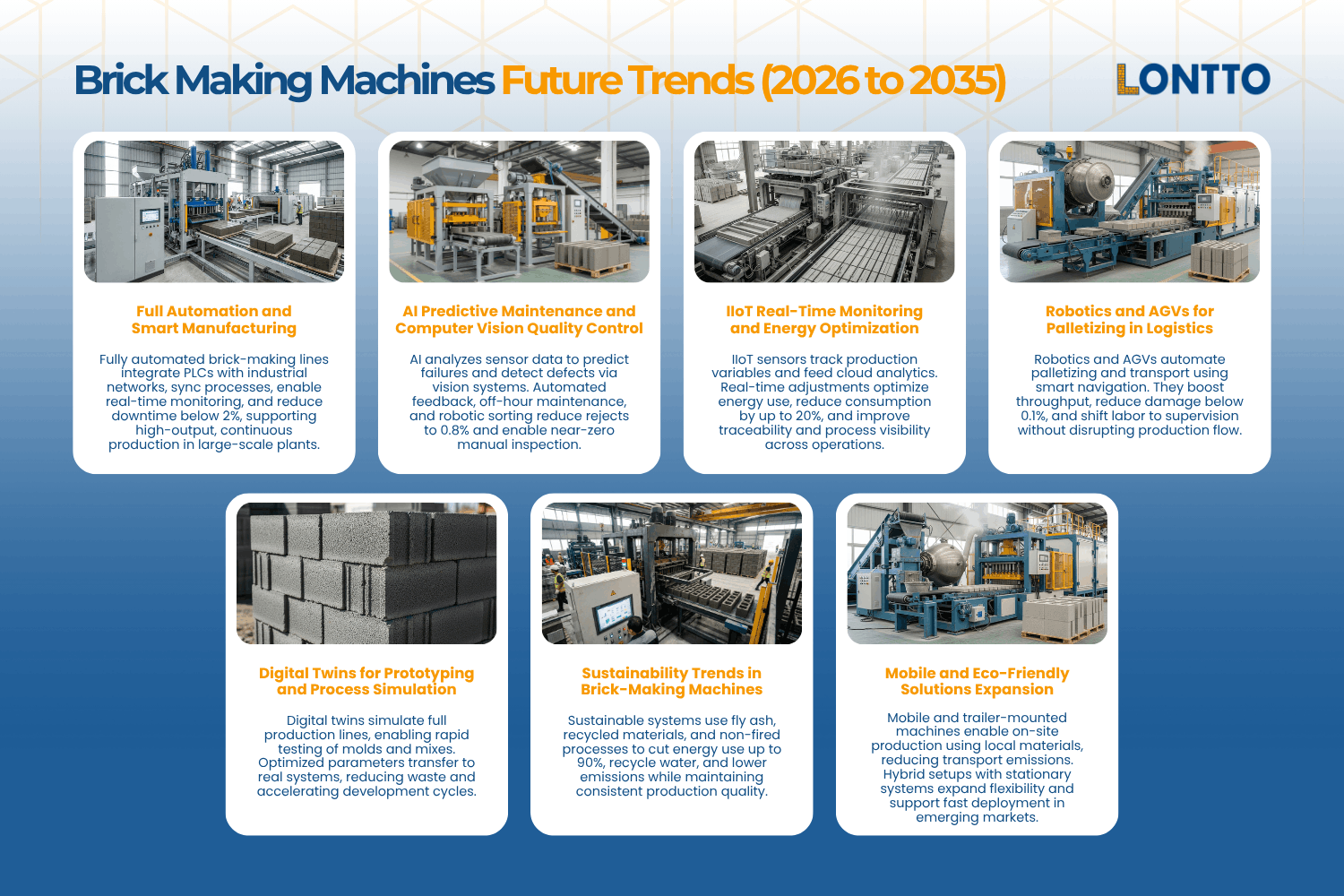
Fully automated brick-making machines connect PLCs to industrial networks such as Profinet and OPC UA. Stations transmit vibration, pressure and cycle data to MES servers. Software synchronizes speed and timing across the line. Dashboards deliver live views remotely and adjustments apply in seconds.
Consistency holds across shifts and downtime falls below 2%. Manufacturing technology enables retrofits on older brick-making machine units through gateways. Fully automatic stationary brick-making lines and automatic stationary brick-making machines dominate large-scale brick production. In this part of the brick-making machine market, large plants continue to favor high-output systems built for continuous operation.
AI Predictive Maintenance and Computer Vision Quality Control
AI processes sensor data every 100 ms. Models predict bearing and seal failures 72 hours ahead. Post-mold cameras scan at high speed. Neural networks detect cracks and dimensional errors in accordance with ASTM standards.
Maintenance schedules during off-hours. Defects trace to mix or vibration issues and robots remove faulty bricks, which means reject rates drop to 0.8%.
Feedback loops adjust parameters instantly. Brick-making machines perform tasks with zero human inspection in the final stages. For the brick-making machine market, this level of automation strengthens quality control in high-volume production environments.
IIoT Real-Time Monitoring and Energy Optimization
Industrial Internet of Things (IIoT) sensors track temperature, moisture and weight across silos, mixers and kilns. Data feeds cloud analytics continuously. Energy patterns reveal inefficiencies, curing shifts to low-rate periods and mix ratios tune live.
Consumption decreases 15 to 20%. Each pallet carries a traceable history. Brick-making machines market trends emphasize this connectivity for efficiency. Across the global brick-making machine market, these systems provide greater process visibility and better energy control across every brick-making machine line.
Robotics and AGVs for Palletizing in Logistics
Robotic arms palletize 1,200 to 2,000 bricks per hour in custom patterns. AGVs use LiDAR for safe navigation. Routes optimize dynamically and manual labor moves to supervision. Damage falls below 0.1%.
Systems adapt to interlocking brick and concrete block sizes. Throughput rises without extra staff. In the market for brick-making machines, robotics continues to support faster material handling without changing production flow.
Digital Twins for Prototyping and Process Simulation
Digital twins replicate entire brick-making machine lines. New molds and fly ash brick mixes simulate in virtual space. Software predicts flow and compaction accurately. Hundreds of tests run in hours.
Optimized settings transfer to real equipment. Trial waste vanishes. Development accelerates for interlocking brick machines. In the brick-making machines industry, digital modeling shortens setup cycles for new product formats and process changes.
Sustainability Trends in Brick-Making Machines
Fly ash can replace up to 40% of the cement. Sensors analyze incoming material. AI recalibrates ratios. Recycled aggregates sort automatically. A non-fired brick manufacturing system eliminates kilns, reducing energy use by 80 to 90%. Water recycling reaches 95%. Emissions drop below 0.4 kg CO2 per unit.
Aims to promote sustainable brick and sustainable brick production, aligning with LEED credits. Clay brick and concrete brick mixes incorporate greater amounts of SCMs. In the global market, this shift supports lower-emission output without changing the need for consistent production performance.
Mobile and Eco-Friendly Solutions Expansion
Mobile brick-making units trailer-mount for rapid setup. They accept local soil and waste. Output occurs on-site, which means transport emissions fall. Portable and trailer-mounted hydraulic brick-making machines are suitable for remote projects.
Multi-functional stationary brick machines complement them in hybrid setups. Demand grows in emerging markets. In the brick-making machine market, these formats expand deployment options for projects that need flexible output and faster installation.
Regional Dominance and Projections
Asia Pacific dominated in 2025 with more than 49% market share, driven by urban expansion and rising equipment purchases. The Asia brick-making machine market remained the largest, with China leading in volume and India scaling quickly.
Japan continued to emphasize quality and South Korea continued to push technology. East Asia brick-making machines remained the leading force in the region.
Europe prioritized greener equipment. Low-emission models continued to rise. The European brick-making machine market grew at a moderate pace. Western European brick-making machines are highly automated. Eastern European brick-making machines followed closely.
North America benefited from funding-backed projects. The American brick-making machine market continued to advance and brick-making machines were acquired from the project activity.
The African brick-making machine market expanded alongside housing demand. Emerging regions continued to show upside. Asia Pacific remained the largest market for brick making.
Drivers of the Brick Making Machines Market
Urbanization continues to drive the brick-making machine market as cities across developing economies expand rapidly. Housing demand rises and construction volume increases with it.
Infrastructure spending remains a major driver of the market for brick-making machines. Governments continue to invest in roads, bridges and public buildings and demand for brick-making equipment follows that spending directly.
Rising labor costs are pushing manufacturers toward automation. Fully automatic stationary brick making reduces crew sizes and increases output, making manual production less competitive.
Stricter sustainability rules are shaping purchasing decisions across the brick-making machine market. Green building codes favor lower-carbon materials and promoting sustainable brick production creates a stronger edge in bids. Fly ash brick and non-fired lines are securing more contracts.
Competitive Landscape and Leading Companies
The global brick-making machine market is split between broad construction original equipment manufacturers and specialist companies focused on brick and block systems.
Heavy machinery brands influence large infrastructure projects through bundled equipment portfolios and strong dealer networks.
Specialist manufacturers compete directly in fully automatic lines, stationary factory setups, mobile units and fly ash or interlocking systems.
Specialist manufacturers include:
- Aimix Group
- Lontto
- Hydraform
- SNPC Machines
- Zhengzhou YingFeng
- Wangda India
- QGM Quangong
- Apolo Zenith
Asia Pacific has the strongest vendor base, with China and India supplying the majority of automatic, stationary and fly ash machines. South Africa remains central for interlocking and soil-based systems. Europe, Japan and North America contribute higher-spec automated machinery with a smaller brick-specific footprint.
What to Prioritize Moving Forward
Taken together, the market is expanding at a steady pace, and Asia Pacific remains the center as infrastructure demand, production scale and vendor depth continue to shape investment.
Growth is coming from commercial demand, automated systems and stationary production lines, with fly ash, non-fired and mobile formats changing how new capacity comes online. Full automation, artificial intelligence-led maintenance, Industrial Internet of Things visibility, robotics and digital twins will separate efficient plants from weaker operators.
Buyers and manufacturers need stronger automation, lower energy use, better material flexibility and clearer sustainability performance to stay competitive.
Lontto manufactures and supplies block and brick production equipment, including concrete block-making machines, automatic brick-making machines and concrete batching plants.
The company pairs that equipment range with installation and training support, draws on more than 30 years of manufacturing experience, operates as an ISO 9001-certified factory, and sells CE-certified brick-making machines exported to more than 100 countries.
Volver arriba: Brick Making Machines Market Trends

Soy Chao Zhang, llevo más de 10 años trabajando en la industria de la fabricación de ladrillos. Tengo un profundo conocimiento e investigación sobre varios modelos de máquinas de fabricación de bloques, especialmente máquinas automáticas de ladrillos, máquinas de bloques de hormigón, máquinas de bloques de tierra comprimida, máquinas de ladrillos de arcilla, máquinas de ladrillos de cemento. Tengo un conocimiento especial de esta industria. Puedo ayudar a mis clientes a elegir la máquina de ladrillos adecuada y ayudarles a diseñar y construir una fábrica de producción de ladrillos. Si desea saberlo todo sobre las máquinas para fabricar ladrillos, póngase en contacto conmigo. Estaré encantado de ayudarle.

 Contacto
 Presupuesto
 Llámenos