
 FR
FR  EN
EN  RU
RU  ES
ES 

 Livraison rapide


 Obtenir un prix
Les blocs de béton et les briques influencent le coût, la solidité et l'apparence de tout projet de construction. Un bloc de béton utilise du ciment et des agrégats, tandis qu'une brique utilise de l'argile façonnée et cuite.
Mais les blocs de béton sont-ils meilleurs que les briques en termes de résistance et de durabilité ? Les propriétaires et les constructeurs comparent ces options pour choisir le matériau de construction qui répond à leurs besoins en termes de performance, de style et de budget.
Qu'est-ce qu'un bloc de béton ?
Un bloc de béton est plus grand qu'une brique et est fabriqué à partir d'un mélange qui lui confère une résistance et des performances prévisibles. Les blocs de béton sont fabriqués dans des moules, durcis dans des conditions contrôlées et largement utilisés parce qu'ils offrent rapidité et polyvalence. Les constructeurs considèrent Blocs de béton et briques en fonction de la composition et du cas d'utilisation.
Composition de base d'un bloc de béton
Un bloc de béton se forme à partir de ciment, de sable, de gravier et d'eau, puis acquiert de la résistance en durcissant. Ce processus les rend intéressants pour les grandes constructions.
- Composé de ciment, d'agrégats (sable, gravier) et d'eau.
- Souvent appelés CMU (concrete masonry units).
- Fabriqués dans des moules et durcis pour gagner en résistance.
Types courants de blocs de béton
Les unités de béton varient en fonction de leur poids, de leur densité et de leur fonction, et les blocs de béton offrent des avantages structurels différents selon le type.
- Blocs solides ou blocs creux : Les unités solides supportent des charges plus lourdes et résistent aux chocs, tandis que les unités creuses réduisent le poids et laissent de l'espace pour le renforcement ou l'isolation.
- Blocs de poids légers contre blocs de poids lourds : Les unités légères facilitent la manipulation et accélèrent l'installation, tandis que les unités lourdes augmentent la stabilité et améliorent le contrôle du son.
- Unités spéciales (blocs de linteau, blocs d'angle, blocs de cloison) : Ces formes rationalisent la construction en créant des ouvertures uniformes, des angles nets et des divisions intérieures droites.
Utilisations typiques des blocs de béton
Les constructeurs choisissent les blocs de béton lorsqu'ils ont besoin de murs solides, d'une installation rapide et d'une bonne répartition des charges. Ils sont souvent utilisés dans :
- Fondations, murs d'enceinte, murs de soutènement.
- Murs porteurs et non porteurs dans les bâtiments commerciaux.
- Structures industrielles, sous-sols et garages.
Qu'est-ce qu'une brique ?
Une brique est une unité cuite qui offre de la couleur, de la texture et de la résistance pour les surfaces visibles. Les briques permettent d'obtenir une forme cohérente et de contrôler les détails. briques ou des blocs de béton en fonction des objectifs de conception. Les briques traditionnelles créent des finitions chaudes et classiques.
Définition et composition de base
Une brique d'argile est formée à partir d'argile brute, façonnée puis durcie dans un four. Cette cuisson contrôlée crée des unités denses appréciées pour leur aspect et leurs performances à long terme.
- Ils sont généralement fabriqués à partir d'argile, de schiste ou de cendres volantes.
- Façonné puis cuit dans un four pour durcir.
- Traditionnellement plus petits et plus denses que les blocs de béton.
Types de briques les plus courants
Différentes briques répondent à des besoins structurels, décoratifs ou financiers. Elles sont flexibles et polyvalentes.
- Briques en terre cuite (ordinaires, de parement, d'ingénierie) : Les briques ordinaires permettent de réaliser les travaux de mur quotidiens, les briques de parement améliorent l'apparence et les briques techniques supportent des charges plus élevées ou des environnements difficiles.
- Briques de cendres volantes et autres variantes modernes : Ces unités utilisent des matériaux recyclés pour réduire l'impact de la fabrication et offrent souvent des surfaces plus lisses et un dimensionnement cohérent.
- Briques pleines, perforées et creuses : Les briques pleines augmentent la résistance, les briques perforées réduisent le poids et les briques creuses améliorent l'isolation et sont plus faciles à manipuler.
Utilisations typiques des briques
Les gens choisissent la brique pour ses détails texturés, sa conception esthétique et son attrait pour les trottoirs, que ce soit dans les grandes ou les petites constructions. On la trouve souvent dans :
- Maisons d'habitation et murs de remplissage.
- Façades et murs décoratifs.
- Pavage, aménagement paysager et éléments de jardin.
Différences entre les blocs de béton et les briques
La comparaison entre les briques et les blocs de béton met en évidence les différences de poids, de résistance, de comportement énergétique et de durabilité. Les constructeurs décident si les blocs de béton sont meilleurs que les briques en examinant les exigences de performance, les conditions du site et le budget.
Taille, forme et poids
Les blocs couvrent une plus grande superficie avec moins d'unités, tandis que les brique permet un placement plus précis des éléments de conception. Les différences de poids influencent la facilité avec laquelle les équipes manipulent chaque unité et la charge que la structure doit supporter.
- Blocs de béton : Leur taille réduit le temps d'installation, mais leur poids supplémentaire augmente les efforts de manutention et nécessite des fondations solides pour les soutenir.
- Briques : Leur poids plus léger facilite le levage et la mise en place, mais le nombre plus élevé d'unités augmente le temps de travail et la charge de travail. maintenance conjointe.
Solidité et durabilité
Les blocs présentent souvent des plages de résistance à la compression plus élevées, tandis que la brique donne de bons résultats dans les climats modérés. Les deux matériaux gèrent différemment les charges et l'usure, et les conditions climatiques influencent la durée de vie de chaque option.
- Plages de résistance à la compression pour les blocs et les briques : Les blocs supportent généralement des charges plus lourdes car leurs mélanges et leurs dimensions plus importantes permettent d'atteindre des niveaux de résistance plus élevés, tandis que les briques offrent des performances stables mais dépendent davantage du processus de cuisson et de la qualité de l'argile.
- Durabilité à long terme sous différents climats : Les blocs résistent mieux aux variations d'humidité et de température dans les régions humides ou froides, tandis que les briques restent fiables dans les régions sèches ou douces, où la dilatation et l'absorption sont moins exigeantes.
- Résistance aux intempéries, aux chocs et à l'usure : Les blocs tolèrent les chocs répétés et les conditions difficiles en raison de leur densité et de leur masse, tandis que les briques résistent à l'usure superficielle mais peuvent subir des effets graduels de l'humidité pendant de nombreuses années.
Performance thermique et acoustique
Les différentes densités contrôlent les mouvements de chaleur et de bruit de manière unique, et certains blocs offrent une meilleure isolation des cavités. Les deux matériaux contribuent à réguler le confort intérieur, mais leur masse et leur structure déterminent la façon dont ils gèrent la température et le bruit.
- Propriétés d'isolation : Les blocs peuvent améliorer l'isolation lorsque leur noyau creux est rempli, tandis que les briques reposent sur une masse solide qui ralentit le transfert de chaleur mais offre moins d'espace dans la cavité.
- Masse et densité : Les appareils lourds absorbent et libèrent lentement la chaleur, ce qui permet de stabiliser les conditions intérieures, tandis que les appareils plus légers réagissent plus rapidement aux températures extérieures.
- Isolation acoustique : Les murs en briques denses réduisent efficacement le bruit dans les petites pièces et les environnements résidentiels, tandis que les blocs offrent une forte insonorisation dans les murs plus grands où une épaisseur supplémentaire ou le remplissage des cavités améliorent les performances.
Résistance à l'humidité et au feu
Les blocs résistent mieux à l'humidité dans les régions humides, tandis que les deux matériaux gèrent les températures élevées en toute sécurité. Les performances dépendent de la densité, du taux d'absorption et de la façon dont chaque unité réagit à une exposition prolongée.
- Taux d'absorption d'eau et risque d'humidité : Les blocs de béton absorbent moins d'eau en raison de leur faible porosité, ce qui réduit le risque de murs humides. Les briques absorbent plus d'humidité et peuvent nécessiter une protection supplémentaire dans les climats humides.
- Comportement dans des conditions humides ou mouillées : Les blocs restent stables et présentent moins de problèmes de dilatation ou de croissance superficielle, alors que les briques peuvent subir une saturation progressive qui affecte l'apparence et l'usure à long terme.
- Résistance au feu et performances à haute température : Les deux matériaux résistent bien à la chaleur, mais les blocs conservent souvent leur résistance plus longtemps en cas d'exposition prolongée au feu, car leur noyau ralentit le transfert de chaleur.
Considérations relatives à la construction et à l'installation
Les gens comparent les systèmes de briques et de blocs pour évaluer la vitesse, les exigences en matière de compétences et le contrôle des détails. Les blocs de béton permettent aux constructeurs de finir rapidement de grandes surfaces, tandis que la pose de briques crée des motifs plus raffinés.
Rapidité et facilité de construction
Les blocs permettent de gagner du temps en raison de leur taille, tandis que la construction en briques nécessite une plus grande précision de placement. Les équipes tiennent compte de la disposition, du nombre de joints et des exigences de manutention lorsqu'elles choisissent entre les deux matériaux.
- Une taille de bloc plus importante = une couverture plus rapide des murs. Les unités plus grandes réduisent le nombre de pièces nécessaires, ce qui permet aux équipes de construire rapidement de grandes surfaces avec moins de joints à aligner.
- Le travail de la brique est plus lent mais permet de réaliser des dessins plus complexes. Les petites unités sont plus longues à placer mais permettent de contrôler les courbes, les motifs et les finitions architecturales détaillées.
- Les blocs ont besoin d'un alignement régulier mais d'un façonnage moins fin, tandis que la maçonnerie exige des maçons qualifiés capables de maintenir des joints précis et des rangées cohérentes.
Flexibilité structurelle et de conception
Les constructeurs choisissent les matériaux en fonction des besoins de charge et de la liberté de conception. Chaque option prend en charge différents types de murs et réagit différemment à la coupe, au façonnage et aux caractéristiques architecturales.
- Les blocs de béton supportent des charges plus lourdes et conviennent bien aux noyaux structurels, tandis que les briques jouent un rôle à la fois structurel et décoratif en fonction de leur épaisseur et de leur emplacement.
- Les blocs supportent les passages mécaniques et les ouvertures avec moins d'effort. Les briques nécessitent plus de soin pour éviter les fissures lors de modifications détaillées.
- Les briques permettent des courbes serrées et des agencements complexes, tandis que les blocs de béton permettent des formes géométriques plus larges et des lignes modernes et épurées.
Mortier, joints et finitions
Chaque système utilise des mélanges et des méthodes de finition spécifiques qui affectent l'aspect final. Ces choix influencent la résistance, le style visuel et l'entretien à long terme.
- Différences entre les mélanges de mortiers : Les blocs de béton utilisent souvent des mélanges plus résistants pour supporter les charges structurelles, et les briques utilisent des mélanges conçus pour l'adhérence, la flexibilité et le travail détaillé des joints.
- Epaisseur du joint : Les joints plus épais permettent de répartir uniformément le poids des blocs, tandis que les joints de briques plus fins créent des lignes plus nettes et des motifs visuels plus raffinés.
- Options de finition (plâtrage, peinture, bardage, finitions apparentes) : Les blocs acceptent une gamme de revêtements pour des surfaces modernes, tandis que les briques peuvent rester apparentes ou recevoir des placages pour rehausser la texture et la couleur.
Comparaison entre les blocs de béton et les briques
La comparaison des briques et des blocs de béton en termes de coût, d'entretien et de conception permet de déterminer quelle option répond aux besoins de votre projet.
| Catégorie | Briques | Blocs de béton |
|---|---|---|
| Coûts des matériaux | Coût initial plus élevé avec des prix qui varient selon la région et le type de brique. | Souvent moins chers, leur coût dépend de leur densité, de leur taille et de leur finition. |
| Disponibilité régionale | La disponibilité dépend des sources d'argile locales et de la capacité de cuisson, ce qui influe sur le coût. | Largement disponible car les agrégats et le ciment sont des matériaux courants. |
| Taux d'emploi | La pose de briques prend plus de temps et exige plus de compétences, ce qui augmente les coûts de main-d'œuvre. | La pose des blocs est plus rapide avec moins d'unités par mur, ce qui réduit le temps de travail total. |
| Entretien et réparations | Entretien modéré, en fonction de l'exposition et du climat. | Besoins minimes de réparations à long terme. |
| Durée de vie | Les murs en briques restent stables pendant des décennies et conservent souvent leur aspect au fil du temps. | Les murs en parpaings durent des dizaines d'années et résistent bien aux lourdes charges structurelles. |
| L'attrait esthétique | Crée une finition chaleureuse et classique qui s'accorde bien avec l'architecture traditionnelle. | S'adapte aux designs modernes avec des lignes épurées une fois rendu ou peint. |
| Flexibilité du style | Prend en charge les formes courbes, les motifs et les dispositions architecturales détaillées. | Il convient parfaitement aux formes audacieuses et aux motifs muraux géométriques simples. |
| Options de couleur et de texture | Offre de nombreuses variations de couleur, de texture et de finition. | Accepte la peinture, l'enduit, le revêtement et les placages pour des surfaces personnalisées. |
Quand les blocs de béton sont préférables
Les blocs offrent souvent une meilleure rapidité et un meilleur rapport qualité-prix que la brique, ce qui les rend pratiques pour les constructions importantes ou structurelles. Leur taille, leur résistance et leurs performances prévisibles aident les constructeurs à gérer des conditions exigeantes où la fiabilité et l'efficacité comptent.
Cas d'utilisation idéaux pour les blocs de béton
Les projets nécessitant un support de charge ou une construction rapide s'appuient souvent sur des systèmes de blocs. Leur poids, leur taille et leur cohérence structurelle en font une solution idéale pour les charpentes complexes et les murs de grande taille.
- Grands bâtiments commerciaux ou industriels : Ces structures dépendent d'une capacité de charge élevée et d'une installation rapide, et les blocs créent des murs stables qui supportent un poids important.
- Murs élevés, structures de soutènement et sous-sols : Les systèmes de blocs gèrent bien la pression et l'humidité du sol, ce qui leur confère un avantage dans les applications souterraines ou renforcées.
- Projets pour lesquels la rapidité et la rentabilité sont des priorités absolues : Les unités plus grandes réduisent le temps d'installation et les besoins en main-d'œuvre, ce qui diminue le coût global du projet.
Avantages des blocs de béton
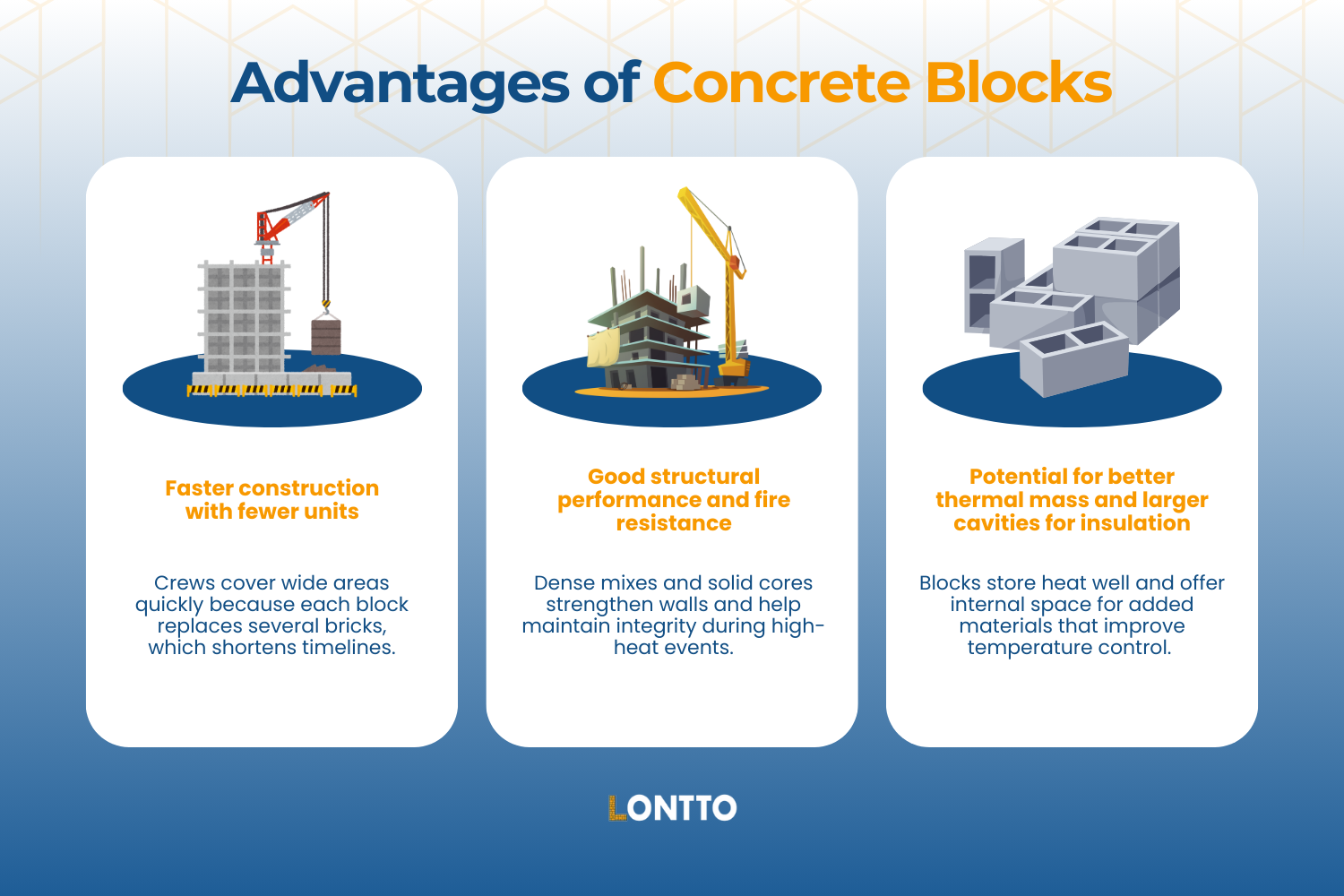
Les blocs supportent de lourdes charges et permettent d'améliorer les performances thermiques dans les cavités. Leur conception répond aux besoins structurels tout en offrant aux constructeurs une certaine flexibilité en matière de renforcement et de placement de l'isolation.
- Construction plus rapide avec moins d'unités : Les équipes couvrent de vastes zones rapidement, car chaque bloc remplace plusieurs briques, ce qui raccourcit les délais.
- Bonne performance structurelle et résistance au feu : Les mélanges denses et les noyaux solides renforcent les murs et aident à maintenir leur intégrité pendant les périodes de forte chaleur.
- Possibilité d'améliorer la masse thermique et d'agrandir les cavités pour l'isolation : Les blocs emmagasinent bien la chaleur et offrent un espace intérieur pour l'ajout de matériaux qui améliorent le contrôle de la température.
Quand les briques peuvent être meilleures
La brique convient parfaitement aux zones visibles et aux petits projets où la texture, la couleur et les détails sont les plus importants. De nombreux propriétaires préfèrent la brique pour leur prochaine rénovation, car ce matériau apporte chaleur, caractère et attrait à long terme à n'importe quel espace.
Cas d'utilisation idéaux pour les briques
La brique convient aux environnements résidentiels et historiques. Son échelle, sa gamme de couleurs et ses variations de surface en font un choix judicieux pour les projets où l'apparence influence l'aspect général de la conception.
- Maisons résidentielles et projets à petite échelle : La brique crée des finitions extérieures et intérieures attrayantes qui s'harmonisent avec de nombreux styles architecturaux.
- Projets où l'esthétique et le caractère sont importants : Sa texture et ses variations naturelles ajoutent une profondeur et un intérêt visuel que les systèmes en blocs ne peuvent pas facilement égaler.
- Travaux de restauration et bâtiments à caractère patrimonial : La brique s'aligne bien sur les proportions historiques et se marie avec les matériaux traditionnels utilisés dans les structures plus anciennes.
Avantages des briques
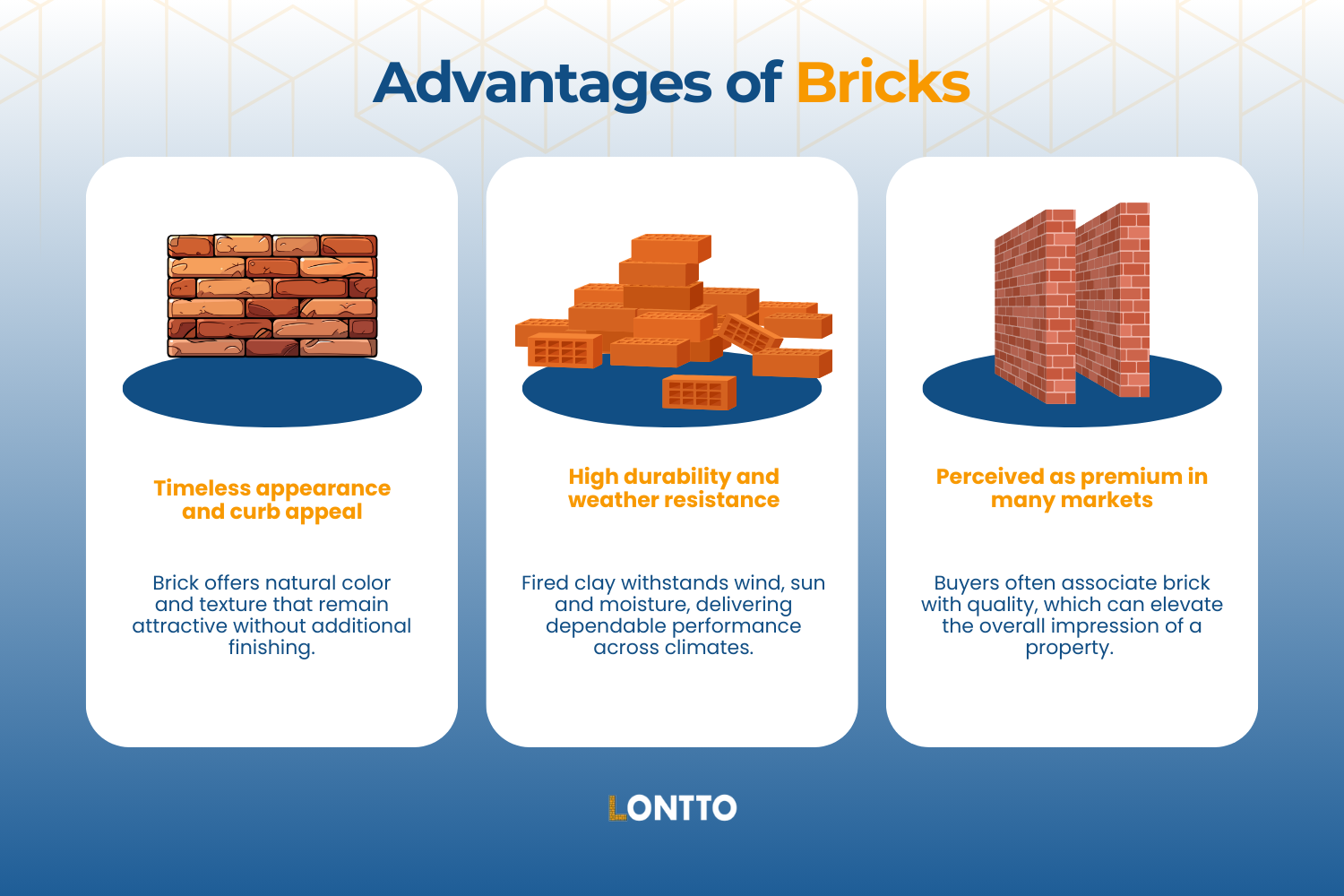
Les surfaces en briques augmentent la valeur et offrent une stabilité à long terme. Leur composition dense et leur résistance au four permettent de conserver leur aspect pendant de nombreuses années d'exposition.
- Apparence intemporelle et attrait pour les trottoirs : La brique offre une couleur et une texture naturelles qui restent attrayantes sans finition supplémentaire.
- Grande durabilité et résistance aux intempéries : L'argile cuite résiste au vent, au soleil et à l'humidité, offrant des performances fiables sous tous les climats.
- Perçu comme un produit haut de gamme sur de nombreux marchés : Les acheteurs associent souvent la brique à la qualité, ce qui peut rehausser l'impression générale d'un bien immobilier.
Conclusion
Les blocs de béton sont-ils meilleurs que les briques ? Cela dépend du type de projet, du budget et des objectifs de conception. Les blocs de béton permettent des constructions rapides et solides, tandis que la brique offre beauté et caractère. Certains constructeurs combinent les deux en utilisant un noyau de blocs avec un placage de briques.
FAQ sur Les blocs de béton sont-ils meilleurs que les briques ?
Peut-on combiner des blocs de béton et des briques dans un même mur ?
Oui, de nombreuses constructions utilisent des blocs de béton comme support structurel avec un placage de briques pour l'apparence. Cette approche permet d'équilibrer la capacité de charge et l'attrait esthétique et apparaît souvent dans les constructions résidentielles et à usage mixte.
Les blocs de béton ou les briques sont-ils plus respectueux de l'environnement ?
L'impact environnemental dépend de l'approvisionnement et de la fabrication. Les briques doivent être cuites dans des fours à haute température, tandis que les blocs de béton dépendent de la production de ciment. Les briques en cendres volantes et les blocs en granulats recyclés réduisent l'impact par rapport aux options traditionnelles.
Quelle est la meilleure isolation acoustique entre les pièces ?
Les blocs de béton isolent généralement mieux le son entre les pièces, car leur masse et leurs noyaux creux réduisent le transfert de bruit. Les briques fonctionnent encore bien dans les espaces résidentiels, mais elles dépendent davantage de l'épaisseur des murs et de la qualité des joints pour contrôler le bruit.
Retour en haut de la page : Les blocs de béton sont-ils meilleurs que les briques ?

Je m'appelle Chao Zhang et je travaille dans l'industrie de la fabrication de briques depuis plus de 10 ans. J'ai une connaissance approfondie et des recherches sur différents modèles de machines de fabrication de blocs, en particulier les machines automatiques à fabriquer des briques, les machines à fabriquer des blocs de béton, les machines à fabriquer des blocs de terre comprimée, les machines à fabriquer des briques d'argile, les machines à fabriquer des briques de ciment. J'ai une connaissance particulière de ce secteur. Je peux aider mes clients à choisir la machine à briques appropriée et les assister dans la conception et la construction d'une usine de production de briques. Si vous voulez tout savoir sur les machines à fabriquer des briques, n'hésitez pas à me contacter. Je me ferai un plaisir de vous aider.

 Contact
 Devis
Devis Appelez-nous