
 FR
FR  EN
EN  RU
RU  ES
ES 

 Livraison rapide


 Obtenir un prix
Les blocs de ciment creux modernes ont été inventés dans les années 1890 et officialisés par des brevets délivrés vers 1900 - la plupart des documents historiques attribuent à Harmon S. Palmer le titre d'inventeur le plus étroitement associé à ce développement.
Le brevet de Palmer fait référence à des “blocs de construction en béton”, ce qui correspond à la terminologie correcte des matériaux. En termes techniques, le ciment est la poudre liante, tandis que le béton est le mélange durci de ciment, d'eau et d'agrégats. Dans ce contexte, inventer signifie créer un bloc creux normalisé et une méthode de production mécanique reproductible.
Des brevets et des expériences antérieurs ont exploré les formes de béton pleines et creuses, mais ces efforts n'ont pas permis d'établir un système commercial durable. La conception de Palmer est largement reconnue comme la première unité creuse standardisée et réussie qui a créé une industrie évolutive. Son système a donné naissance à ce que l'on a appelé plus tard le ‘bloc de béton’ et a influencé l'essor du parpaing en tant que catégorie de produit connexe.
Pourquoi la période 1890-1900 définit-elle l'invention ?
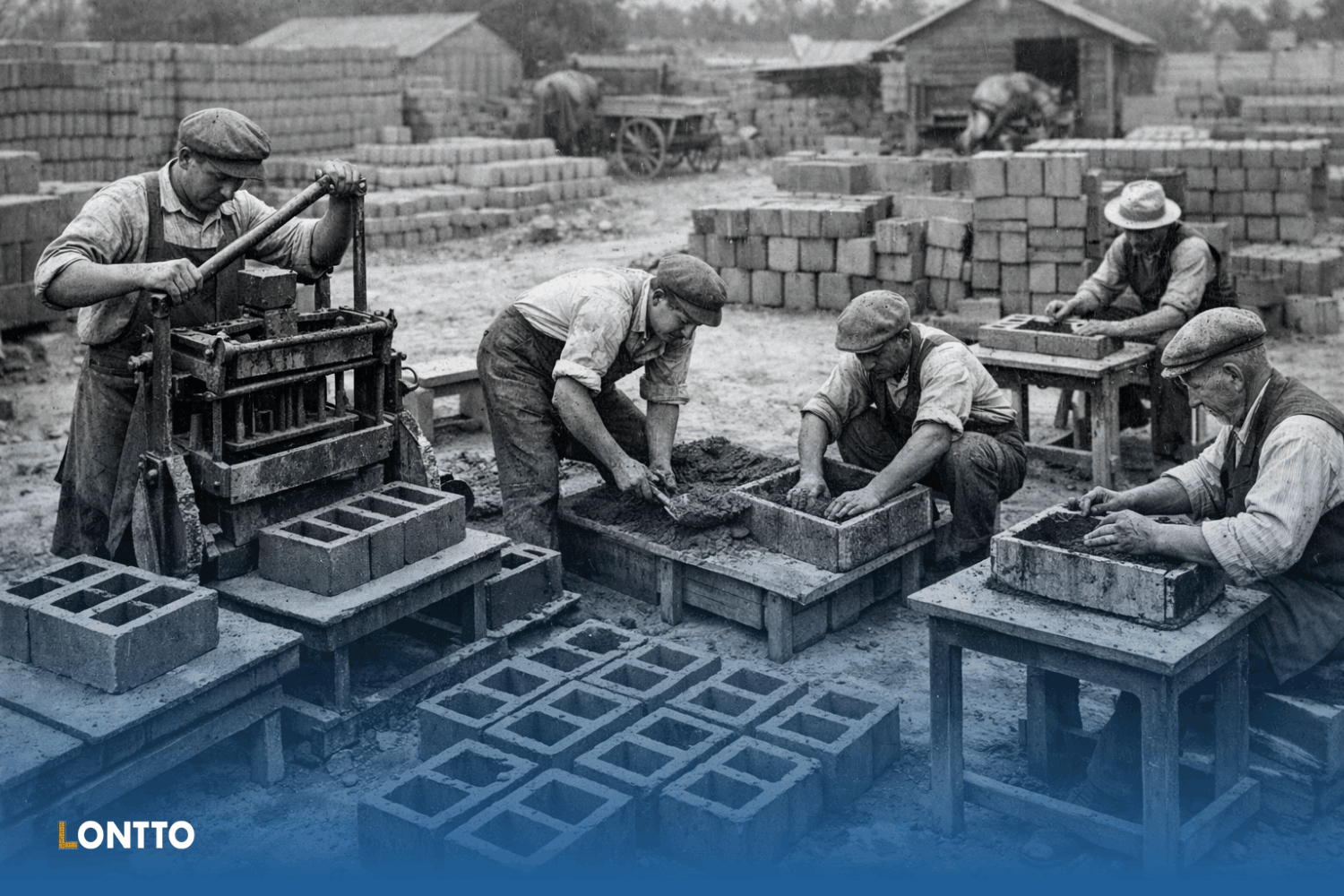
Harmon S. Palmer a commencé à développer un système de blocs de béton creux vers 1890 après avoir testé différentes formes et proportions internes. Ses brevets les plus influents ont été délivrés à la fin des années 1890 et au début des années 1900, notamment en 1899 et 1901.
Palmer a ajusté les proportions des cavités et l'épaisseur des murs pour réduire le poids de l'unité tout en préservant la résistance structurelle. La disposition en creux a également permis de créer de l'espace pour l'armature verticale et de limiter la circulation de l'air, ce qui a amélioré le contrôle de l'humidité par rapport aux anciens coffrages en ciment massif.
La première machine Palmer moulait une unité par cycle grâce à un système de levier manuel qui abaissait les noyaux et libérait les formes latérales. Un seul opérateur pouvait produire de nombreuses unités uniformes en une seule journée. Cette intégration de la géométrie normalisée des blocs et de la production contrôlée a défini le premier modèle commercial complet, qui a ensuite influencé l'industrie moderne des parpaings.
Ce qui existait juste avant cette période
Avant l'apparition du bloc de béton moderne, les constructeurs du XIXe siècle ont expérimenté des “pierres” en béton moulé dont la forme ressemblait à celle des blocs extraits des carrières. Les entrepreneurs ont coulé des blocs solides sur le chantier et les ont utilisés comme matériaux de construction structurels, bien que les résultats varient en taille et en densité.
Certains producteurs locaux ont introduit des dimensions propriétaires, mais celles-ci n'ont pas dépassé les marchés régionaux. Aucune norme industrielle ne régissait la disposition ou les tolérances, et il a fallu attendre les efforts de la National Concrete Masonry Association dans les années 1920 pour qu'une coordination formelle se mette en place.
Les noyaux creux ne faisaient pas partie de la conception dominante et la production de masse fiable n'était pas encore au point. Sans cohérence dimensionnelle, le béton ne pouvait pas fonctionner comme une maçonnerie modulaire. La plupart des projets s'appuyaient encore sur la brique ou la pierre naturelle pour les murs structurels et la construction des fondations.
Comment le design de Palmer a changé le bloc lui-même
La conception des blocs de béton creux de Harmon S. Palmer a permis de réduire considérablement l'utilisation et le poids des matériaux. Les noyaux creux facilitent le levage des blocs et offrent un espace pour le coulis, améliorant ainsi le contrôle de l'humidité et l'isolation, qui ont été des avantages importants dès le début.
Plus tard, cette conception a également permis de prévoir un espace pour le renforcement, ce qui a encore amélioré la résistance de la structure. Les dimensions typiques des blocs de Palmer ont évolué, la taille 8x8x16 devenant une norme ultérieure. Les premiers blocs étaient conçus pour s'aligner sur les rangées de briques et les épaisseurs de mur standard, ce qui simplifiait la construction.
Les blocs de Palmer présentent souvent des finitions de surface qui imitent les textures traditionnelles de la pierre ou de la paroi rocheuse, ce qui leur permet de ressembler à de la maçonnerie classique. L'uniformité des dimensions permet de construire des murs plus droits et plus prévisibles que la pierre taillée à la main, ce qui rend les blocs attrayants pour les ingénieurs, les petits constructeurs et les propriétaires.
Comment l'invention s'est répandue après 1900
Après l'invention du système de blocs de béton par Palmer, de petits chantiers locaux de fabrication de blocs ont commencé à apparaître dans les villes de tout le pays. Les fabricants d'équipements ont commencé à vendre des machines à blocs et des moules interchangeables aux constructeurs et aux entrepreneurs, permettant ainsi une production de blocs uniforme à plus grande échelle.
L'introduction de tailles et de formes normalisées a permis aux architectes et aux ingénieurs de spécifier plus facilement les éléments de maçonnerie dans les plans de construction. Les premiers utilisateurs ont utilisé le bloc de béton principalement pour les fondations, les sous-sols, les garages et les dépendances, avant d'étendre son utilisation aux murs de la maison entière.
Le marketing a mis l'accent sur “l'aspect pierre à moindre coût”, attirant ainsi les propriétaires et les promoteurs soucieux de leur budget. Cette alternative économique à la pierre ou à la brique traditionnelle est devenue un argument de vente clé, alimentant l'adoption généralisée des blocs de béton dans la construction résidentielle et commerciale.
Du brevet à la pratique : Les blocs de ciment dans la construction au début du 20e siècle
Au début des années 1900, les catalogues de plans de maisons ont commencé à mentionner le bloc de béton ou le bloc de ciment comme option de mur, reflétant la popularité croissante de ce nouveau matériau de construction.
Les revues spécialisées et les magazines de construction ont rapidement suivi, publiant des articles et des publicités présentant des maisons construites avec des blocs de ciment creux. Ces publications ont présenté aux lecteurs les avantages pratiques du matériau.
Certains des premiers livrets d'instruction apprenaient même aux lecteurs à fabriquer leurs propres parpaings ou à choisir un fournisseur local, en faisant explicitement référence au nouveau type de bloc. Les manuels de construction de cette époque contenaient des conseils détaillés sur la pose des blocs creux, leur jointoiement et leur renforcement.
Au fil du temps, les règlements de construction et les bulletins techniques ont commencé à spécifier les utilisations autorisées et les limites de portée des murs en blocs de ciment creux, consolidant ainsi la place de l'invention dans les normes officielles.
De la machine de Palmer à la production de blocs modernes
Ce qu'Harmon S. Palmer a créé dans les années 1890 avec une machine à levier manuel et un seul moule a évolué vers des systèmes de production modernes capables de fabriquer des milliers de blocs de béton en une seule équipe.
Le principe, cependant, n'a pas changé. La percée de Palmer était centrée sur la répétabilité de la production, les dimensions normalisées et la capacité d'un seul opérateur à produire des unités de maçonnerie cohérentes à l'échelle. Les machines à blocs d'aujourd'hui prolongent cette idée en offrant une plus grande vitesse, des tolérances plus étroites et un contrôle avancé du mélange des matériaux et du durcissement.
Des fabricants comme Lontto perpétuent cette tradition en produisant des machines à blocs de béton qui vont des systèmes manuels compacts pour un seul opérateur aux lignes de production entièrement automatiques pour les grands chantiers de blocs.
Si vous envisagez de lancer ou d'étendre la production de blocs, Découvrez les systèmes de machines à blocs de béton de Lontto pour trouver l'équipement qui convient à votre échelle de production et à la demande du marché. Contactez nous si vous avez besoin de conseils pour trouver la machine la mieux adaptée à vos besoins.
Quand les blocs de ciment ont-ils été inventés ? FAQ
Les premiers blocs de ciment n'étaient-ils utilisés qu'aux États-Unis ?
Non, ce n'était pas le cas. Alors que le système de Palmer s'est imposé aux États-Unis, les blocs creux en béton et en ciment se sont rapidement répandus en Europe et au-delà au début du 20e siècle. Si chaque pays a développé ses propres dimensions de blocs, ses propres finitions de surface et ses propres termes, le concept de base des unités creuses modulaires est resté le même.
Comment les premiers blocs de ciment ont-ils résisté aux tremblements de terre et aux vents violents ?
Les performances varient en fonction de la qualité et du niveau de détail. Les murs en blocs massifs non armés pouvaient se fissurer ou céder sous l'effet des forces latérales, mais avec le temps, les constructeurs ont commencé à renforcer les blocs et à améliorer les connexions.
Ces améliorations ont considérablement renforcé leurs performances dans les zones sismiques et à fort vent et ont influencé les codes de construction qui font désormais la distinction entre la maçonnerie renforcée et la maçonnerie non renforcée.
Les premières constructions en blocs de ciment ont-elles modifié la manière dont les maisons étaient isolées ?
Oui, c'est vrai. Les noyaux creux ont créé des espaces d'air à l'intérieur des murs, ce qui a modifié le flux de chaleur par rapport à la maçonnerie solide ou au bois.
Certains constructeurs ont laissé les noyaux vides, tandis que d'autres ont essayé de les remplir ou de combiner les blocs avec des fourrures et de l'isolant. Ces pratiques ont finalement influencé le développement des méthodes thermiques pour les murs en maçonnerie.
Comment les blocs de ciment ont-ils affecté la main-d'œuvre et la formation dans le secteur de la construction ?
Les blocs de ciment ont réduit le besoin de maçons hautement qualifiés. Bien que des maçons compétents soient toujours nécessaires, les blocs uniformes et modulaires ont facilité la formation des travailleurs et la normalisation des procédures sur le site. Cette évolution a permis d'accélérer le calendrier des projets et de mieux prévoir les coûts de la main-d'œuvre, en particulier pour les projets de petite et moyenne envergure.
Pourquoi certains bâtiments historiques en blocs de ciment survivent-ils mieux que d'autres ?
La durabilité dépend souvent de facteurs tels que la qualité du mélange, les conditions de durcissement, l'exposition et l'entretien, et pas seulement de l'âge.
Les bâtiments qui bénéficient d'un drainage adéquat, de joints de mortier bien entretenus et d'une protection contre les cycles de gel et de dégel tendent à rester en excellent état, tandis que ceux dont les détails sont médiocres ou qui manquent d'entretien présentent des signes de détérioration tels que des épaufrures, des fissures ou des problèmes d'humidité.
Quand les parpaings ont-ils été utilisés pour la première fois pour les fondations ?
Le "parpaing", qui utilise des cendres de charbon pour alléger le poids, a été breveté par F.J. Straub en 1917. Bien que les cendres de charbon ne soient plus couramment utilisées, ayant été remplacées par des matériaux tels que le schiste expansé, l'argile ou l'ardoise, le produit de Straub est devenu un choix populaire pour les fondations résidentielles en raison de ses propriétés isolantes et de son prix abordable. Il a joué un rôle important dans la croissance de l'utilisation des blocs de béton.
Retour en haut de la page : Quand les blocs de ciment ont-ils été inventés ?

Je m'appelle Chao Zhang et je travaille dans l'industrie de la fabrication de briques depuis plus de 10 ans. J'ai une connaissance approfondie et des recherches sur différents modèles de machines de fabrication de blocs, en particulier les machines automatiques à fabriquer des briques, les machines à fabriquer des blocs de béton, les machines à fabriquer des blocs de terre comprimée, les machines à fabriquer des briques d'argile, les machines à fabriquer des briques de ciment. J'ai une connaissance particulière de ce secteur. Je peux aider mes clients à choisir la machine à briques appropriée et les assister dans la conception et la construction d'une usine de production de briques. Si vous voulez tout savoir sur les machines à fabriquer des briques, n'hésitez pas à me contacter. Je me ferai un plaisir de vous aider.

 Contact
 Devis
Devis Appelez-nous