
 ES
ES  EN
EN  FR
FR  RU
RU 

 Entrega rápida


 Obtener precios
The automatic block-making machine market is projected to reach $1.74 billion in 2026, growing at 8.6% annually as construction demand accelerates worldwide. A block-making business can be profitable in that environment, but only if you control input costs and match your machine size to local demand.
Most operations succeed in urban growth corridors, peri-urban expansion zones, and infrastructure development areas. Rapid construction activity, housing shortages, and population growth are driving demand for concrete blocks. This is particularly evident in developing countries across Africa, the Middle East, and South America.
Is Block Making Profitable? (A Realistic Answer)
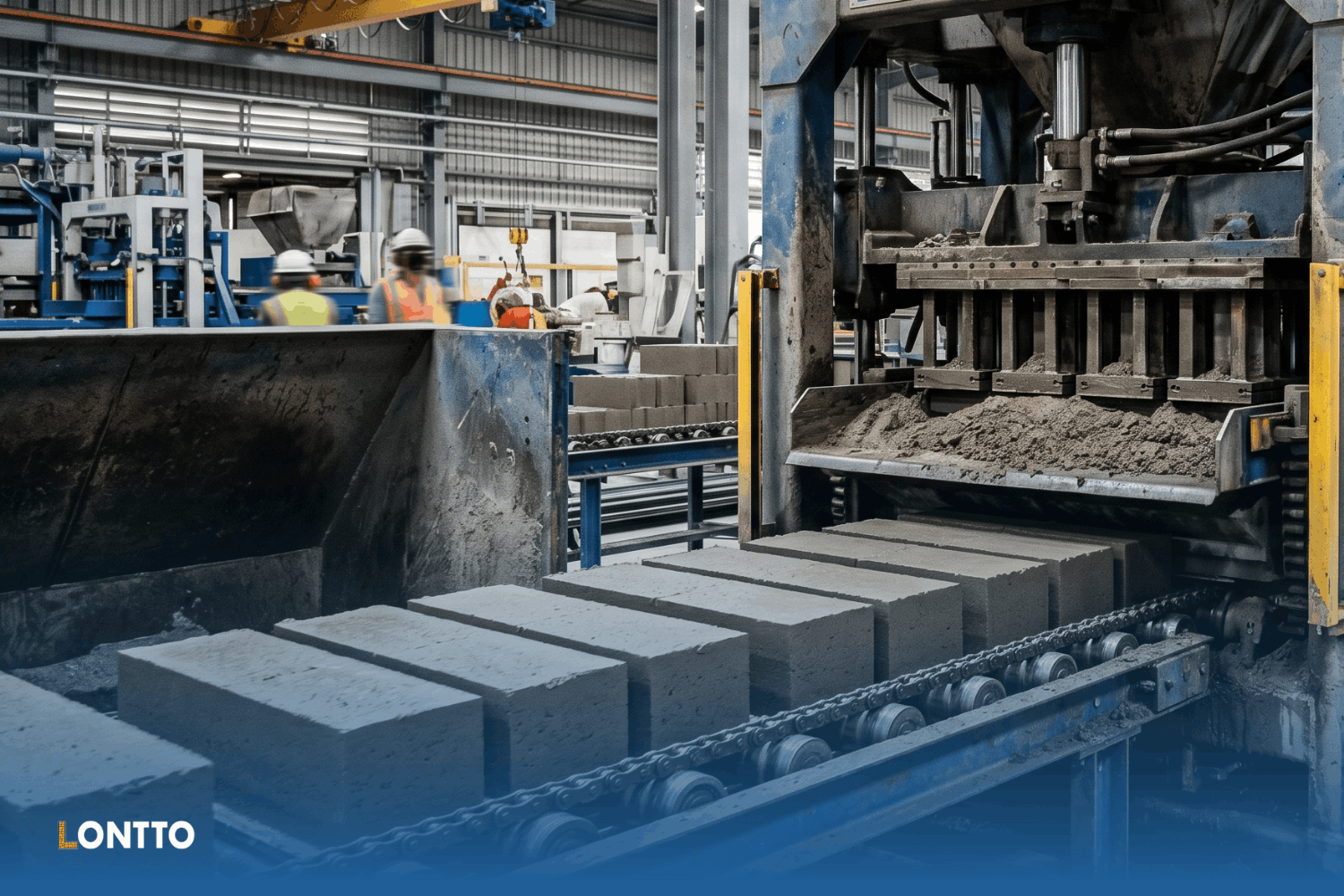
Block making business profitability depends on production volume, raw material costs, and how well selling prices hold against local competition. A semi-automatic machine producing 1,200 blocks per day can generate strong monthly returns, but figures vary significantly by country, setup cost, and market conditions. Operations that sustain strong returns track cost per unit daily and secure buyers before production starts.
How to calculate your daily profit
Daily profit equals selling price per block minus total production costs per block, multiplied by daily output. For example, at a $0.85 selling price and $0.58 total cost, each block returns $0.27 in a low-cost market scenario. Actual selling prices and input costs vary widely by country and must be verified locally before projecting any returns.
Cement is the largest single cost driver at $0.35 per block, based on 2.2 kg at $0.16 per kg. Sand, aggregate, labor, energy, depreciation, and consumables account for the remaining $0.22, with water and additives adding $0.01. Securing cement at competitive local prices delivers the fastest improvement to profit margins.
What affects your payback period
Machine capacity, local block selling prices, competition, and total setup cost determine how quickly you recover your initial investment. Real-world payback periods range from six months to over three years, depending on market conditions, automation level, and total capital deployed.
For example, a semi-automatic plant in Kenya with a $150,000 total setup recovered its investment in six to 10 months, and a comparable operation in Ghana at $350,000 total setup reached payback in around 9 months. Operations in Asia-Pacific typically see payback in 12 to 18 months.
Country-specific taxes extend the timeline further. Corporate income tax, VAT, and import duties in markets with 25 to 30% tax rates can add several months to your ROI calculation. Factor those costs into your block-making business plan before finalizing equipment purchases.
Machine downtime is the most damaging variable. Two weeks of idle production during peak construction season can delay payback by a full month. Spare parts availability and technical support from your supplier must factor into every equipment decision from the start.
Where Block Making Businesses Succeed
The strongest markets for a block manufacturing business are developing countries in Africa, the Middle East, and South America, where rapid construction activity, housing shortages, and population growth keep demand for concrete blocks consistently high.
Construction companies are the largest buyers, placing bulk orders for residential and industrial projects. Municipalities provide the most reliable secondary revenue through continuous paving block and curbstone orders.
Independent contractors and private builders generate steady, smaller orders for housing projects and renovations. Landscaping companies and homeowners buy decorative paving blocks at higher margins than standard hollow block products. Serving multiple customer types protects revenue when any single segment slows down.
Startup Cost Breakdown
Starting a concrete block factory requires capital across seven categories before a single block is produced. Machinery and equipment represent the largest line item at $5,500, followed by raw material stock at $3,200. The $2,000 working capital reserve covers two months of operating costs before revenue stabilizes. Underfunding either category is the most common reason new businesses fail in the first 90 days.
| Cost Category | Description / Assumptions | Amount (USD) |
|---|---|---|
| Land and site preparation | 3-month lease deposit for a 500 m² yard plus basic leveling and drainage | $800 |
| Machinery and equipment | Block machine, mixer, extra molds, steel pallets, curing racks, water tank | $5,500 |
| Initial raw material stock | 15 tons of cement, 40 tons of sand, 30 tons of gravel, approx. 30 days of production at 1,000 blocks/day | $3,200 |
| Utilities and connections | Electricity connection deposit, water setup, small generator | $450 |
| Permits, licensing, and business insurance | Business registration, environmental permit, public liability insurance (1 year) | $600 |
| Working capital reserve | 2 months of operating costs, labor, utilities, and maintenance | $2,000 |
| Transport and miscellaneous | Machinery delivery, tool kit, safety gear, signage | $550 |
| Total estimated startup capital | $13,100 |
Disclaimer: Figures reflect a micro-scale entry operation. Larger setups require significantly higher capital. Verify all costs against your local market.
Need to Produce Blocks at Scale?
Our block making machines are built for commercial and industrial production. Get expert advice and a custom price quote — we respond within 24 hours.
Choosing The Right Machine for Your Scale
The block-making machine you choose directly affects production capacity, labor requirements, and product quality. Buying above your market’s current demand creates unnecessary financial pressure. Buying below it caps growth potential before the business gains traction.
| Machine Class | Daily Output | Crew Size | Power Requirement | Machine Cost (USD) | Best For |
|---|---|---|---|---|---|
| Manual | 300–600 blocks | 2–3 | None | $900–$2,800 | Micro/home-based, low startup, intermittent production |
| Semiautomático | 800–2,000 blocks | 3–5 | 3–5 HP electric or diesel | $3,800–$9,500 | Small-scale commercial, steady daily output |
| Fully automatic mobile | 2,500–6,000 blocks | 1-2 | 10–15 HP, 3-phase electric | $16,000–$38,000 | Medium-scale, high-volume contracts, low labor dependency |
| Fully automatic stationary | 6,000–12,000+ blocks | 1 operator + loader | 20–40 HP, 3-phase electric | $45,000–$85,000+ | Large-scale industrial, multi-shift production |
Disclaimer: Verify machine pricing and availability with suppliers in your region before purchasing and match machine output to verify local demand, not projected demand.
Micro and small-scale startups
A manual or semi-automatic making machine suits entrepreneurs entering the block making business with limited capital and untested local demand. Semi-automatic machines produce 800 to 2,000 blocks per day with a crew of three to five, requiring only 3 to 5 HP of power. The lower machine price reduces financial exposure while the operation builds its customer base.
Labor dependency is the primary trade-off. Brick-making machine production at this level needs more staff per block produced, and inconsistent operator performance directly affects the quality. Upgrading to a higher-capacity machine becomes the logical next step once volume and demand stabilize.
Medium and large operations
A fully automatic, stationary making machine producing 6,000 to 12,000 blocks per day suits commercial-scale block production, serving large construction projects and municipal contracts. Automation level and capacity at this scale reduce the crew to one operator plus a loader, cutting labor costs significantly against output.
Concrete block making at this volume requires three-phase power infrastructure, a structured production line, and adequate space for material handling, curing, and storage. Total setup costs at this scale typically range from $350,000 to $600,000 or more, with payback periods of six to 12 months under consistent demand.
Mobile block making for rural and on-site work
A fully automatic mobile making machine producing 2,500 to 6,000 blocks per day allows manufacturers to produce on-site, eliminating finished block transport costs. Rural markets and remote construction projects benefit most where road access makes block delivery expensive and unreliable.
Mobile units run on 10 to 15 HP of three-phase power with a crew of one to two. A generator can substitute where grid power is unavailable, though fuel costs must be factored into the production cost calculation before committing to that setup.
Raw Materials: What You Need and What it Costs
Cement, sand, crushed aggregate, and water are the core inputs for any concrete block machine operation. Cement and aggregates together account for around 74% of total production costs per block, making raw material procurement the most impactful cost lever in the business. Transport costs erode profit margins quickly when aggregate is sourced from distant quarries, making supplier proximity a direct profitability factor.
Raw material storage must be planned into the site layout before production starts. Cement requires dry, covered storage. Aggregate needs a defined yard area separated from the production floor. Poor storage planning leads to material waste, contamination, and inflated operational costs.
Modern brick production increasingly incorporates fly ash, slag, and recycled concrete as partial cement substitutes. Cement brick and solid block production can use these materials without compromising compressive strength, reducing the highest single cost in the operation where local supply allows.
Site Requirements
A functional block plant requires six operational zones: raw material storage, aggregate feeding, mixing, block forming, curing, and finished product storage. Three-phase power, a water supply system, and drainage must be confirmed before any making machine is installed. The right location near suppliers, customers, and reliable utilities is a cost control decision that affects every shift.
Leasing industrial land during the early phase preserves liquidity before sales channels stabilize. Truck access roads and forklift circulation must be factored into the layout from the start. Land that cannot accommodate a second block making machine limits block production capacity before the block-making business gains traction.
Understanding Your Production Economics
Block manufacturing economics hinge on the cost per block. Cement and aggregates together account for around 74% of total production costs, making raw material pricing the most sensitive variable in the operation.
The table below uses indicative figures for a low-cost market scenario. Actual costs and selling prices vary significantly by country, market, and scale.
| Componente | Per Block (USD) | Micro - 500/day | Small - 1,200/day | Medium - 4,000/day |
|---|---|---|---|---|
| Cement (2.2 kg at $0.16/kg) | $0.35 | $175/day | $420/day | $1,400/day |
| Sand and aggregate (14 kg) | $0.08 | $40/day | $96/day | $320/day |
| Water and additives | $0.01 | $5/day | $12/day | $40/day |
| Direct labor | $0.07 | $35/day | $84/day | $280/day |
| Energy | $0.02 | $10/day | $24/day | $80/day |
| Equipment depreciation | $0.03 | $15/day | $36/day | $120/day |
| Consumables and maintenance | $0.02 | $10/day | $24/day | $80/day |
| Total production cost | $0.58 | $290/day | $696/day | $2,320/day |
| Selling price | $0.85 | $425/day | $1,020/day | $3,400/day |
| Daily net profit | $0.27 | $135/day | $324/day | $1,080/day |
| Monthly net profit (26 days) | $3,510 | $8,424 | $28,080 | |
| Payback period | 2.5–3 months | 1.5–2 months | 1.5–2 months |
Disclaimer: Indicative figures based on low-cost market assumptions. Verify local input costs and selling prices before projecting returns.
Energy and labor together add $0.09 per block. Automation is the primary lever for reducing cost per block at higher volumes, with a fully automatic machine running at 90% efficiency, delivering significantly lower cost per block than a semi-automatic setup at equivalent daily output.
Common Startup Mistakes
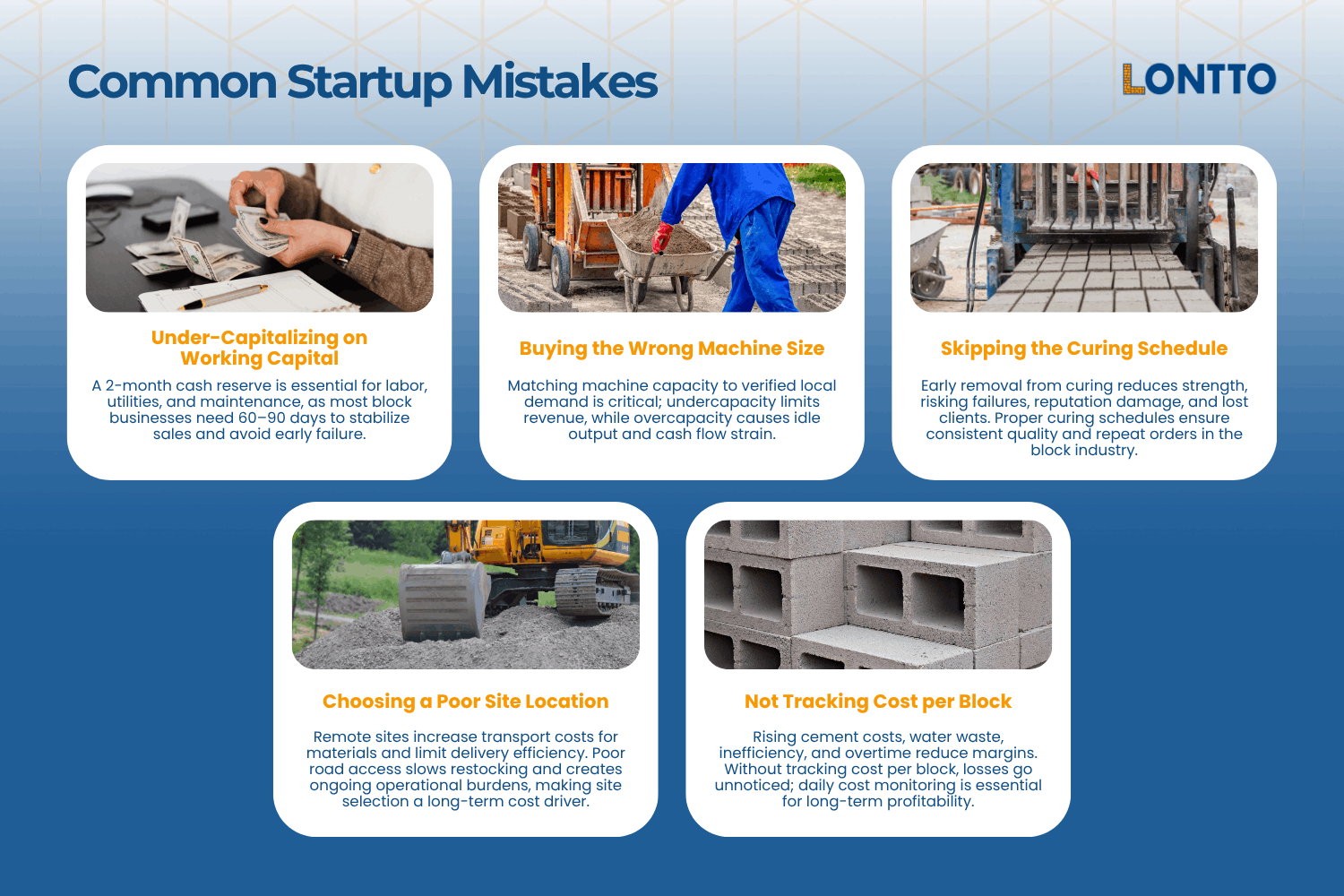
Most block-making business failures trace back to five avoidable decisions made before production starts. Undercapitalization, wrong machine sizing, skipped curing schedules, poor site selection, and absent cost tracking each independently damage profitability. Addressing all five in your block-making business plan is the difference between a profitable venture and an expensive lesson.
Under-capitalizing on working capital
A two-month cash reserve covering labor, utilities, and maintenance is the minimum buffer for any start-up block making a business plan. Most operations take 60 to 90 days to build a reliable customer base and generate consistent daily sales. Running out of cash before revenue stabilizes is the fastest way to shut down block manufacturing operations permanently.
Buying the wrong machine size
Choosing a small unit when local demand supports higher volume caps revenue from day one. Choosing a high-capacity machine in a market that cannot absorb the output creates idle production time and cash flow pressure. Production capacity must match verified local demand, not projected demand.
Skipping the curing schedule
Blocks removed from curing racks too early fail compressive strength requirements. Weak blocks damage your reputation with construction companies and contractors, who will not reorder. A proper curing schedule is the foundation of consistent quality and repeat business in the block industry.
Choosing a poor site location
A site far from raw material suppliers raises input transport costs. Poor access roads limit delivery truck capacity and slow restocking. Both problems compound daily and are difficult to fix after the manufacturing plant is established. Site selection is a permanent cost structure decision.
Not tracking cost per block
Cement price increases, water waste, machine inefficiency, and labor overtime all erode profit margins silently. Operators who track revenue without tracking cost per block cannot identify where losses are occurring. Daily cost tracking is the only way to protect the block manufacturing business's profit over time.
Business Registration And Local Compliance
Starting a block-making business legally requires business registration, a manufacturing permit, and zoning approval before any equipment is installed. Business insurance, including public liability cover, is required by most municipal contracts and protects the operation against third-party claims. Build all compliance costs into your startup budget as fixed line items, not afterthoughts.
A clear plan documenting your business structure, estimated revenue, and production capacity speeds up the registration process in most markets. Zoning compliance is non-negotiable. Your manufacturing plant must sit on land approved for industrial or light manufacturing use before the first making machine arrives on-site.
Let Lontto Help You Start Strong
Lontto supplies mobile, manual, semi-automatic, fully automatic, and hydraulic block-making machines throughout Asia, the Middle East, Africa, and Latin America. We offer machines of all sizes to suit every budget, so you can start and grow your business.
Contacte con Lontto hoy mismo to discuss your needs and get a quote on the right block-making machine for your operation.
Block Making Business Guide 2026 FAQs
How do you test concrete blocks for compressive strength?
For a basic field test, soak a cured block in water for 24 hours, surface-dry it for an hour, then strike it firmly with a heavy hammer. A properly cured block resists shattering and shows only minor surface marks. For formal verification, send random samples to a local materials testing lab. Most load-bearing hollow blocks must hit 2.8 to 5.5 N/mm². Municipal buyers typically require a lab certificate before awarding contracts.
How do you find your first bulk buyers?
Approach two or three local contractors or hardware stores with a written quote guaranteeing delivery within 30 days of your production start. Bring a sample block and offer a 5-10% discount on their first order for a signed letter of intent.
Visit active construction sites and speak directly to site managers about their current supplier's pain points. Position your operation as the more reliable alternative for delivery time and consistent quality.
What financing options are available for a block-making startup?
Equipment leasing is the most common route, with many suppliers offering lease-to-own agreements at 20 to 30% down. Microfinance institutions and agricultural development banks across Africa and Asia offer small manufacturing loan products with lower collateral requirements.
Raw material supplier credit is often negotiable once you show a purchase order. In some markets, government youth enterprise funds or construction sector grants cover up to 40% of equipment costs for qualifying startups.
How do you manage cash flow during slow seasons?
Demand drops sharply during heavy rainy seasons in tropical and subtropical markets, when on-site construction slows or stops. Peak periods run through dry months and typically surge ahead of government infrastructure spending deadlines.
Build a stockpile of fast-moving block types during peak production and offer discounted off-season delivery to price-sensitive buyers. Paving blocks and decorative products are less weather-dependent and can sustain revenue during slow months. A six-month cash reserve is prudent in markets with a pronounced rainy season.
Volver arriba: Block Making Business Guide 2026: Startup Costs, Profit Margins & Equipment

Hable con nuestro Experto en máquinas de ladrillos
Póngase en contacto con nuestro agradable equipo hoy mismo para obtener una estimación del precio de una máquina bloquera.

Soy Chao Zhang, llevo más de 10 años trabajando en la industria de la fabricación de ladrillos. Tengo un profundo conocimiento e investigación sobre varios modelos de máquinas de fabricación de bloques, especialmente máquinas automáticas de ladrillos, máquinas de bloques de hormigón, máquinas de bloques de tierra comprimida, máquinas de ladrillos de arcilla, máquinas de ladrillos de cemento. Tengo un conocimiento especial de esta industria. Puedo ayudar a mis clientes a elegir la máquina de ladrillos adecuada y ayudarles a diseñar y construir una fábrica de producción de ladrillos. Si desea saberlo todo sobre las máquinas para fabricar ladrillos, póngase en contacto conmigo. Estaré encantado de ayudarle.
 Presupuesto
 Llámenos