
 ES
ES  EN
EN  FR
FR  RU
RU 

 Entrega rápida


 Obtener precios
Las máquinas de ladrillos de ceniza ya no son una opción secundaria en las plantas de construcción. Ahora son la base de gran parte de las nuevas líneas de producción, a medida que los constructores se decantan por materiales industrializados y eficientes en el uso de los recursos.
Las previsiones del sector indican que cerca de 47% de próximos proyectos de construcción incorporarán ladrillos de cenizas volantes, lo que hará que las decisiones sobre el equipamiento sean mucho más importantes que antes.
Esta revisión presenta nueve fabricantes líderes de máquinas de ladrillos de ceniza de diferentes capacidades y tecnologías.
Qué buscar en los fabricantes de máquinas de ladrillos de ceniza
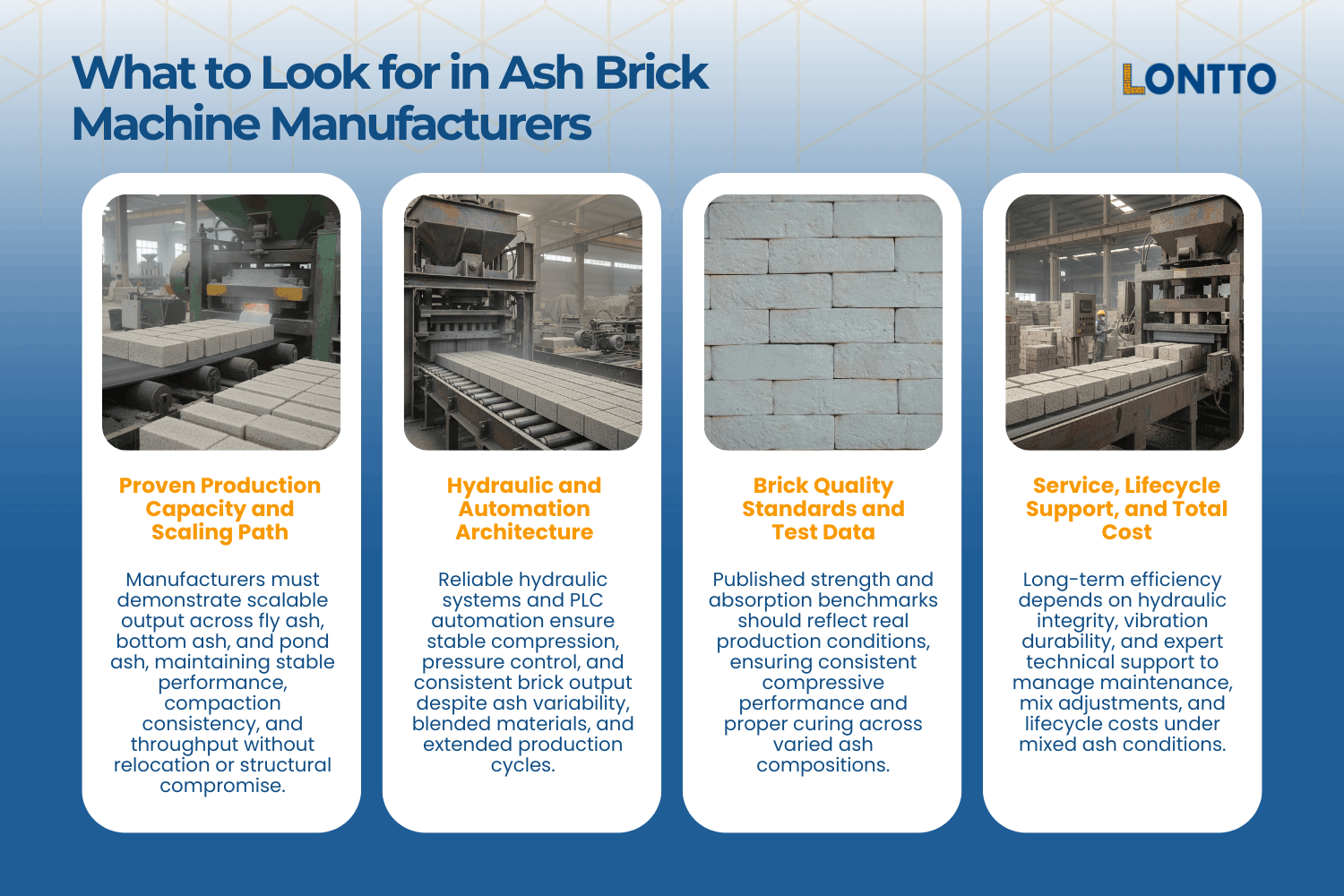
Los fabricantes fiables de máquinas de ladrillos de ceniza demuestran una producción constante, un control hidráulico estable y un rendimiento de calidad documentado. Sus sistemas deben manipular cenizas volantes, cenizas de fondo y cenizas de estanque sin comprometer la resistencia ni la precisión dimensional. Unas vías de actualización claras, una automatización práctica y un servicio de asistencia fiable indican la fiabilidad del proyecto a largo plazo.
Capacidad de producción demostrada y vía de ampliación
Un fabricante creíble de máquinas de ladrillos de ceniza volante debe demostrar bandas de producción que se ajusten al crecimiento por fases y confirmen la adaptabilidad a entradas de ceniza variadas. La producción debe permanecer estable independientemente de si la planta procesa cenizas volantes estándar, cenizas de fondo o cenizas de estanque.
Las cenizas de fondo a menudo requieren un control de la granulometría, mientras que las cenizas de estanque exigen una estabilización de la humedad antes del moldeo. Un fabricante de máquinas de fabricación de ladrillos capaz documentará el rendimiento sostenido de la carrera a través de estas variaciones de material. El escalado no debería requerir una reubicación completa ni comprometer la estabilidad de la compactación con objetivos de mayor rendimiento.
Arquitectura hidráulica y de automatización
La consistencia hidráulica adquiere mayor importancia cuando fluctúa la calidad de las cenizas. Las cenizas de fondo con una textura más gruesa someten a los sistemas de vibración y compresión a esfuerzos diferentes que las cenizas volantes finas. La regulación basada en PLC mantiene una presión uniforme y protege el número previsto de ladrillos por turno de las variaciones de densidad.
Cuando se requiere una inversión por fases, una configuración semiautomática de cenizas volantes debe mantener el control de la compresión incluso con aportaciones de material mezclado. La refrigeración, la capacidad de aceite y la calibración de la presión influyen en la estabilidad durante ciclos prolongados.
Normas de calidad y datos de ensayo de los ladrillos
La diversidad de materiales afecta directamente a los resultados de resistencia y absorción. Los valores de referencia publicados deben reflejar las condiciones reales de producción y no las mezclas controladas de laboratorio.
Cuando se introducen cenizas de fondo o de balsa, el comportamiento a la compresión de los distintos tipos de ladrillos debe ser constante. Unas directrices de curado adecuadas garantizan la obtención de ladrillos de cenizas volantes de alta resistencia a pesar de la variabilidad en la composición de las cenizas.
Servicio, asistencia durante el ciclo de vida y coste total
La manipulación de mezclas de cenizas alternativas puede influir en los intervalos de mantenimiento y los índices de desgaste.
El coste a largo plazo de una línea de producción de cenizas volantes depende de la limpieza hidráulica y de la durabilidad del sistema de vibración en condiciones de mezcla de materiales. Un fabricante y exportador de probada eficacia debe proporcionar orientación para el ajuste de la mezcla sobre el terreno y asistencia técnica cuando varíen las características de las cenizas.
Top 9 fabricantes de máquinas de ladrillos de ceniza
1. Máquina de bloques Lontto
Lontto fabrica máquinas de ladrillos de ceniza en su planta de producción de Yinan, ciudad de Linyi, provincia de Shandong, China. El emplazamiento soporta la producción de máquinas de ladrillos de ceniza volante, sistemas de bloques de hormigón, equipos de tuberías y plantas de dosificación dentro de una única ubicación centralizada.
Lontto ha creado una importante presencia en línea, con más de 200.000 seguidores en Facebook y una sólida posición en las búsquedas de Google, lo que proporciona a los compradores referencias de productos accesibles y la validación de sus pares antes de la compra. Lontto realiza envíos a clientes de África, Asia, América y Europa, y cuenta con experiencia documentada en exportación a múltiples regiones.
Las certificaciones ISO9001 y CE confirman el cumplimiento de las normas internacionales. Cada máquina se somete a una inspección antes de su envío para confirmar su rendimiento estable en condiciones de funcionamiento.
Las máquinas de ladrillos de cenizas volantes de Lontto también pueden procesar cenizas de fondo y cenizas de estanque cuando se controla la granulometría y el contenido de humedad mediante cribado, secado y proporciones de mezcla calibradas.
Lontto ofrece modelos manuales y semiautomáticos de cenizas volantes que admiten una producción escalable para la puesta en marcha y la expansión de las operaciones de fabricación de ladrillos.
- LMT4-40: Funciona a 3 kW y produce hasta 17.304 bloques sólidos cada 8 horas con un consumo de energía controlado.
- LMT4-35: Aumenta la capacidad de bloques sólidos a 20.160 piezas por turno de 8 horas para una mayor producción diaria.
- LMT4-26: Funciona como un sistema semiautomático con una producción que alcanza los 34.112 bloques sólidos cada 8 horas.
- QMJ4-45: Proporciona producción móvil de ladrillos huecos con un ciclo de moldeo de 45 segundos y control por un solo operario.
| Pros | Contras |
|---|---|
| ✅ Ofrece una amplia compatibilidad de moldes para diferentes dimensiones y formas de ladrillos. | ❌ Depende de una clasificación uniforme del material para evitar defectos superficiales y variaciones de resistencia. |
| ✅ Proporciona documentación de envío internacional para apoyar el despacho de aduanas para múltiples regiones de exportación en los mercados internacionales. | |
| ✅ Utiliza componentes modulares que simplifican la sustitución de piezas in situ. | |
| ✅ Ofrece cobertura de garantía y asistencia técnica postventa para reducir el riesgo del comprador. | |
| ✅ Ofrece orientación formativa para ayudar a los operarios a ponerse al día rápidamente tras la instalación. |
2. Industrias Revomac
Revomac Industries fabrica máquinas de ladrillos de ceniza, centrándose en la producción automatizada de ladrillos de ceniza volante para aplicaciones de la construcción en la India.
La empresa diseña máquinas de fabricación de ladrillos de cenizas volantes que utilizan subproductos de la combustión del carbón como materia prima principal para la producción de ladrillos estructurales. Las máquinas automáticas de fabricación de ladrillos de ceniza volante controlan la alimentación, la mezcla, el moldeado y el apilamiento dentro de un ciclo de producción definido para mantener la precisión dimensional y la consistencia de la producción.
Dependiendo de la configuración del molde, la capacidad oscila entre 2.880 y 8.400 ladrillos por hora. La resistencia, absorción y calidad superficial conseguidas dependen de la calibración de las proporciones de la mezcla y del control del curado en todo el pie de la línea de producción.
Revomac configura sus máquinas de ladrillos de ceniza volante en función de los formatos de ladrillo especificados y el rendimiento nominal.
- Ladrillos de ceniza volante sin rana: 230 x 75 x 110 mm: Produce 4.800 piezas por hora o 38.400 piezas por turno.
- Ladrillos de ceniza volante con rana: 230 x 110 x 75 mm: Produce 2.880 piezas por hora o 23.040 piezas por turno.
- Ladrillos de ceniza volante sin: Rana 230 x 110 x 75 mm: Produce 8.400 piezas por hora u 84.000 piezas por turno.
- Niveles de automatización: Ofrecemos configuraciones manuales, semiautomáticas y totalmente automáticas en función de los requisitos de producción.
- Sistema de control: Regule los tiempos de ciclo y el flujo de materiales mediante controles operativos integrados.
| Pros | Contras |
|---|---|
| ✅ Reduce la dependencia de las cadenas de suministro de arcilla cocida en horno. | ❌ Implica la asignación de espacio de curado que puede afectar a la planificación del patio. |
| ✅ Se adapta a trazados de plantas urbanas con disponibilidad limitada de terreno. | |
| ✅ Se integra con la manipulación de palés y la logística del patio de curado. |
3. Q Green Techcon Ltd
Q Green Techcon Ltd fabrica sistemas de producción de ladrillos de ceniza volante, centrándose en el control hidráulico y el diseño de plantas escalables. En funcionamiento desde 2007, la empresa desarrolla equipos basados en cenizas volantes mediante fabricación nacional y una empresa conjunta con Beijing REIT Technology Company Ltd.
Su cartera de máquinas de fabricación de bloques se centra en la producción de ladrillos de cenizas volantes, con el apoyo de la ejecución de proyectos llave en mano para configuraciones de producción completas. Q Green posiciona sus sistemas en torno a la integración digital y el control calibrado de procesos para mantener una calidad constante de los ladrillos de cenizas volantes bajo parámetros operativos definidos.
La serie de cenizas volantes de Q Green incluye los siguientes sistemas de producción:
- QGH 14: Tiene una capacidad de prensado hidráulico de 50 toneladas, produce seis ladrillos por carrera a seis ciclos por minuto y admite un tamaño de palet de 600 x 300 mm.
- QGH 17: Aplica una capacidad de prensado hidráulico de 50 toneladas con seis ladrillos por carrera y soporta una producción superior a 16.000 ladrillos por turno.
- QGH 25: Ofrece una capacidad de prensado hidráulico de 80 toneladas con seis ladrillos por carrera para mayores rangos de salida de turno.
- QGH 25A Twin: Integra prensas dobles de 80 toneladas para producir 12 ladrillos por carrera para una producción superior a 23.000 ladrillos por turno.
- Configuración automática: Cada máquina automática de ladrillos de ceniza volante admite sistemas opcionales de prealimentación y una mezcladora de bandeja de 1.000 kg dentro de un esquema de producción totalmente automatizado.
| Pros | Contras |
|---|---|
| ✅ Se integra con los sistemas automatizados de manipulación de materiales y de patio de curado. | ❌ Requiere una infraestructura de servicios estable para mantener la potencia nominal de los turnos. |
| ✅ Admite la ampliación a la producción multilínea sin necesidad de rediseñar toda la planta. | |
| ✅ Proporciona capacidad de producción orientada a la exportación para los mercados regionales. |
4. Fujian Qunfeng Machinery Co., Ltd.
Con más de 30 años de desarrollo de ingeniería, el fabricante detrás de la QF800 apoya al sector mundial de la construcción mediante sistemas de producción inteligentes. A 215.000 m2 proporciona la base para la fabricación a gran escala y el ensamblaje controlado.
La exportación de equipos a más de 120 países demuestra la existencia de una red de distribución internacional consolidada. La QF800 es una bloquera compacta para la producción de bloques de cenizas volantes en instalaciones pequeñas y medianas. Su bastidor permite una instalación sencilla y un funcionamiento estable con cargas de producción diarias.
La QF800 combina el control de la vibración y el diseño estructural para mejorar la consistencia de la compactación.
- Motor de doble conversión de frecuencia: Potencia el sistema de vibración con fuerza calibrada para una densidad uniforme.
- Sistema de desmoldeo en forma de arco: Reduce la tensión del impacto durante la liberación para proteger los componentes estructurales.
- Rango de altura del molde de 50 a 200 mm: Admite diversos formatos de bloques de cenizas volantes dentro de una plataforma de máquina.
- Funcionamiento de ciclo rápido: Aumenta la capacidad de producción diaria sin una demanda excesiva de energía.
- Huella compacta: Se adapta al espacio limitado de la planta como máquina automática de ladrillos de ceniza volante.
| Pros | Contras |
|---|---|
| ✅ Se ajusta a las cadenas de suministro de la construcción urbana que requieren una producción descentralizada. | ❌ Requiere la inspección programada de los conjuntos vibratorios para evitar la desviación del rendimiento. |
| ✅ Se integra con los sistemas de circulación de palés y de gestión del patio de curado. | |
| ✅ Se adapta a las mezclas de áridos y a las fuentes de cenizas volantes específicas de cada región. |
5. Ingeniería Tecnócrata
Technocrat Engineering es un fabricante de máquinas para la fabricación de ladrillos, especializado en sistemas hidráulicos de producción de cenizas volantes diseñados para una producción controlada y de gran volumen. La serie Techno de la empresa integra paneles de control basados en PLC, regulación automática de la presión y manipulación mediante cinta transportadora para mantener ciclos de moldeo constantes.
La presión de funcionamiento oscila entre 140 y 200 bares en todos los modelos, con sistemas de aceite hidráulico de 420 litros de capacidad. Los sistemas hidráulicos de prellenado permiten una respuesta de ciclo más rápida, mientras que la tecnología de molde antifisuras protege la integridad estructural durante el desmoldeo. Cada configuración está diseñada para proporcionar unidades de ladrillo de ceniza volante de alta calidad con precisión dimensional y estabilidad a la compresión adecuadas para la construcción estructural.
La línea Techno escala la producción mediante una potencia hidráulica y una capacidad de carrera definidas.
- Tecno 24: Produce de 34.000 a 36.000 ladrillos por turno de 8 horas utilizando un motor hidráulico de 20 CV y 24 ladrillos por carrera.
- Tecno 18: Entrega de 25.000 a 26.000 ladrillos por turno con una potencia hidráulica de 15 CV y 18 ladrillos por carrera.
- Techno 15: Soporta de 20.000 a 21.000 ladrillos por turno con 12 ladrillos por carrera y accionamiento hidráulico de 15 Hp.
- Tecno 10: Genera de 14.000 a 15.000 ladrillos por turno con 8 ladrillos por carrera y 10 CV de potencia hidráulica.
- Diseño del sistema: Combina la refrigeración por agua, el control automático de la presión y la fabricación de una sola placa para respaldar una producción de ladrillos duradera y respetuosa con el medio ambiente.
| Pros | Contras |
|---|---|
| ✅ Ofrece disposiciones integradas en el transportador que simplifican la planificación del flujo de producción. | ❌ Implica un mayor consumo de energía en los modelos de gama alta. |
| ✅ Admite flexibilidad de cambio de molde para formatos de ladrillo rana y no rana. | |
| ✅ Incorpora sistemas de refrigeración por agua para gestionar la acumulación de calor hidráulico. |
6. Industria hidráulica L&T
L&T Hydraulic Industry fabrica sistemas de producción de cenizas volantes diseñados para una producción escalable en configuraciones manuales, semiautomáticas y totalmente automatizadas. La empresa estructura cada máquina de fabricación de bloques en torno a la estabilidad hidráulica, la fabricación reforzada y los ciclos de compactación controlados.
La gama admite desde pequeñas unidades piloto hasta plantas industriales de gran volumen, al tiempo que mantiene la coherencia dimensional en condiciones de funcionamiento continuo. La personalización modular permite una configuración basada en los objetivos de producción definidos y en las restricciones de disposición de la planta.
Los sistemas de cenizas volantes de L&T incluyen:
- Sistema de prensa manual: Produce de 200 a 300 ladrillos por hora con una prensa manual adecuada para unidades rurales y de escala piloto.
- 3 Sistema semiautomático CVT: Entrega de 600 a 900 ladrillos por hora mediante prensado hidráulico con control de automatización parcial.
- LT 8800 ALPHA-8CVT Sistema totalmente automático: Produce hasta 2.200 ladrillos por hora mediante un funcionamiento hidráulico totalmente automatizado para una producción a escala industrial.
| Pros | Contras |
|---|---|
| ✅ Proporciona orientación sobre la instalación y la puesta en marcha para apoyar el despliegue estructurado del proyecto. | ❌ Requiere una programación del mantenimiento preventivo integrada en los planes de gestión de la planta. |
| ✅ Ofrece maquinaria preparada para la exportación e idónea para su implantación en el mercado internacional. | |
| ✅ Admite el suministro localizado de piezas de repuesto para reducir el riesgo de inactividad. |
7. Maquinaria de alta tecnología Karmyog
Karmyog Hi-Tech Machineries se ha consolidado a lo largo de dos décadas gracias a la fabricación propia y a la ingeniería de producción controlada. La empresa desarrolla máquinas integradas de fabricación de ladrillos diseñadas para ofrecer durabilidad industrial y un control inteligente de los procesos.
Sus sistemas admiten una amplia gama de aplicaciones de cenizas volantes, junto con soluciones de hormigón y pavimentación, mediante la tecnología de vibrocompactación. Los diseños estructurados de las plantas, los componentes certificados y la manipulación coordinada de materiales permiten un rendimiento estable bajo cargas operativas sostenidas.
La línea de producción de Karmyog incluye los siguientes sistemas:
- KHM144H: Funciona con una fuerza de prensado de 144 toneladas y vibración inferior, produciendo aproximadamente 2.880 unidades por hora en una configuración de ladrillos de ceniza volante totalmente automática.
- KMM48: Utiliza una presión hidráulica de 48 toneladas con accionamiento de palanca manual, una potencia instalada de 19 CV o 14 kW y suministra aproximadamente entre 2.500 y 3.000 unidades al día.
- Configuración de potencia: Soporta suministro eléctrico trifásico alineado con las operaciones a nivel de planta.
- Capacidad multiproducto: Se integra con la configuración de una extendedora de bloques para mantener una calidad uniforme de los ladrillos en distintos formatos de construcción.
| Pros | Contras |
|---|---|
| ✅ Ofrece variantes de máquinas económicas adecuadas para principiantes con presupuestos más bajos. | ❌ Necesita una planificación del inventario de piezas de repuesto para minimizar las interrupciones operativas. |
| ✅ Ofrece una coordinación estructurada de los servicios preventa y posventa. | |
| ✅ Adapta la arquitectura de la máquina a la evolución de las normas sobre materiales de construcción. |
8. Máquinas y servicios técnicos TARA
TARA Machines and Tech Services Private Limited ofrece tecnología de construcción ecológica centrada en la producción descentralizada de materiales de construcción. Promovida por TARA en el marco del Grupo Development Alternatives, la empresa estructura sus sistemas para apoyar la construcción sostenible mediante el control de procesos de ingeniería.
Sus plataformas integradas de máquinas de fabricación de ladrillos y bloques están diseñadas para la fabricación de ladrillos de hormigón y cenizas volantes en entornos de pequeñas y medianas empresas. La automatización, la compactación controlada y la manipulación guiada del material garantizan la consistencia dimensional antes de que los ladrillos se curen para su uso estructural.
La serie MechRam de TARA incluye los siguientes sistemas:
- MechRam X-16: Produce 1.600 unidades por hora con 4 ladrillos por ciclo, gracias a la alimentación, compactación y expulsión controladas por PLC.
- MechRam X-2500: Suministra 2.500 unidades por hora con 12 ladrillos por ciclo, con transferencia y apilado de palés automatizados.
- MechRam X-1250: Produce 1.250 unidades por hora con 4 ladrillos por ciclo y una plataforma deslizante de transferencia.
- Gama de automatización: Configurado para adaptaciones de manipulación manual de cenizas volantes y entornos de producción de cenizas volantes semiautomáticos escalables.
| Pros | Contras |
|---|---|
| ✅ Alinea la oferta tecnológica con las iniciativas de vivienda sostenible. | ❌ Necesita una planificación del emplazamiento que permita la manipulación de palés y el flujo de curado. |
| ✅ Soluciones estructuradas para su adopción por pequeñas y medianas empresas. | |
| ✅ Integra la tecnología con modelos empresariales orientados a la subsistencia. |
9. QGM Quangong Machinery Co., Ltd
Fundada en 1979, QGM Machinery Co., Ltd desarrolla sistemas integrados para producir ladrillos de cenizas volantes y unidades de hormigón mediante vibración y control hidráulico de ingeniería. La empresa opera desde un amplio campus industrial de aproximadamente 60 acres y colabora con socios alemanes para reforzar la integración técnica.
En lugar de ofrecer una única unidad fija, QGM estructura cada planta de ladrillos de cenizas volantes como un sistema de producción configurado a la medida de la disposición del emplazamiento, el nivel de automatización y los requisitos del producto.
Sus plataformas combinan la vibración estática y dinámica para mejorar la densidad y la estabilidad dimensional. El movimiento guiado con precisión regula la alineación del pisón durante el moldeo, lo que favorece una producción uniforme en todos los entornos industriales.
Los sistemas de producción de QGM incorporan las siguientes capacidades:
- Alta fuerza de vibración: Genera hasta 172 KN para formar bloques y ladrillos densos con ajustes de frecuencia controlados.
- Sistema de guiado de cuatro barras: Mantiene un movimiento preciso entre la cabeza del pisón y el molde para un moldeado uniforme.
- Módulos hidráulicos integrados: Utiliza componentes alemanes e italianos optimizados con motores ABB para un control estable de la compresión.
- Control de conversión de frecuencia: Equipa cada máquina automática de ladrillos de ceniza volante con regulación de velocidad programable y capacidad de servicio remoto.
- Producción multiformato: Admite ajustes de moldes y actualizaciones de parámetros dentro de un diseño de planta automatizado.
| Pros | Contras |
|---|---|
| ✅ Admite operaciones industriales a gran escala con diseños de planta de ingeniería. | ❌ Las máquinas no están listas para la recogida, el embalaje y el envío inmediato debido a los requisitos de configuración. |
| ✅ Ofrece diagnóstico remoto y asistencia técnica en la nube. | |
| ✅ Diseña sistemas adaptables a diversas especificaciones de productos. |
Fabricantes de máquinas de ladrillos de ceniza Preguntas frecuentes
¿Qué comprobaciones diarias de mantenimiento necesitan las máquinas de ladrillos de ceniza volante?
La inspección diaria debe incluir una comprobación visual de fugas hidráulicas y desgaste de las mangueras. Verificar el nivel de aceite y de agua de refrigeración antes de la puesta en marcha. Inspeccione los transportadores, las correas y los sensores en busca de residuos o desalineación. Confirme que la intensidad de las vibraciones y las lecturas de presión hidráulica se mantienen dentro de los límites nominales.
¿Es ruidosa una fábrica de ladrillos de cenizas volantes durante su funcionamiento?
La operación genera un ruido mecánico continuo procedente de las unidades de vibración y los sistemas hidráulicos. El ruido adicional procede de mezcladoras, compresores y accionamientos de cintas transportadoras. El nivel general de ruido depende del diseño del recinto, la amortiguación de los cimientos y las condiciones de mantenimiento.
¿Pueden estas máquinas funcionar varios turnos de forma continua sin pausas de refrigeración?
La mayoría de los sistemas están diseñados para funcionar en varios turnos cuando los sistemas de refrigeración funcionan correctamente. Los operadores deben controlar la temperatura del aceite y la carga del motor durante toda la producción. A temperaturas ambiente elevadas, pueden ser necesarias pausas breves o refrigeración adicional para proteger los componentes hidráulicos.
Volver arriba: Top 9 fabricantes de máquinas de ladrillos de ceniza

Soy Chao Zhang, llevo más de 10 años trabajando en la industria de la fabricación de ladrillos. Tengo un profundo conocimiento e investigación sobre varios modelos de máquinas de fabricación de bloques, especialmente máquinas automáticas de ladrillos, máquinas de bloques de hormigón, máquinas de bloques de tierra comprimida, máquinas de ladrillos de arcilla, máquinas de ladrillos de cemento. Tengo un conocimiento especial de esta industria. Puedo ayudar a mis clientes a elegir la máquina de ladrillos adecuada y ayudarles a diseñar y construir una fábrica de producción de ladrillos. Si desea saberlo todo sobre las máquinas para fabricar ladrillos, póngase en contacto conmigo. Estaré encantado de ayudarle.

 Contacto
 Presupuesto
 Llámenos