
 FR
FR  EN
EN  RU
RU  ES
ES 

 Livraison rapide


 Obtenir un prix
Concrete block makers supports a wide range of construction activities across the United States, from small residential projects to large infrastructure contracts.
Contractors use these machines à blocs de béton in homebuilding yards to produce hollow blocks for foundations and structural walls, while paving facilities manufacture interlocking pavers and curbstones for driveways and walkways.
Renovation shops supply architectural and retaining wall units, and commercial plants turn out solid masonry products for retail and industrial buildings. In 2026, North America is expected to account for roughly 37% of global revenue in the concrete block equipment sector.
What to Look for in Concrete Block Making Machine Manufacturers in USA
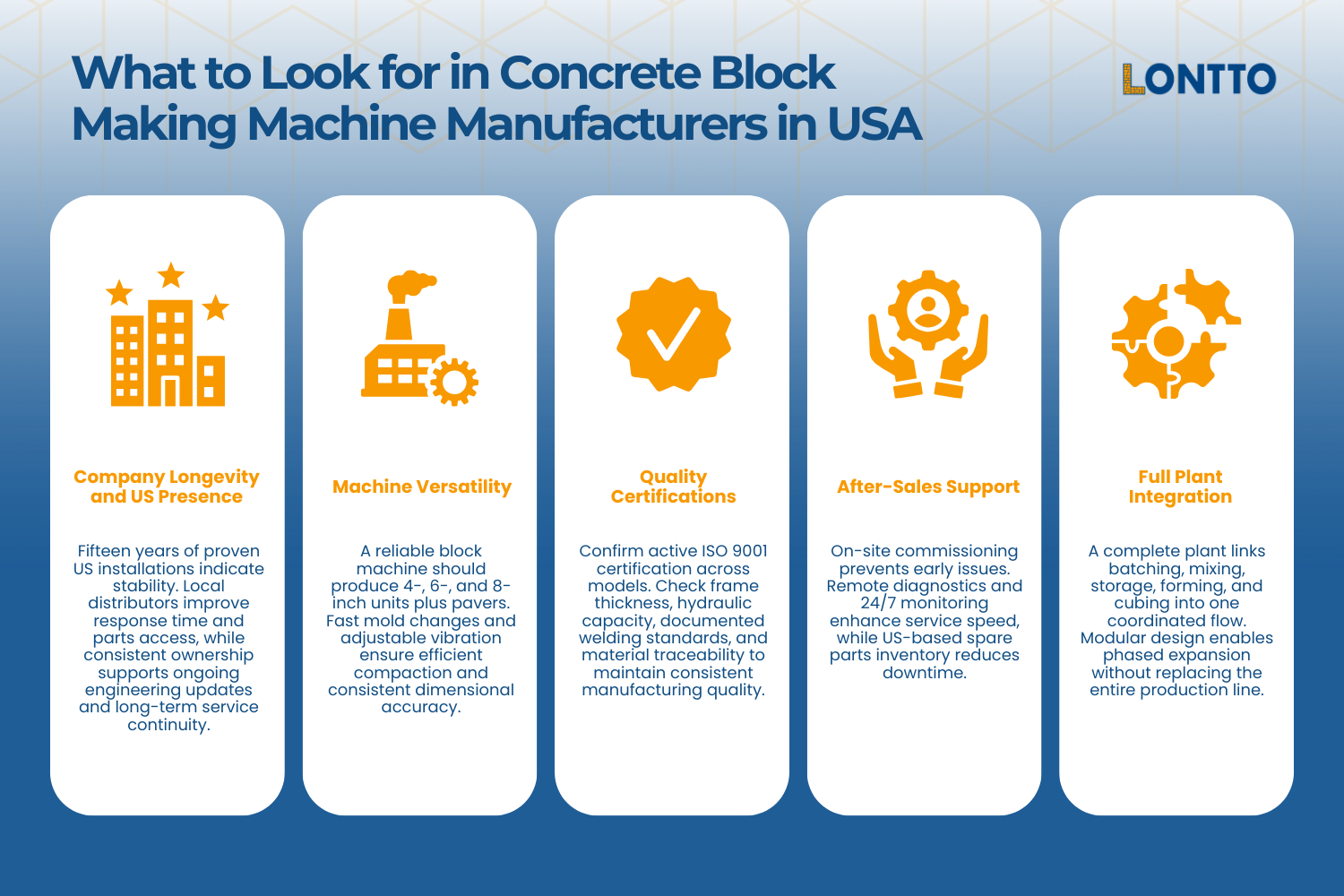
When evaluating brick making machine suppliers, start with production fit. The selected concrete block maker must align with your daily volume targets and available labor.
Compare the full cost of ownership, including freight, commissioning and long-term service agreements. Review documented US installations to confirm that the supplier’s concrete machines operate reliably under local raw material conditions and regulatory standards.
Company Longevity and US Presence
Fifteen years of documented US installations signal operational stability. Local distributors matter. They reduce response time and improve parts access. Stable ownership structures also support continuity in engineering updates and long-term service planning.
Machine Versatility
A capable concrete block maker should handle different sizes such as 4-inch, 6-inch and 8-inch units plus pavers.
Mold swaps must be fast. Under 30 minutes is reasonable. Systems that vibrate at adjustable frequencies allow operators to fine-tune compaction and maintain dimensional accuracy across product runs.
Quality Certifications
Verify active ISO 9001 coverage across all production models. Inspect frame thickness and hydraulic capacity. Welding standards should be documented. Material traceability strengthens quality control.
After-Sales Support
On-site commissioning reduces early operational errors. Remote diagnostics should be available. Around-the-clock monitoring improves response speed. US-based spare parts inventory limits extended downtime.
Full Plant Integration
A complete concrete products plant connects batching, mixer, silo, forming and cubing into a coordinated material flow. Each stage must communicate. Modular layouts allow phased expansion. Growth should not require replacing the entire production line.
Top Concrete Block Making Machine Manufacturers in USA
1. American Block Machinery
American Block Machinery has operated since 1999 and is now in its third generation of ownership. The company supplies concrete block machines to producers in the United States and international markets, serving both start-up yards and established plants.
The company designs its machines to produce both concrete blocks and paver bricks on the same system, allowing manufacturers to switch between products without the need for separate lines.
Their equipment includes:
- ABM 1200 Supermax hydraulic machine: Built with pallet feeder, pallet ejector and exit cleaning brush; uses 100 x 200 x 400 mm, 150 x 200 x 400 mm and 200 x 200 x 400 mm molds to produce 4-inch, 6-inch and 8-inch blocks at daily outputs up to 12,000 units.
- SHD-1000 automatic hydraulic block making machine: Uses hydraulic pressure to form stronger 4-inch, 6-inch and 8-inch blocks at defined per-cycle counts.
- SBS-107 egg-laying hydraulic machine on wheels: Moves across concrete floors and lays blocks directly on the slab, removing the need for wood pallets.
The machines combine multi-size mold capability, pallet handling integration and mobile floor-laying production within compact hydraulic systems. No specific third-party certifications are publicly listed.
| Pour | Cons |
|---|---|
| ✅ Provide comprehensive onboarding resources that include manuals, gated video instruction, remote troubleshooting and optional on-site training. | ❌ No publicly disclosed third-party certifications. |
| ✅ Support international buyers through global travel for commissioning and operator setup. | |
| ✅ Offer equipment suited for both entry-level producers and higher-volume block yards. |
2. Besser Company
Besser Company, headquartered in Alpena, Michigan, has been in operation since 1904 and is employee-owned.
The company manufactures high-output concrete products, machinery and mold systems and supplies turnkey production lines with pallet handling and finishing integration. Through its partnership with the World Center for Concrete Technology, it provides formalized training and product testing support.
Its equipment lineup includes:
- Servopac Infinity: Combines mold vibration and impact vibration in one system, produces units from 1 to 12 inches or 25 to 300 millimeters, completes mold and height changes in under 15 minutes and operates without a pit foundation
- Bescopac: Produces three to four 8-inch units per cycle at up to six cycles per minute with accessible hydraulic systems and automated pallet scraping
- Vibrapac and Servopac series: Deliver up to nine cycles per minute with independent vibration control for varied product heights
- Select, Classic and Premier systems: Integrate pallet handling, finishing lines and automated product movement
Besser also designs and manufactures its own mold systems and maintains a parts catalog supporting every machine platform it produces.
| Pour | Cons |
|---|---|
| ✅ Support product changeovers through structured mold libraries and documented tooling references. | ❌ Involve higher maintenance planning due to multi-component automation systems. |
| ✅ Offer defined control panel upgrades, such as Allen-Bradley SLC500 integration with programmable presets. | |
| ✅ Design hydraulic systems with externally mounted service components for direct maintenance access. |
3. Columbia Machine
Columbia Machine is headquartered in Vancouver, Washington, United States and has operated since 1937. The company supplies concrete products and equipment to customers in more than 100 countries across six continents.
In 1945, it introduced one of the first semi-automatic hydraulic block machines. That early engineering focus shaped its expansion into full plant systems that now extend from batching and mixing through automatic cubing and splitting. No specific third-party certifications are publicly listed.
Its equipment portfolio includes:
- Small pallet machines such as SPM20 and Model 16: Produce two to three products per cycle, reach up to 1,440 units per hour and support product heights from 0.75 to 12 inches
- CPM+ production series, including CPM+30 through CPM+120: Produce three to 12 products per cycle with pallet lengths up to 43.3 inches and product heights up to 12 inches
- SHP 5000 PRO C and SHP 6000 PRO C: Produce 12 products per cycle with maximum product heights up to 550 millimeters for larger-format applications
- Batching, mixing, mold and robotic palletizing systems: Connect upstream material preparation with downstream handling and cubing
Columbia integrates vibration technology with upstream material handling and downstream automation within a single manufacturing organization.
| Pour | Cons |
|---|---|
| ✅ Offer plant layout design and installation planning services. | ❌ Involve longer lead times for custom-configured plant solutions. |
| ✅ Support operator onboarding through structured training facilities. | |
| ✅ Develop proprietary control software to manage sequencing and machine coordination. |
4. REIT
RETO Eco-Solutions, Inc. was founded in 1999 in Beijing and develops block-making systems for international markets, including exports to the United States.
The company combines block production equipment with solid waste processing technology. Its approach converts construction waste, tailings and fly ash into usable building materials through coordinated machinery systems.
Machine and system offerings include:
- Fully automatic block making machines such as RTQT12 and RT15A: Produce standard bricks, hollow blocks, curbstones and large-format pavers with cycle times of 13 to 20 seconds and vibration force up to 150 kilonewtons
- Semi-automatic and grouped systems: Support flexible production volumes for concrete blocks and paving units
- Face mix systems: Apply controlled surface layers for colored and architectural pavers
- Solid waste processing lines: Crush, sort and prepare industrial and construction waste for reuse in block production
RETO integrates Siemens programmable logic controllers with cloud diagnostics, connecting digital machine control directly to waste-based material input and finished block output.
| Pour | Cons |
|---|---|
| ✅ Support enterprise hosting and after-sales operational management for ecological projects. | ❌ Focus heavily on infrastructure-scale deployments rather than entry-level standalone units. |
| ✅ Expand digital oversight capabilities through Internet of Things integration and remote monitoring frameworks. | |
| ✅ Provide end-to-end engineering from site assessment through operational commissioning. |
5. Lontto
Lontto was established in 1990 and introduced its independent export brand in 2003, focusing on international construction markets. The company manufactures block-making machines in China across three factories totaling 3,587,970 square feet and reports an annual production capacity of 12,000 machine sets.
Dedicated workshops handle raw material processing, mold fabrication and heat treatment, supporting in-house control over component production. Lontto holds ISO 9001 certification and supplies CE-certified machines to more than 60 countries, including the United States.
Production models include:
- LMT4-40 and LMT4-35 manual machines: Produce 4-inch to 6-inch hollow blocks for low-volume output using compact pallet formats
- LMT4-26 semi-automatic system: Produce concrete and hollow blocks with an integrated 6-meter conveyor and 350 mixer support
- QT3-20 and QT4-25C automated machines: Produce pavers, hollow blocks and porous bricks with automated vibration and pallet handling
- QT4-18, QT4-15 and QT5-15 hydraulic systems: Automate pallet loading, material feeding, conveying and stacking for higher-density block production
| Pour | Cons |
|---|---|
| ✅ In-house mold fabrication and heat treatment workshops for component control. | ❌ Depend on local technician capability for long-term maintenance support. |
| ✅ Provide ISO 9001 and CE-certified equipment for international compliance. | |
| ✅ Include bundled accessories such as conveyors and mixers with select models. |
6. Hongfa Group
Hongfa Group was founded in 1990 and manufactures building material machinery from two production bases in China, with operations spanning 440,000 square meters and 180,000 square meters of factory buildings.
The company holds ISO certification and CE certification, supports customers through 14 overseas service centers and supplies equipment to users in more than 100 countries and regions. Hongfa operates as an exporter for block and wall panel production systems serving international markets.
Machinery lines include:
- QT4 to QT18 series brick making machine models: Produce concrete blocks and pavers such as hollow blocks, solid bricks, curbstones, interlock bricks and permeable bricks using hydraulic forming cycles
- Full automatic concrete block production lines: Combine batching, mixing, pallet feeding and stacking to produce concrete blocks and pavers at plant scale
- AAC block and panel production lines: Produce autoclaved aerated concrete units with capacities from 50,000 to 400,000 cubic meters annually
- EPS cement wall panel lines: Produce solid core, hollow core and composite wall panels up to 1,000,000 square meters per year
The equipment supports multiple types of block through mold replacement and layout customization.
| Pour | Cons |
|---|---|
| ✅ Offer pre-shipment equipment testing before export dispatch. | ❌ Depend on remote diagnostics when local field technicians are unavailable. |
| ✅ Supply plant-level documentation packages covering electrical and hydraulic systems. | |
| ✅ Support phased factory expansion by allowing additional lines to be added later. |
7. Qingdao HF Machinery
Qingdao HF Machinery Co., Ltd. has operated since 1989 and develops concrete block-making machines from three manufacturing bases in Qingdao covering 500 acres.
The company holds CE, SGS, CIC and Intertek certifications and exports equipment to more than 130 countries. HF emphasizes component sourcing from Siemens, Schneider and Yuken to standardize control and hydraulic performance across its platforms.
Its machinery is structured for operators who need to produce concrete blocks with consistent density and dimensional control:
- H1000 automatic system: Produce hollow blocks, solid units, pavers and curbstones with synchronized hydraulic and vibration systems
- QT10-15, QT12-15 and QT15-15 lines: Automate feeding accuracy, material distribution and discharge to stabilize the production process
- QT4-16 and QT4-25 models: Adapt molds for varied types of block in medium-scale cement block-making plants
- QT4-26 and T10 systems: Deliver compact or energy-optimized hollow block machine configurations
The machines combine hydraulic pressure, timed vibration and PLC control to maintain uniform density and dimensional accuracy during each cycle.
| Pour | Cons |
|---|---|
| ✅ Offer structured pre-shipment inspection and trial production before dispatch. | ❌ Require on-site calibration to match local aggregate quality and mix design. |
| ✅ Maintain spare-parts stocking programs to reduce downtime risk. | |
| ✅ Design machines with modular subassemblies that simplify component replacement. |
8. Revomac Industries
Revomac Industries was established in 2010 in Ahmedabad and manufactures concrete block-making machines and fly ash brick systems at its in-house facility.
The company builds its equipment around vibro compaction Indian technology to support contractors who need to produce concrete blocks for housing, paving and infrastructure projects. Revomac publicly advertises ISO 9001:2015 certification for its quality management systems.
Production platforms include:
- Robotic 9000 automatic concrete block machine: Produce concrete blocks, pavers, kerb stones and retaining blocks with robotic handling and controlled vibration
- MAC+ 4000 and MAC+ 3000 premium series: Produce high-density blocks using heavy-duty structure and advanced vibration systems
- MAC 1400, 1800 and 2500 smart series: Produce interlocking bricks, hollow blocks and solid blocks with automated height and temperature control
- Robotic 6000 series: Automate material feeding, compaction and product discharge within integrated control systems
Mold change capability allows the same equipment frame to manufacture multiple concrete product formats within one plant layout.
| Pour | Cons |
|---|---|
| ✅ Structure machine layouts with accessible service points for faster routine maintenance. | ❌ Operate primarily from one geographic manufacturing region, which may affect freight timing for distant buyers. |
| ✅ Offer optional heating pad and sensor-based control enhancements for climate-sensitive production. | |
| ✅ Design frames with replaceable wear liner plates to extend operational lifespan. |
9. Bharatmach
Bharat Hydraulic Industries LLP was established in 2008 and manufactures brick, block and paver machinery for construction applications. The company is ISO 9001:2015 certified and operates as both a manufacturer and exporter of fly ash brick plants and manual block systems.
Its equipment range supports small-scale and mid-scale producers through vibration-based compaction and practical mechanical layouts. Standard dispatch is available within 8 days of order confirmation, with shipments routed through Mundra or Mumbai ports.
Equipment platforms include:
- BHS-204FV manual concrete brick and block machine: Produce four 9 x 4 x 3 inch bricks per cycle using hand pressure and vibration, reaching up to 1,920 bricks per shift
- Vibrotech series manual systems: Produce hollow blocks, paving bricks and solid bricks for low-capacity production
- Fully automatic fly ash brick and paver plants: Automate feeding, forming and discharge for higher output environments
- Mixing and material handling systems: Support batching and workflow preparation
Interchangeable molds allow multiple brick and block formats within the same machine structure.
| Pour | Cons |
|---|---|
| ✅ Design equipment suited to areas with limited automation infrastructure. | ❌ Face freight cost variability tied to international shipping rates. |
| ✅ Provide technical guidance during installation to reduce startup errors. | |
| ✅ Offer compact machine footprints suitable for space-constrained workshops. |
Top Concrete Block Making Machine Manufacturers FAQs
How do concrete block machines help us contractors?
A modern concrete block maker allows contractors to control supply instead of relying on third-party yards.
By producing units on-site or nearby, crews can adjust mix design, density and dimensions to meet specific structural or architectural requirements. These concrete machines also reduce delivery delays and support faster response to schedule changes. Local production improves cost predictability and material availability.
What factors influence the choice of production setup?
Production setup depends on daily volume targets and labor availability. Smaller teams may select compact systems that are easier to manage. Larger operations often require automated lines to handle higher throughput. Planning for expansion matters as well. The chosen configuration should support future growth without requiring a complete equipment replacement.
Why invest in fully integrated systems?
An integrated concrete products plant connects batching, mixer, silo storage and forming stations in one coordinated production process. Material flows continuously. Machines vibrate to compact blocks in different sizes with consistent density. This streamlined layout improves efficiency and reduces handling interruptions.
Retour en haut de la page : Top Concrete Block Making Machine Manufacturers in USA

Je m'appelle Chao Zhang et je travaille dans l'industrie de la fabrication de briques depuis plus de 10 ans. J'ai une connaissance approfondie et des recherches sur différents modèles de machines de fabrication de blocs, en particulier les machines automatiques à fabriquer des briques, les machines à fabriquer des blocs de béton, les machines à fabriquer des blocs de terre comprimée, les machines à fabriquer des briques d'argile, les machines à fabriquer des briques de ciment. J'ai une connaissance particulière de ce secteur. Je peux aider mes clients à choisir la machine à briques appropriée et les assister dans la conception et la construction d'une usine de production de briques. Si vous voulez tout savoir sur les machines à fabriquer des briques, n'hésitez pas à me contacter. Je me ferai un plaisir de vous aider.

 Contact
 Devis
Devis Appelez-nous