
 FR
FR  EN
EN  RU
RU  ES
ES 

 Livraison rapide


 Obtenir un prix
Vibration-based brick machines often produce lower-density units and higher cement use. They create more noise during operation and place more stress on parts. Frequent maintenance follows, and plant layout usually suits larger-scale output better than urban production or smaller factories.
Static brick making machine suppliers serve plants that need dense output with lower operating strain. A well-built hydraulic press applies controlled force for stronger concrete bricks and durable cement blocks with less cement.
Low-vibration forming machines reduces noise, supports lower maintenance and fits small and medium-sized sites. Static press systems suit urban areas where stable brick production and quieter operation matter.
What to Look for in Static Brick Making Machine Suppliers
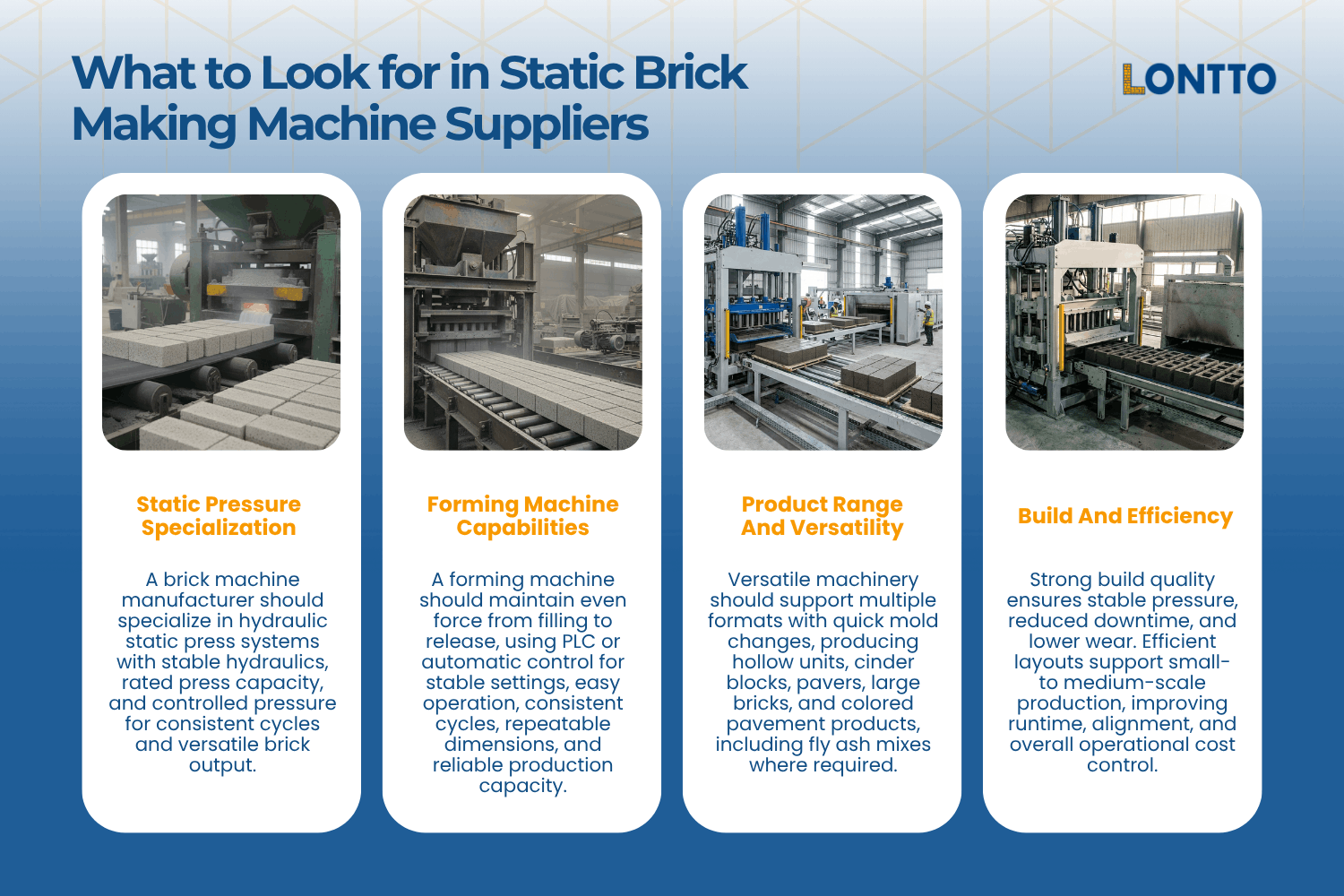
Static Pressure Specialization
A specialized brick machine manufacturer should focus on hydraulic static press equipment. Press design should include a stable hydraulic system, a rated hydraulic press and controlled static pressure in each cycle.
Forming performance should cover concrete block, hollow brick and dense cement blocks with limited vibration. Product scope should extend to paving brick, pavement bricks and clean concrete brick output.
Forming Machine Capabilities
A capable forming machine should keep force even from fill through release. Control should come from an industrial PLC control system or a responsive automatic control system. Stable settings keep an automatic block-making machine easy to operate during long shifts and consistent cycle control supports repeatable dimensions and stated production capacity.
Product Range And Versatility
Versatile block machinery should cover several formats with quick mold changes. Durable brick making machinery should handle concrete hollow units and standard hollow brick machine production.
The product range should include multiple types of hollow units, cinder block sizes and small-block output. Mold sets may extend to large brick, paver lines and various colored pavement products with fly ash mixes where required.
Build And Efficiency
Build quality affects runtime, alignment and wear rate. A stable automatic block line should hold pressure under load and reduce unplanned stoppages. Durable construction helps manage labor costs and suits small and medium-sized plants.
Similar layouts often serve established block factories and lines well-suited to small- and medium-sized production programs.
Top 5 Static Brick Making Machine Suppliers
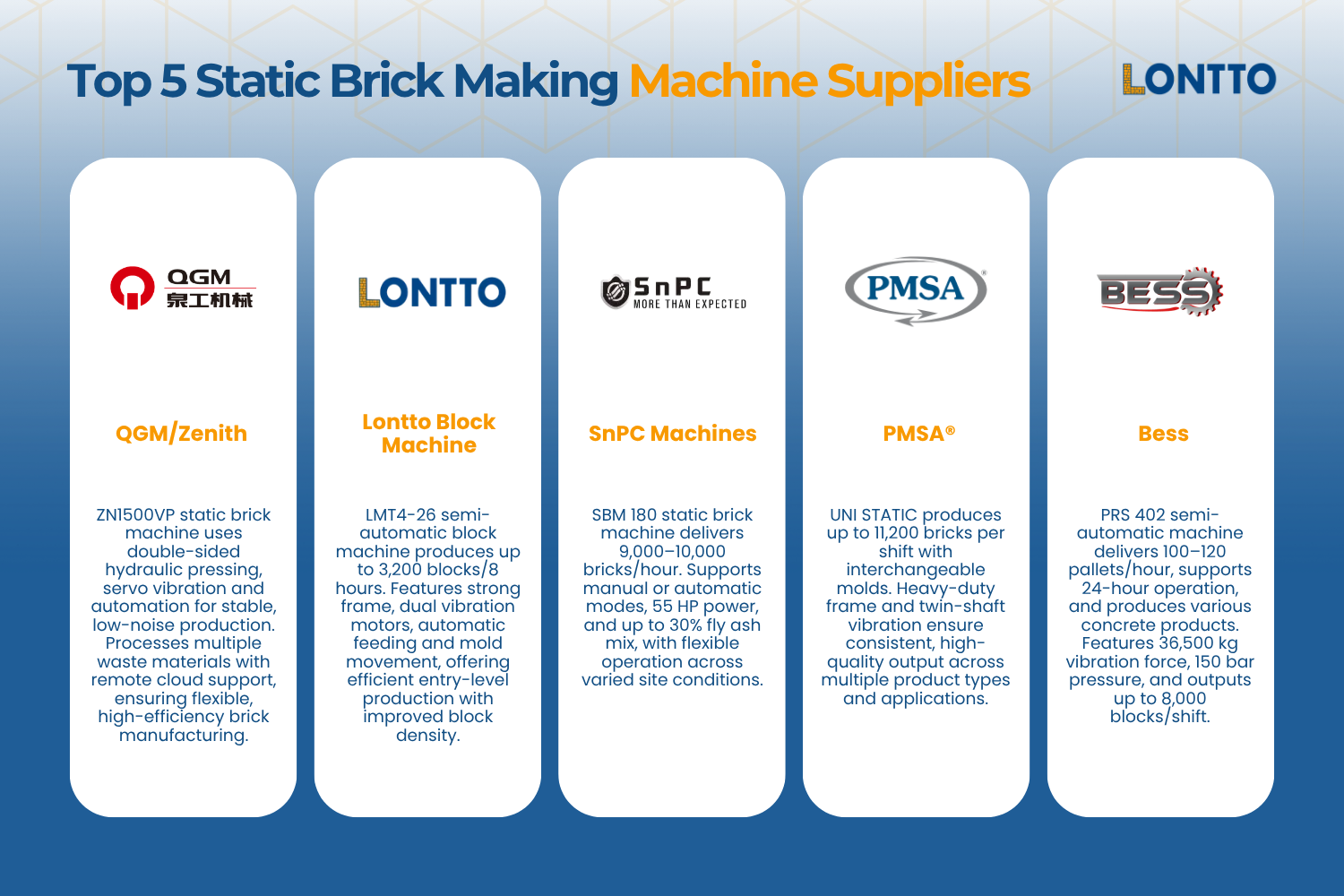
1. QGM/Zenith
The ZN1500VP static brick machine is built for cement brick production. The model uses a double-sided press structure with hydraulic transmission. The design focus centers on energy savings, stable pressing force and lower operating noise during block forming.
Automatic control supports output quality across the brick pressing cycle. QGM describes the machine as a system with high automation, low labor intensity and stable production performance. The machine platform combines servo vibration, servo-based control and remote cloud support for operation access, maintenance support and program updates across regions.
ZN1500VP can process multiple waste-based materials for finished brick production. Suitable inputs include construction solid waste, metallurgical solid waste, tailings, stone powder, sludge and sand washing mud. Its material range gives QGM greater flexibility than equipment designed for a more limited range of raw materials.
The ZN1500VP supports 40 to 200 mm product height, uses a 1400×1200 mm pallet size, applies 1,500 tons of main pressure and uses a φ800 mm main cylinder bore.
| Pour | Cons |
|---|---|
| ✅ Simplifies maintenance through replaceable wear plates and a hydraulically locked feeding section. | ❌ May increase setup and troubleshooting complexity because frame, hydraulic and control systems operate as an integrated platform. |
| ✅ Improves finished-product consistency through mechanical synchronization and precise demolding. | |
| ✅ Supports wider product changeover through vibration control that adjusts to different concrete product requirements. |
2. Lontto
LONTTO offers the LMT4-26 as a semi-automatic concrete block machine for smaller production operations. The package includes the main machine with a concrete mixer. A belt conveyor and one mold set complete the line. Output reaches 3,200 hollow blocks in eight hours, giving new entrants a practical starting point.
The LMT4-26 uses a six-steel pillar frame with four guide rails for stronger support during operation. A super-strong vibration motor improves hollow block density and finished strength.
Machine layout includes automatic mold movement and automatic material feeding. A separate control cabinet supports easier operation. Integrated gas and electricity, with two super-strong vibration motors, offers higher production efficiency than the LMT4-35.
| Pour | Cons |
|---|---|
| ✅ Includes an automatic mold back-and-forward motor for mold movement. | ❌ Limits plant scale compared with larger block lines built for higher-volume production. |
| ✅ Uses two sets of super-strong vibration motors with integrated gas and electricity. | |
| ✅ 16Mn steel frame equivalent to Q345 for higher strength and better compression resistance. |
3. SnPC Machines
SnPC Machines Private Limited offers the SBM 180 as its static or fixed brick machine. The model runs in manual or automatic mode for different production needs. Product capacity reaches 9,000 to 10,000 bricks per hour.
The SBM 180 uses an MS and SS body structure with an SnPC-made chassis. Machine design works with prepared raw material for brick production. The unit requires 55 horsepower and can run on a power supply or a generator.
Flyash mixing reaches up to 30%, subject to soil quality. Static machine format gives SnPC a fixed-line option within its broader brick equipment range. Operating flexibility and power-source compatibility help the SBM 180 fit sites with different utility conditions.
| Pour | Cons |
|---|---|
| ✅ Supports backup production during grid disruption because generator use remains available. | ❌ Depends on prepared raw material, so on-site material prep remains outside the machine's scope. |
| ✅ Fits mixed operator skill levels because the machine can run in either control mode. | |
| ✅ Expands material cost flexibility when site conditions support flyash blending. |
4. PMSA®
PMSA® offers the UNI STATIC as a small-capacity static machine for brick, block and paver production. The machine uses interchangeable molds to produce multiple product types on a single platform. Output reaches 11,200 standard bricks, 8,000 pavers, 5,400 maxi bricks or 2,000 hollow blocks per nine-hour shift.
The UNI STATIC is built for product consistency and long service life. PMSA uses a heavy-duty four-column design with a distortion-free frame to keep products within specification. Twin-shaft vibration supports compaction, strength and dimensional accuracy across repeated production cycles.
The machine layout supports entry-level manufacturing and offers greater product flexibility. The unit works with standard and customised molds and can produce bricks, pavers, hollow blocks, decking blocks, retaining wall blocks and garden kerbs.
PMSA positions the machine for customers starting a brick, block and paver business, with training, technical support and spare parts available.
| Pour | Cons |
|---|---|
| ✅ Supports easier product changeover because molds interchange across multiple product formats. | ❌ Keeps capacity in the small-output range for businesses planning larger plant volume. |
| ✅ Reduces lubrication tasks because vesconite bushes do not require greasing. | |
| ✅ Improves dimensional control through replaceable wear strips and four mold-guide columns. |
5. Bess
Bess manufactures the PRS 402 as a semi-automatic paving block machine for continuous production of concrete products. Machine layout follows a mortar plant design and supports 24-hour operation. mold changes allow production of paving blocks, hollow blocks, insulated bricks, curbstones, asmolen blocks and chimney blocks with product heights from 5 cm to 25 cm.
The PRS 402 uses an operator control system with an output of 100 to 120 pallets per hour. The technical setup includes double mortar hoppers with a capacity of 0.5 cubic meters and a vibration force of 36,500 kilograms. Total power usage reaches 18 kilowatts, hydraulic pressure reaches 150 bar and machine weight reaches 7,500 kilograms.
Daily output can easily manage 8 up to 8,000 hollow blocks in the 100 x 400 x 200 mm format, or 300 square meters of interlocking paving blocks, in an eight-hour shift. For safe installation and efficient material flow, Bess recommends a minimum of 2,500 m² of site area to accommodate the machine, curing zones, and product stockyard.
| Pour | Cons |
|---|---|
| ✅ Supports broad product changeover through one machine platform, so buyers can expand output mix without replacing the unit. | ❌ Leaves drying and curing rooms outside the stated turnkey scope, so full plant planning still needs added infrastructure. |
| ✅ Reduces additional equipment planning because plant pricing covers a turnkey setup apart from drying and curing rooms. | |
| ✅ Keeps the site layout more flexible because roofing is not required for the installation area. |
Static Brick Making Machine Suppliers FAQs
How much space does a static brick making machine need?
Installation space depends on machine size and plant layout. Most static press models fit within 500 to 1,500 sq. ft., depending on output level and any optional stacking system. Higher-capacity lines require more space for material flow, product staging and operator access.
Can a static brick making machine use recycled materials?
Static machines can process recycled materials when the mix design is controlled correctly. Many models handle high fly ash content up to 70% to 80% and work with selected waste aggregates. Material quality still affects the density, strength and surface finish of the final product.
What is the lifespan of a static brick making machine?
Most static brick-making machines operate for 10 to 20 years with regular maintenance. Service life is longer because the hydraulic design is simple and the machine avoids vibration-induced wear. Frame condition, hydraulic care and mold maintenance all affect long-term performance.
Retour en haut de la page : Static Brick Making Machine Suppliers

Je m'appelle Chao Zhang et je travaille dans l'industrie de la fabrication de briques depuis plus de 10 ans. J'ai une connaissance approfondie et des recherches sur différents modèles de machines de fabrication de blocs, en particulier les machines automatiques à fabriquer des briques, les machines à fabriquer des blocs de béton, les machines à fabriquer des blocs de terre comprimée, les machines à fabriquer des briques d'argile, les machines à fabriquer des briques de ciment. J'ai une connaissance particulière de ce secteur. Je peux aider mes clients à choisir la machine à briques appropriée et les assister dans la conception et la construction d'une usine de production de briques. Si vous voulez tout savoir sur les machines à fabriquer des briques, n'hésitez pas à me contacter. Je me ferai un plaisir de vous aider.

 Contact
 Devis
Devis Appelez-nous