
 FR
FR  EN
EN  RU
RU  ES
ES 

 Livraison rapide


 Obtenir un prix
Les céramiques traditionnelles, fabriquées à partir de matériaux à base d'argile, sont utilisées pour la fabrication des briques. Dans le domaine de la construction, la brique est un matériau céramique fabriqué à partir d'argile, façonné et cuit dans un four, ce qui la place résolument dans la catégorie des céramiques traditionnelles plutôt que dans celle des céramiques techniques ou avancées.
Si la céramique traditionnelle est une vaste catégorie qui comprend la poterie, le grès et la porcelaine, les briques relèvent de la “faïence”, un type de céramique cuite à des températures plus basses que les autres.
Les fabricants utilisent souvent un mélange d'argile, comme l'argile de surface combinée à l'argile réfractaire ou à l'argile à boulets, pour former une masse d'argile facile à travailler, plus résistante et plus stable lors de la fabrication et de la cuisson. Ce mélange améliore les performances dans le four et permet d'obtenir des résultats constants dans la cuisson. fabrication de briques.
Pourquoi les céramiques traditionnelles (argile) sont-elles utilisées pour les briques ?
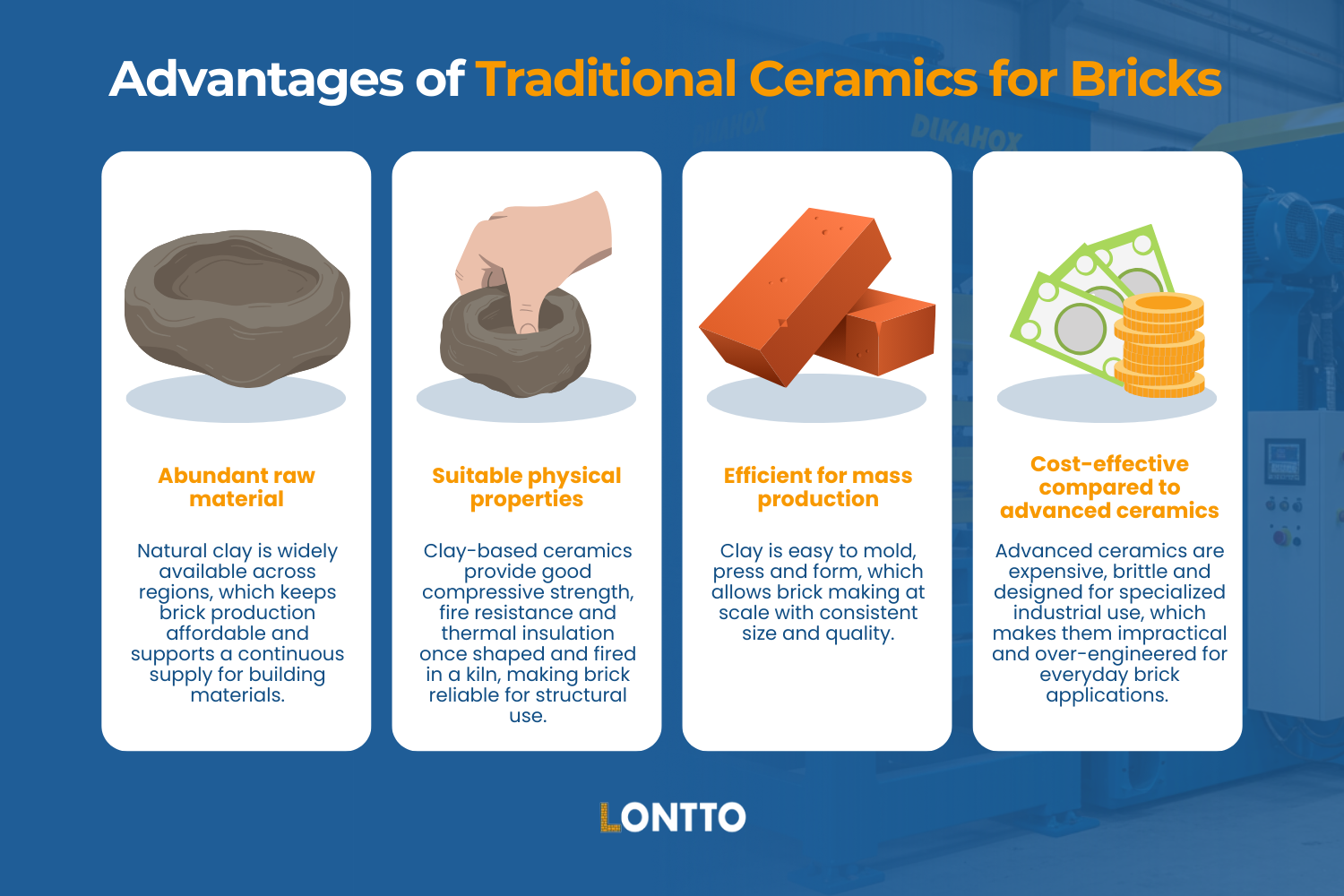
Les céramiques traditionnelles fabriquées à partir d'argile restent le choix standard pour les production de briques parce qu'ils offrent un équilibre entre le coût, la performance et la praticité pour une utilisation à grande échelle dans le domaine de la construction. Les avantages sont les suivants :
- Matière première abondante : L'argile naturelle est largement disponible dans toutes les régions, ce qui maintient la production de briques à un prix abordable et favorise un approvisionnement continu en matériaux de construction.
- Propriétés physiques appropriées : Les céramiques à base d'argile offrent une bonne résistance à la compression, une bonne résistance au feu et une bonne isolation thermique une fois façonnées et cuites dans un four, ce qui rend la brique fiable pour une utilisation structurelle.
- Efficace pour la production de masse : L'argile est facile à mouler, à presser et à former, ce qui permet de fabriquer des briques à l'échelle avec une taille et une qualité constantes.
- Coût avantageux par rapport aux céramiques avancées : Les céramiques avancées sont coûteuses, fragiles et conçues pour un usage industriel spécialisé, ce qui les rend peu pratiques et trop techniques pour les applications quotidiennes de la brique.
Matériaux céramiques utilisés dans les types de briques
Les différents types de briques reposent sur des matériaux céramiques et des compositions d'argile spécifiques pour obtenir la résistance, la durabilité et les performances requises pour l'utilisation prévue dans la construction. Voici un guide rapide des propriétés des différents types de briques. types de briques.
| Type de brique | Briques communes rouges/de parement | Ingénierie/Briques denses | Briques de schiste |
|---|---|---|---|
| Matériaux/types d'argile | Argiles de surface (argiles communes riches en fer), souvent avec des additifs de silice/sable | Argiles réfractaires (plus d'alumine, moins d'impuretés), parfois mélangées à des argiles de surface | Schistes (argiles sédimentaires compactes, souvent riches en fer) |
| Caractéristiques principales | Poreux à semi-vitreux, bonne résistance à la compression, abordable | Dense, peu poreux, très résistant et durable | Surface dense et texturée, solide et résistante aux intempéries |
| Température de cuisson | 1 650 °F à 2 010 °F (900 °C à 1 100 °C) | 2 010 °F à 2 190 °F (1 100 °C à 1 200 °C) | 1 830 °F à 2 190 °F (1 000 °C à 1 200 °C) |
| Couleur/apparence | Argile rouge (à partir d'oxyde de fer) | Bleu/gris, chamois ou multicolore | Varié (rouge, brun, texturé) |
| Utilisations typiques | Murs de construction générale, parement | Couches portantes, couches anti-humidité, trous d'homme | Pavage, murs à haute durabilité |
Le processus de fabrication des briques
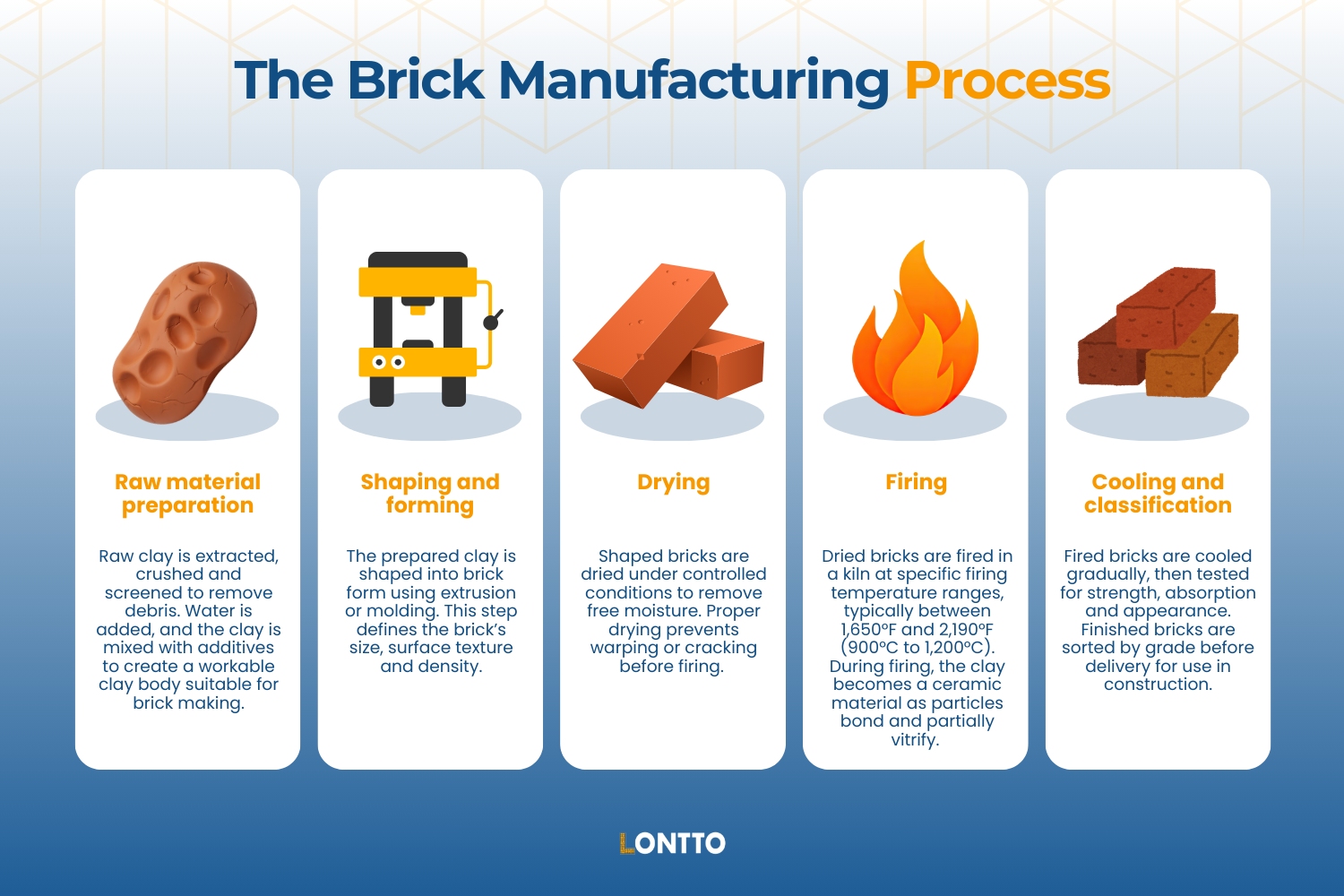
La fabrication de briques transforme l'argile brute en une brique céramique finie grâce à un processus contrôlé en plusieurs étapes qui améliore la résistance, la durabilité et la cohérence. Chaque étape prépare le matériau argileux pour l'étape suivante et influe directement sur la qualité de la brique finale.
- Préparation des matières premières : L'argile brute est extraite, concassée et tamisée pour éliminer les débris. De l'eau est ajoutée et l'argile est mélangée à des additifs pour créer une masse d'argile facile à travailler et adaptée à la fabrication de briques.
- Façonner et former : L'argile préparée est façonnée en forme de brique par extrusion ou moulage. Cette étape permet de définir la taille, la texture de la surface et la densité de la brique.
- Séchage : Les briques façonnées sont séchées dans des conditions contrôlées afin d'éliminer l'humidité libre. Un séchage adéquat permet d'éviter les déformations ou les fissures avant la cuisson.
- Tir : Les briques séchées sont cuites dans un four à des températures spécifiques, généralement comprises entre 900 °C et 1 200 °C. Pendant la cuisson, l'argile devient un matériau céramique car les particules se lient et se vitrifient partiellement.
- Refroidissement et classification : Les briques cuites sont refroidies progressivement, puis testées en termes de résistance, d'absorption et d'apparence. Les briques finies sont triées par catégorie avant d'être livrées pour être utilisées dans la construction.
Additifs pour le renforcement des briques
La fabrication des briques fait souvent appel à des additifs pour améliorer les performances tout en conservant l'argile comme matériau céramique de base. Ces ajouts modifient le retrait, la résistance, la couleur et le comportement à la cuisson sans modifier les céramiques traditionnelles utilisées pour la fabrication des briques.
- Sable ou quartz : Ajouté à la masse d'argile pour réduire le retrait pendant le séchage et la cuisson, ce qui réduit le risque de fissuration et aide les briques à conserver leur forme dans le four.
- Composés de chaux et de fer : La chaux améliore la durabilité et la stabilité de la cuisson, tandis que l'oxyde de fer renforce la brique et produit une coloration rouge, brune ou noire après la cuisson.
- Variations des matériaux modernes : Certains fabricants mélangent des cendres volantes au mélange d'argile, notamment dans le cadre d'une production à grande échelle, mais la brique reste fabriquée à partir d'argile ou de schiste plutôt que de matériaux non céramiques.
Ces additifs renforcent la résistance et la consistance tout en préservant les propriétés qui font que les céramiques traditionnelles peuvent être utilisées dans la production de briques.
Quand les céramiques de pointe sont utilisées dans les briques
Les céramiques avancées ne sont utilisées dans les applications de briques que dans des environnements industriels étroits, et non dans la construction standard. Ces briques sont fabriquées à partir de matériaux céramiques haute performance qui leur permettent de résister à une chaleur extrême, à une exposition chimique et à des chocs thermiques que les briques ordinaires à base d'argile ne peuvent supporter. Les matériaux céramiques avancés comprennent par exemple des composés à haute teneur en alumine ou du carbure de silicium.
Ce type de brique est utilisé dans les fours, les fourneaux, les chaudières, les incinérateurs et les équipements de traitement chimique qui fonctionnent à des températures élevées. Les bâtiments résidentiels et commerciaux n'ont pas besoin de ce niveau de performance.
Quel type de céramique est utilisé pour la fabrication des briques ?
Quels sont les autres types de céramiques ?
La céramique traditionnelle comprend la faïence, le grès et la porcelaine, tous fabriqués à partir d'argile cuite dans un four. Ces matériaux sont utilisés pour fabriquer briques, Les produits de l'industrie de l'acier sont les suivants : la céramique, la poterie, les carreaux et les articles ménagers.
Les céramiques avancées sont des matériaux techniques tels que l'alumine ou le carbure de silicium, conçus pour un usage industriel nécessitant des températures élevées, une résistance à l'usure ou une stabilité chimique, plutôt que pour la construction générale.
À quoi servent les céramiques ?
Les céramiques sont utilisées pour fabriquer des briques, des tuiles, des poteries, des pièces en porcelaine, des appareils sanitaires, des réfractaires et des composants industriels, car les matériaux à base d'argile peuvent être façonnés, séchés et cuits pour gagner en solidité, en résistance à la chaleur et en durabilité à long terme.
Le béton est-il une céramique ?
Les briques en béton ne sont pas des céramiques. Bien que les produits en béton et en céramique puissent se ressembler à l'usage, le béton est fabriqué à partir de ciment, d'agrégats et d'eau, et non d'argile cuite. Les céramiques sont définies par de l'argile façonnée et cuite dans un four, tandis que le béton durcit par durcissement chimique à température ambiante.
Peut-on fabriquer des briques à partir de matériaux recyclés ?
Oui, certaines briques sont fabriquées à partir de matériaux recyclés, mais elles reposent toujours sur l'argile en tant que matériau principal. Des additifs recyclés tels que des cendres volantes, des briques concassées ou des sous-produits industriels peuvent être combinés à d'autres argiles pour améliorer la résistance ou réduire les déchets.
Même avec un contenu recyclé, ces briques restent des céramiques traditionnelles car le mélange d'argile est façonné et cuit, ce qui définit le processus de fabrication des briques en céramique.
Retour en haut de la page : Quel type de céramique est utilisé pour fabriquer des briques ?

Je m'appelle Chao Zhang et je travaille dans l'industrie de la fabrication de briques depuis plus de 10 ans. J'ai une connaissance approfondie et des recherches sur différents modèles de machines de fabrication de blocs, en particulier les machines automatiques à fabriquer des briques, les machines à fabriquer des blocs de béton, les machines à fabriquer des blocs de terre comprimée, les machines à fabriquer des briques d'argile, les machines à fabriquer des briques de ciment. J'ai une connaissance particulière de ce secteur. Je peux aider mes clients à choisir la machine à briques appropriée et les assister dans la conception et la construction d'une usine de production de briques. Si vous voulez tout savoir sur les machines à fabriquer des briques, n'hésitez pas à me contacter. Je me ferai un plaisir de vous aider.

 Contact
 Devis
Devis Appelez-nous