
 EN
EN  FR
FR  RU
RU  ES
ES 

 Fast Delivery


 Get Machine Pricing
Concrete quality depends on scale accuracy in every batching cycle. The calibration procedure of concrete batching plant scales defines how operators verify load-cell response, correct zero drift, and confirm tolerance compliance under controlled conditions.
Even minor deviations in weighing alter the water-cement ratio and affect compressive strength results. Electronic scales and flowmeters lose precision over time; documented recalibrations protect mix performance and support audit readiness. A structured concrete batching plant scales calibration program also reduces material loss and unplanned stoppages.
Calibration System for Concrete Batching Plant Scales

A defined calibration system governs how operators verify the accuracy of the batch plant scale under operating loads. In this review, we evaluate the integration of advanced weighing systems with concrete batching plant scales, linking scale diagnostics directly to the central control interface.
The control panel guides technicians through each adjustment step with clear parameter feedback. That configuration limits manual intervention and improves traceability. Service documentation advises plants to inspect scale assemblies and recalibrate every 6 months to control drift and maintain tolerance compliance.
The calibration procedure includes:
- Isolate the batching plant and prepare certified reference loads.
- Zero each scale to establish an accurate baseline.
- Apply known loads at defined test points across the weighing range.
- Record indicated values against actual loads and calculate deviation.
- Adjust span and linearity parameters within the control system.
- Re-test scales until readings fall within specified tolerances.
- Confirm scale performance through controlled trial batches.
Preparing the Concrete Batching Plant Scales for Calibration
Preparation sets the reference condition for any batching plant scale calibration procedure. Technicians remove the plant from service and secure all energy sources before beginning scale checks.
A clean, unloaded structure allows the plant’s weighing systems to establish accurate zero values before span verification. Mechanical resistance within a hopper frame or along a conveyor can introduce force distortion, which is why technicians confirm unrestricted movement at each support location.
Preparation steps include:
- Isolate electrical and pneumatic power sources using lockout and tagout devices.
- Discharge residual material from weigh hoppers and dosing tanks.
- Confirm unrestricted travel of gates, belts, and skip mechanisms.
- Examine load cell mounts, signal wiring, and display modules for defects.
Setting Zero and Checking Stability
Accurate zeroing establishes the reference point for every batch measurement. Each scale must reach a stable baseline before technicians apply certified test loads.
Operators monitor the display under normal operating conditions and confirm that no residual force affects the structure. Any fluctuation at zero signals a mechanical or electrical issue that requires correction before further calibration steps continue.
Zero-setting and stability checks include:
- Empty each scale and set the indicator to zero.
- Observe the zero reading for a defined time interval.
- Identify drift beyond tolerance limits.
- Inspect for mechanical friction or structural restriction.
- Evaluate vibration from adjacent equipment.
- Verify the presence of electrical noise or temperature influence.
Selecting Test Points and Reference Loads
Selecting appropriate checkpoints determines how effectively a scale’s full capacity is evaluated. Defined load percentages reveal deviation patterns that affect measurement accuracy across the weighing range.
Calibration practice follows the Rule of Ten, maintaining a test-uncertainty ratio of 4:1 or 10:1 so that reference standards remain significantly more precise than the device under test. Most concrete batching plant scales target an accuracy of around 0.5%. Therefore, certified weights must carry substantially tighter tolerances to prevent error masking. Technicians record each nominal reference value before applying the load so that the results remain traceable.
Test point and reference load selection includes:
- Define load checkpoints at fixed capacity percentages such as 0%, 20%, 40%, 60%, 80% and 100%.
- Select certified test weights with a tolerance substantially tighter than 0.5% of the applied load.
- Record nominal reference values on the official calibration sheet before testing.
Applying Test Loads and Recording Readings
Applying certified loads verifies the accuracy with which raw materials are measured by weight within the batching system. Technicians place each reference weight on the scale in ascending order, beginning at the lowest defined test point.
After the indicator stabilizes, operators document the displayed value to establish traceable calibration results. Technicians then remove the loads in reverse sequence and record readings again to detect hysteresis or mechanical lag.
Accurate records confirm that the scales for the concrete batching plant maintain correct proportions during dosing. The finished concrete is measured by weight within specified tolerances.
Adjusting Span and Linearity
Adjusting span and linearity corrects systematic deviation identified during the calibration procedure of concrete scales. Technicians quantify error at each checkpoint before modifying controller parameters.
Controlled adjustments protect tolerance compliance and support reliable batching performance. Verified calibration results confirm that corrections hold across the full weighing range.
Adjustment steps include:
- Calculate error at each test point as the displayed value minus the certified reference value.
- Express each deviation as a percentage of rated capacity.
- Adjust span or multi-point linearization parameters within the indicator or controller.
- Repeat loading and unloading cycles until all checkpoints meet the required tolerance.
Calibrating Aggregate Scales
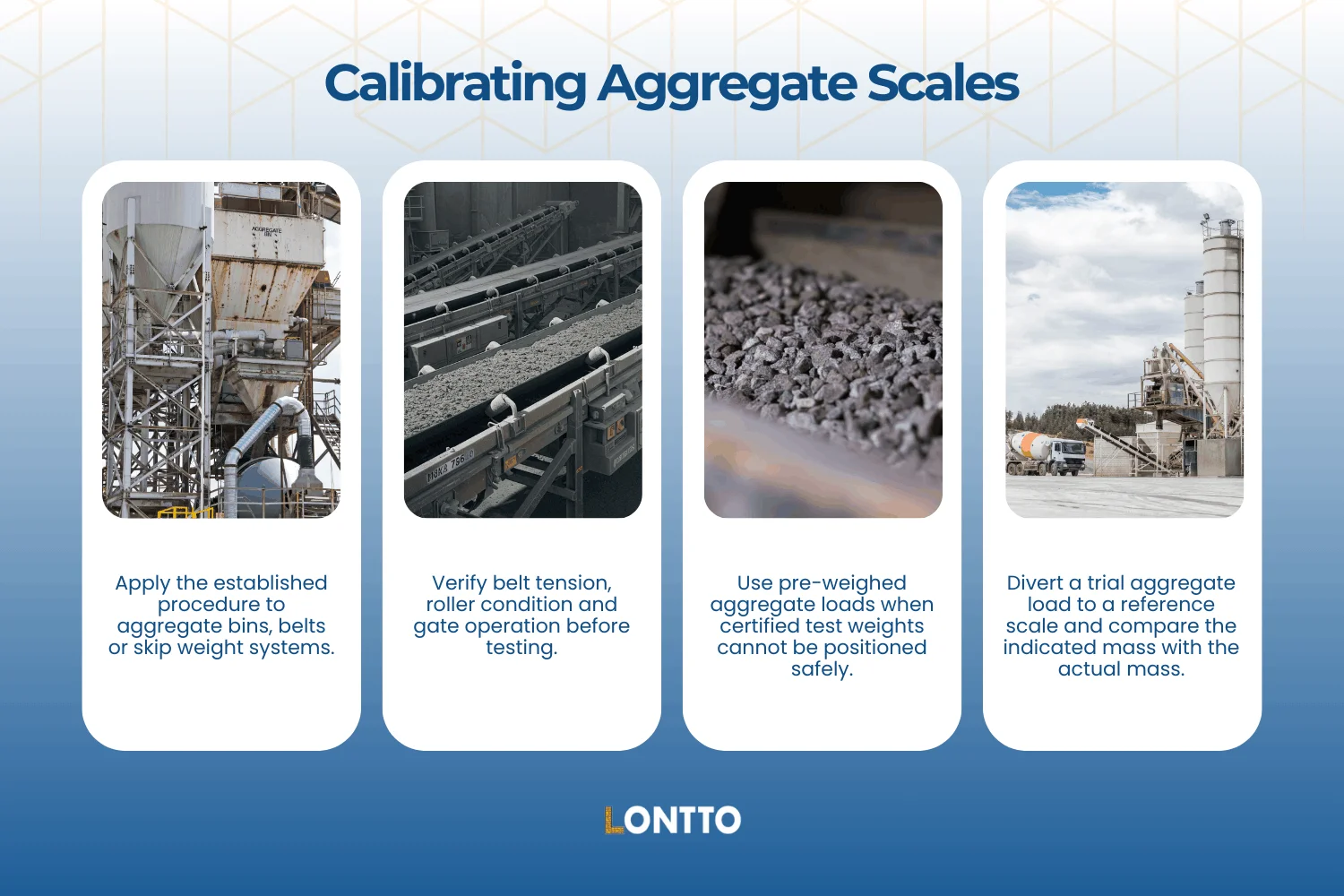
Aggregate calibration verifies that concrete plant scales measure bulk material accurately before each batch of concrete enters the mixer.
Proper aggregate dosing supports on-site concrete production, including mobile or portable plants. Technicians complete defined scale checks before confirming performance against a reference standard.
Aggregate calibration steps include:
- Apply the established procedure to aggregate bins, belts, or skip weight systems.
- Verify belt tension, roller condition, and gate operation before testing.
- Use pre-weighed aggregate loads when certified test weights cannot be positioned safely.
- Divert a trial aggregate load to a reference scale and compare the indicated mass with the actual mass.
Calibrating Cement Scales
Cement scale calibration controls the accuracy of the material used in the concrete during batching.
Because cement proportioning directly influences concrete quality, technicians apply tighter tolerances than those applied to aggregate systems. Controlled isolation prevents external forces from distorting load readings during verification.
Cement scale calibration steps include:
- Apply the established calibration procedure to the cement weigh hopper.
- Isolate aeration systems, vibrators, and silo discharge valves before testing.
- Use certified test weights or pre-weighed cement loads at defined checkpoints.
- Confirm that the final measurement error remains within the specified cement tolerance.
Calibrating Water and Admixture Systems
Calibrating liquid systems verifies that each cycle dispenses the correct volume required for mix design compliance.
Precise adjustment of water meters, admixture dispensers, and supporting controls protects accurate dosing across production shifts. Verified moisture probes confirm that total water content remains within specified limits before batching continues.
Water and admixture calibration steps include:
- Apply the load, record, and adjust routine to water weight hoppers using measured water as the reference.
- Run known volumes through water meters into a calibrated container and compare the indicated volume with the actual volume.
- Adjust flowmeter or controller parameters to correct the deviation.
- Deliver repeated small doses from admixture dispensers into a measuring cylinder or onto a precision scale.
- Modify dosing settings until each measured volume falls within the required tolerance.
Verifying Calibration with Trial Batches
Trial batching confirms that completed adjustments translate into correct mix behavior under production conditions.
Independent verification validates material proportioning before the plant resumes full operation. Consistent physical properties demonstrate that calibrated systems support optimal performance during routine batching.
Verification steps include:
- Produce trial concrete batches using a standard approved mix design.
- Measure the masses or volumes of ingredients from the trial batch using a reference scale or calibrated container.
- Compare recorded values with programmed setpoints in the control system.
- Evaluate slump or other specified properties to confirm mix behavior matches design requirements.
Acceptance Criteria and Re‑Calibration Triggers
Defined limits determine whether each scale meets industry standards and project-specific requirements. Documented tolerances and trigger events also establish the required batching plant calibration frequency under operating conditions.
State Departments of Transportation (DOTs) may impose stricter intervals, and DOTs may require recalibration to be performed more frequently after relocation, load-cell replacement, or major service affecting weighing accuracy.
Acceptance and recalibration steps include:
- Define numerical tolerances for aggregate, cement, water, and admixture scales that determine pass or fail status.
- Inspect and repair mechanical or electrical components if a scale cannot meet the assigned tolerance.
- Repeat calibration after plant relocation, load-cell replacement, or any significant maintenance that affects weighing accuracy.
Recording Calibration Results and Labelling Scales
Accurate documentation supports traceability during an audit and provides evidence for an inspector during the plant inspection. Proper record control confirms that calibration activities are maintained, made available for review, and provided to the inspector without delay.
Documentation and labeling steps include:
- Complete calibration records for each scale, including test points, reference loads, indicated readings, calculated errors, and final status
- Record any parameter changes made to indicators or controllers during adjustment.
- Affix a label to each scale showing calibration date, responsible technician, and next due date.
- Store paper or digital records in a controlled system for retrieval during inspection or audit.
Daily Operational Verification and Scale Stability Log
Daily verification protects weighing accuracy across the entire operation and identifies instability before production is affected.
Important daily verification steps include:
- Confirm load cell mounts are secure and signal wiring shows no fraying or moisture ingress.
- Ensure the floating hopper has no contact with the plant frame and no aggregate lodged in clearance gaps.
- Verify the digital display returns to zero within one graduation after each discharge cycle.
- Check that no hardened material accumulates on weigh hoppers or scale arms.
- Monitor digital weight indicators for drift or erratic fluctuation.
- Confirm hoses and cables remain slack and do not apply external force.
- Ensure discharge gates close fully and prevent residual flow.
- Initiate recalibration after installing replacement load cells or modifying scale accessories to maintain weighing stability.
Lontto Pro Tip
If digital weight indicators start “hunting” — also known as signal jitter or display noise — where numbers continuously fluctuate without a load change, investigate electrical interference first.
Nearby radio transmitters, variable frequency drives, or poor grounding can introduce noise into the load cell circuit. Inspect grounding connections and shielded cable integrity before adjusting calibration settings, since electronic noise often causes unstable scale readings.
With over 30 years of experience, Lontto knows the ins and outs of concrete batching plants. The company designs and manufactures plants with integrated weighing and control systems used in real production environments.
If you’re setting up a new concrete production facility or scaling an existing operation, speak with the Lontto team for guidance on batching plant systems and automation options that match your production targets.
Concrete Batching Plant Scales Calibration FAQs
How does environmental loading from wind or rain affect outdoor scale accuracy?
Wind can apply a vertical force that digital weight indicators interpret as added material weight. Rainwater pooling on a hopper creates a tare offset and prevents proper zero return. During storms, technicians should inspect weather shields and confirm that no shroud contacts the hopper, thereby restricting movement.
Can a scale be calibrated if load cells are unmatched or have different capacities?
No, for calibration to remain valid across the entire operation, all replacement load cells on one hopper must have identical mV/V sensitivity and rated capacity. Mismatched cells distort corner-load balance and create position-dependent error.
What is the difference between static calibration and in-motion compensation?
Static calibration verifies the accuracy of the dead-weight using certified loads. In-motion compensation adjusts software timing to account for material still falling after gate closure. A scale can pass weight testing, yet still over-batch if discharge timing is not corrected.
Back to Top: Calibration Procedure of Concrete Batching Plant Scales

I am Chao Zhang, I have been working in the brick making industry for over 10 years. I have a deep understanding and research on various models of block making machines, especially automatic brick machines, concrete block machines, compressed earth block machines, clay brick machines, cement brick machines. I have a special understanding of this industry. I can help my clients choose the suitable brick machine and assist them in designing and building a brick production factory. If you want to know everything about brick making machines, please contact me. I am happy to help you.

 Contact Us
 Price Quote
 Call Us