
 EN
EN  FR
FR  RU
RU  ES
ES 

 Fast Delivery


 Get Machine Pricing
Wall foundation choice shapes structural performance from the first pour. A poured concrete wall can carry heavy loads with fewer joints, while a cinder block wall depends on unit alignment and mortar quality for consistent support. Material choice also affects moisture movement and future repair exposure across the full wall system.
Construction methods change how each wall comes together on-site. Poured concrete walls use a liquid mix placed into temporary forms, then cured in one continuous section. Block walls use precast units, and each concrete block is stacked in courses before crews fill joints with mortar.
We’ll compare each wall type in strength and water resistance. The comparison also covers cost, build time, and the construction method behind each system. Supply chain planning and equipment needs also shift because formed concrete and block installation rely on different labor flow.
What Are Poured Concrete Walls?
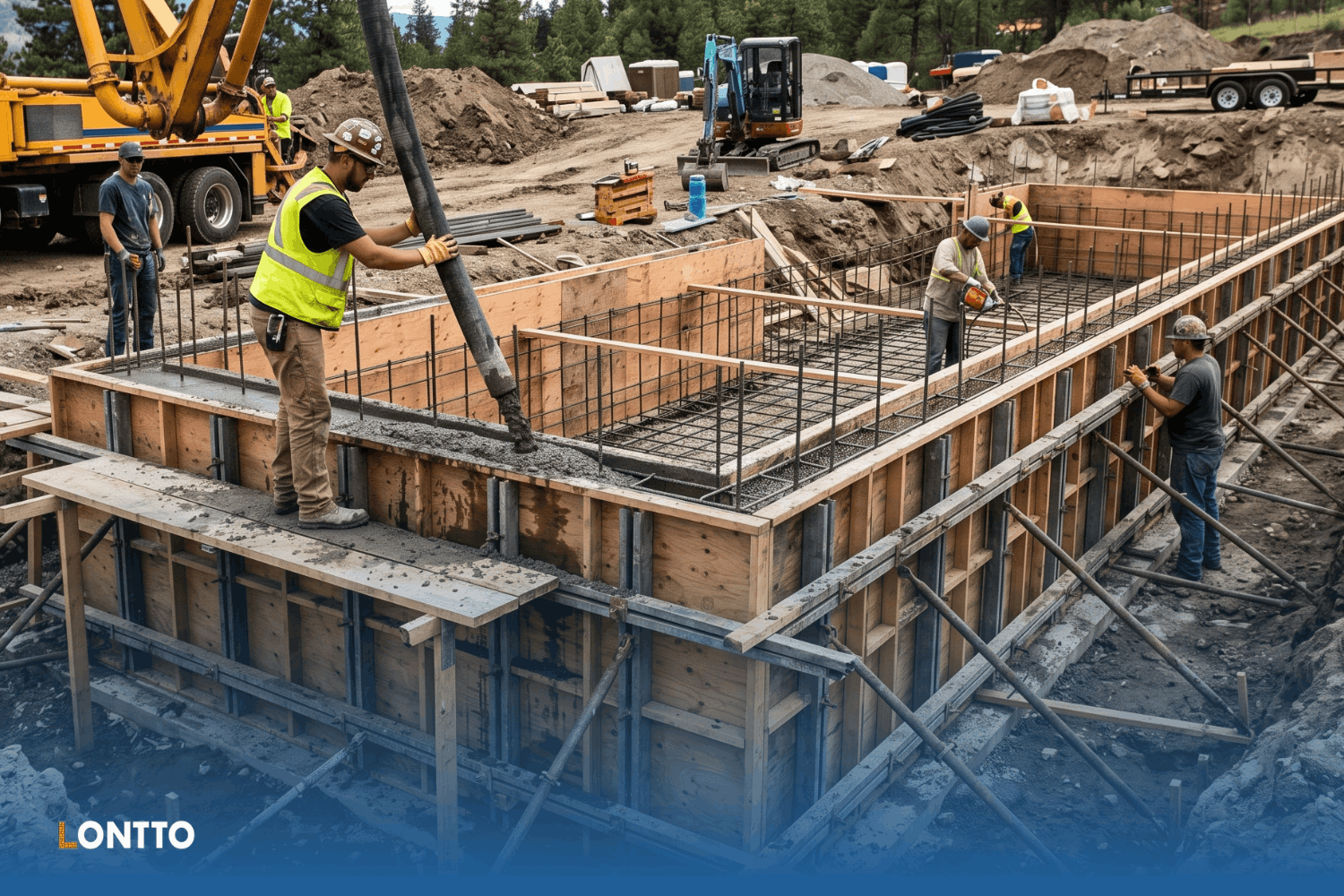
Poured concrete walls are made from cement, sand, gravel, and water in a specified ratio. They’re formed on-site as the concrete mix is poured into forms and hardens into a single wall section with continuous strength.
A poured concrete foundation belongs to the cast-in-place category, which sets it apart from precast panels made at another location. As the concrete fills the form shape before it sets, poured concrete walls allow for more complex geometry than many prefabricated systems.
Construction leaves little room for late changes. Post-pour cutting or coring is possible, but the work usually requires specialized tools and engineering approval, which makes changes more complex and more costly than pre-pour adjustments.
Most poured walls are 8 to 10 inches thick, though exact dimensions depend on the project and the engineering plan. Rebar size and placement also follow structural specifications, and longer wall runs may still require a control joint.
Poured wall construction relies on local ready-mix suppliers and pump truck availability, so builders don’t control every part of the schedule. Mix consistency and delivery timing can affect labor flow, which makes planning just as important as placement.
What Are Block Walls?
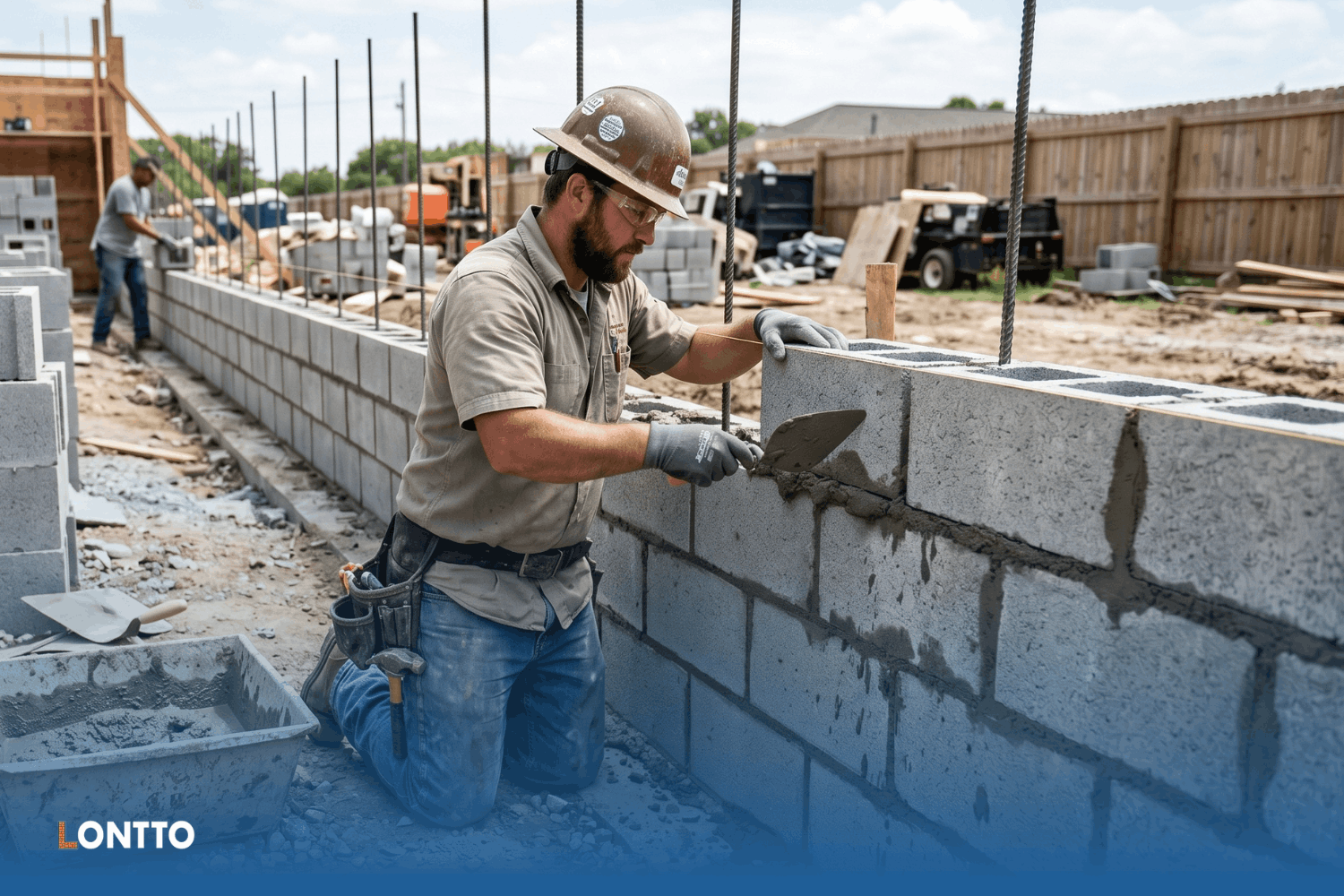
Block walls are foundation walls built by stacking precast concrete masonry units (CMUs). Mortar bonds each unit in place, so the wall forms as an assembled structure rather than a single pour. CMU construction belongs to the masonry category, which separates it from cast-in-place concrete and precast panel systems.
Each block starts as a hollow unit made with a brick machine. Manufacturers can produce concrete masonry units in a plant, or crews can make them on-site with a mobile machine. The production method gives builders more control over unit supply, which can simplify scheduling on jobs that need a steady material flow.
Standard block size is 8 inches by 8 inches by 16 inches, though machine setup and mold design can support other dimensions. Crews usually stack units in a running bond layout, while mortar joints hold alignment and transfer load between courses.
Wall strength depends on the reinforcement choices made during installation. Hollow cores can take grout and rebar for added capacity, but some walls remain partially grouted or ungrouted. Lower reinforcement usually means lower load ratings, so structural performance changes with the wall specification.
Need to Produce Blocks at Scale?
Our block making machines are built for commercial and industrial production. Get expert advice and a custom price quote — we respond within 24 hours.
Head-to-Head Comparison: The Main Differences
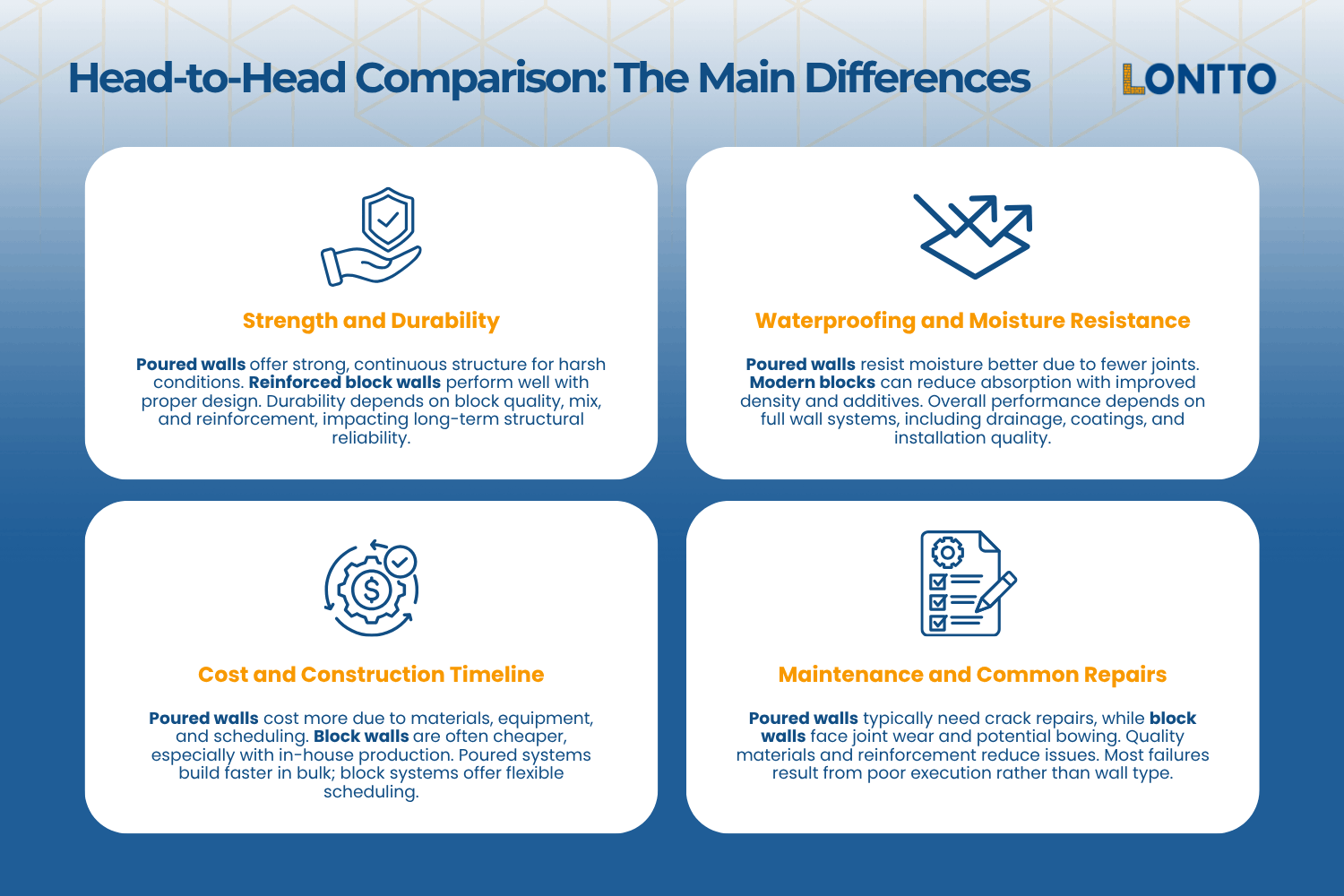
Block walls vs poured walls have distinct differences that make each one suited for different uses. Here’s how they compare in strength and durability, moisture resistance, cost, timeline, and maintenance.
Strength and durability
Poured walls usually provide higher lateral strength under harsh site conditions. A poured wall often suits high water tables or unstable soils because the wall cures as one continuous section. Reinforced block walls can still perform at a similar level for many residential and light commercial jobs when grout and rebar follow the engineering plan.
Block quality affects wall durability. Modern machine-made units can reach higher compressive strength than many commodity blocks, though results still depend on mix design and aggregate quality. Poor unit density or uneven dimensions can weaken cinder block foundations, which raises the risk for builders who buy inconsistent material.
Reinforced block systems offer a practical alternative to poured walls, especially when the builder manages block quality in-house. A concrete retaining wall also depends on the same principle because reliable units and correct reinforcement support better wall performance over time.
Waterproofing and moisture resistance
Poured walls are usually easier to waterproof because the surface has fewer joints. Lower permeability helps a poured wall stay dry more easily than a standard block wall under similar site conditions. Exact moisture performance still varies with mix density and coatings, so installation quality remains important.
Modern block production can narrow the moisture gap. Brick machines can produce denser units with lower absorption, especially when the mix includes water repellents or finer aggregate control. Many contractors treat the wall as waterproof when crews pair an exterior drainage membrane with interior drain tile and a parge coat.
Moisture control depends on the full wall assembly, not only the block. The permeability gap between poured and block walls is real, though the difference becomes more manageable with better unit quality and a correct waterproofing specification.
Cost and construction timeline
Poured walls often land at the higher end of project cost. Ready-mix delivery, pump rental and formwork all add cost, while scheduling dependencies can push labor expenses higher. Block walls are often cheaper to build on a per-square-foot basis, especially when the builder produces units in-house.
In-house production changes the cost structure. A brick machine turns blocks from purchased material into a manufactured asset, which can reduce material cost across repeated projects. Savings vary by labor rates and local supply, though on-site production often creates a lower wall cost than poured construction.
Schedule control also differs between the two systems. Poured walls can move quickly on large and simple runs once forms and crews are ready, but timing still depends on ready-mix availability and weather conditions. Block walls can be phased with more flexibility when block supply stays under the builder’s control, though masonry speed still depends on crew productivity.
Maintenance and common repairs
Poured wall repairs often start with shrinkage cracks. Crews can usually address those cracks with epoxy injection or carbon fiber reinforcement, depending on the crack width and structural movement. Block walls face different repair needs because mortar joints can deteriorate over time and unreinforced sections are more prone to bowing.
Stair-step cracks also appear more often in block construction. High-quality machine-made units with tight dimensional control can reduce uneven mortar joints, which helps lower that risk from the start. Reinforcement at regular intervals or grouted cores can also prevent many common failure points in block wall systems.
Most block wall failures come from execution problems, not the format. Poor unit quality or inconsistent mason work usually creates more trouble than the basic wall type itself. A builder who controls block production can manage one major variable before installation begins.
Which One Should You Choose?
The best wall system depends on site conditions and how you plan to build. Structural demands usually point the decision first, while production control and scheduling shape the better long-term fit for the job.
When to choose block walls
Block walls fit projects where cost control and supply flexibility matter most. Builders who produce their own units can manage material quality more directly, while stored inventory supports multiple active jobs without the one-pour scheduling limits common to poured work. In-house production also creates a path into the concrete products market for contractors who want to sell blocks to other crews.
Return on investment also improves when project volume stays consistent. Contractors with steady demand often find that block production creates better cost control than buying every unit or relying only on subcontracted ready-mix. Careful review of your market and machine utilization will show whether block walls are the right choice for your operation.
When to choose poured walls
Poured walls make more sense when site pressure drives the decision. A poured wall usually suits a high water table or unstable clay, especially when the engineering plan calls for a monolithic foundation type. A poured wall can also simplify moisture control in a basement where water pressure and vapor management matter more than production flexibility.
Some builders also use poured walls as part of a hybrid plan. Poured construction can handle demanding below-grade work, while machine-made blocks support above-grade walls and retaining applications with more flexibility. The combination can balance structural demands with better equipment use across a broader project pipeline.
Contact Lontto for expert guidance on concrete block production, foundation applications and equipment options that fit your project goals.
Poured Walls vs Block Walls FAQs
Does wall type affect thermal performance or insulation requirements?
Neither wall system adds much insulation by itself. Poured concrete and concrete block both transfer heat easily, so either option usually needs added insulation to meet current energy codes. Rigid foam, spray foam, or a framed wall with batt insulation can all work, but the assembly design and local code matter more than the wall type alone.
How does climate affect the long-term performance of each wall type?
Climate mainly changes how much moisture stress the wall must handle over time. In freeze-thaw regions, water that enters a block wall through mortar joints can freeze and expand, which speeds up joint wear and surface damage. Poured walls have fewer paths for water entry, so they are generally less vulnerable to that cycle, though both systems perform better with proper drainage and an air-entrained concrete mix.
Does the foundation wall type influence a property’s resale value or appraisal?
Wall type alone rarely changes an appraisal, but visible condition often does. A block wall with bowing, stair-step cracks or deteriorated mortar can raise concerns for buyers, inspectors and lenders during a sale. Foundation problems of any kind can reduce home value by about 10 to 15% and block wall damage is often easier to spot during a walkthrough than minor shrinkage cracks in a poured wall.
Back to Top: Poured Walls vs Block Walls: What’s the Difference?

Speak To Our Brick Machine Expert
Get in touch with our nice team today to get a price estimate for a block machine.

I am Chao Zhang, I have been working in the brick making industry for over 10 years. I have a deep understanding and research on various models of block making machines, especially automatic brick machines, concrete block machines, compressed earth block machines, clay brick machines, cement brick machines. I have a special understanding of this industry. I can help my clients choose the suitable brick machine and assist them in designing and building a brick production factory. If you want to know everything about brick making machines, please contact me. I am happy to help you.
 Price Quote
 Call Us