
 EN
EN  FR
FR  RU
RU  ES
ES 

 Fast Delivery


 Get Machine Pricing
A brick-making business converts raw materials such as cement, fly ash, or clay into structural units sold directly to construction supply chains. Profit margins depend on your production method, not just the industry.
Kiln-fired systems carry higher fuel exposure and initial costs, while machine-pressed production offers lower startup capital and more predictable operating costs. Both models serve real markets, but choosing between them early determines your capital structure, your cost per unit, and how quickly your brick manufacturing business reaches profitability.
Bricks vs. Blocks: What’s the Difference?
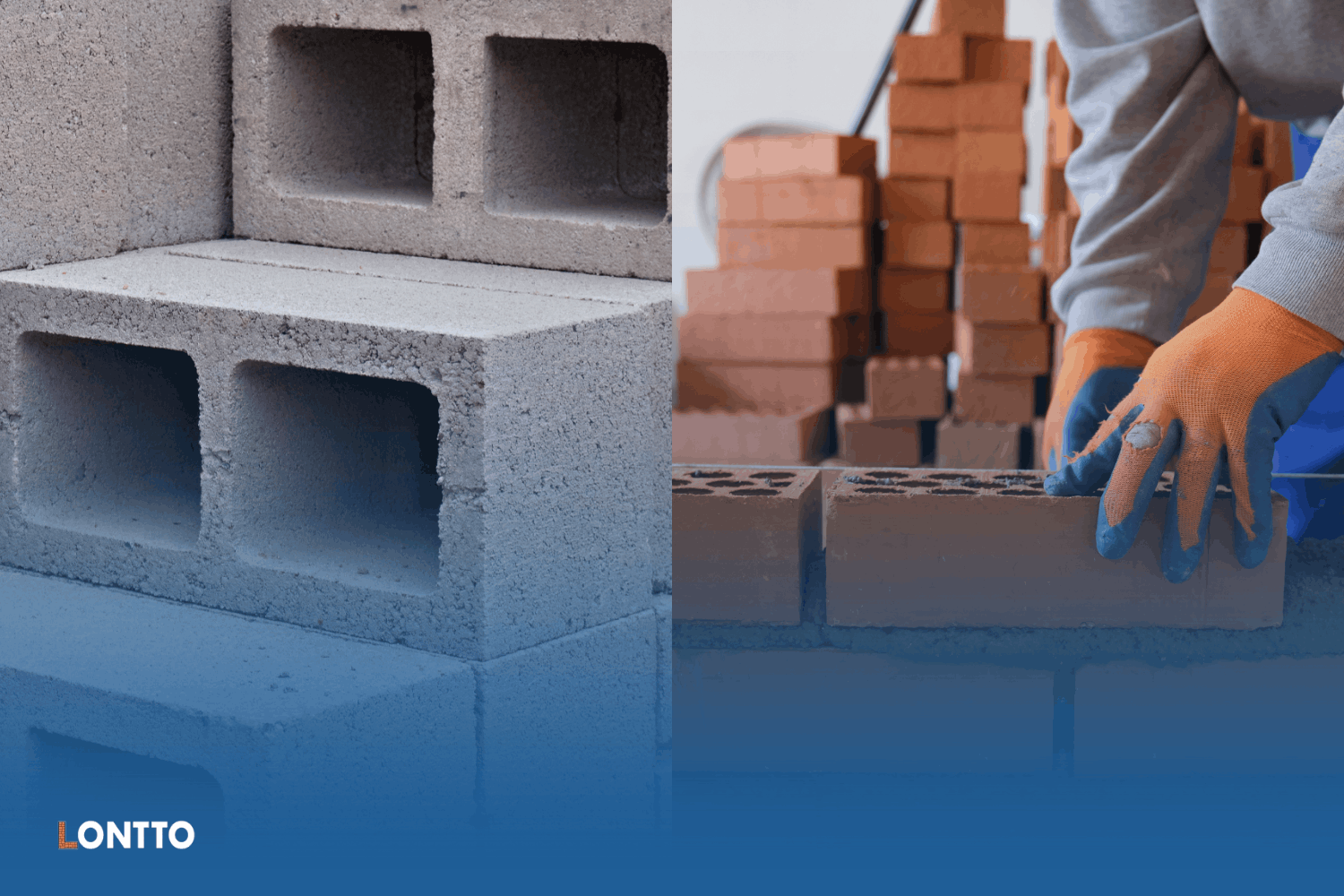
Clay bricks gain strength through heat, while cement-based bricks and concrete blocks gain strength over time. A kiln costs more to build than a brick-making machine, and a brick-making machine produces blocks faster than a kiln cycle allows.
| Factor | Clay Bricks | Cement and Fly Ash Bricks | Concrete Blocks |
|---|---|---|---|
| Raw material | Clay-bearing soil | Cement, fly ash, sand | Cement, aggregate, water |
| Production method | Kiln firing | Hydraulic pressing | Hydraulic pressing |
| Startup equipment | Kiln | Brick-making machine | Block-making machine |
| Strength source | Heat treatment | Curing period | Curing period |
| Common buyer | Traditional residential builders | Cost-conscious contractors | Commercial and infrastructure projects |
Is Brick Making a Profitable Business?
Brick making is a good business in markets with active construction demand, but profitability depends on three controllable factors. Production method, access to raw materials, and operational efficiency each affect your net margin more directly than industry conditions do.
- Production method: Machine-pressed brick production offers stronger cost control. Input costs for cement, fly ash, and sand are predictable, keeping margins consistent across output levels. Kiln-fired production introduces fuel as a variable cost, compressing margins sharply when energy prices rise.
- Raw material access: Producers located near aggregate suppliers or fly ash sources carry a structural cost advantage. Competitors farther down the supply chain cannot easily close that gap through pricing alone.
- Operational efficiency: A well-run block business maintains consistent quality and minimizes downtime. Every hour of unplanned stoppage increases your effective production cost per unit and narrows the margin on each brick you ship.
Kiln vs. Brick-Making Machine: Which Method is Right for You?
Your choice of method shapes every downstream decision, from land requirements and staffing structure to energy contracts and buyer segments. Understanding both models before you commit protects your capital and your brick-making business plan.
Kiln-fired production model
Kiln-fired production suits clay-rich regions where fired bricks dominate the local market. Infrastructure costs are front-loaded, with kiln construction or procurement accounting for a large share of your budget before a single brick is produced.
Fuel systems and drying infrastructure add further to that figure. Wood, coal, and gas consumption during the firing cycle create an ongoing cost that rises with output volume. Batch dependency adds another constraint: each cycle must complete before the next load begins, which caps daily throughput.
Entry-level clamp kilns sit at the lower end of the capital range. Higher labor demands and less consistent output quality make them harder to scale than more advanced systems.
Machine-pressed production model
Machine-pressed production suits urban and peri-urban markets where cement bricks, fly ash bricks, and concrete blocks meet most construction demand. Unlike kiln-based systems, the production line runs continuously, and output scales through machine upgrades rather than new civil infrastructure.
Curing replaces firing as the final step. Blocks and pressed bricks harden over 7 to 14 days in covered storage, removing fuel as an operating cost variable entirely. Manual, semi-automatic, and fully automatic configurations each carry a different capital threshold, giving you more entry points at different investment levels.
Kiln vs. Machine: A direct comparison
Machine‑pressed production eliminates kiln fuel dependency and scales through machine upgrades rather than new kiln infrastructure. Kiln‑fired production suits traditional clay markets but demands higher capital at an industrial scale and ongoing fuel management at every output level.
| Factor | Kiln-Fired | Machine-Pressed |
|---|---|---|
| Startup cost | High at an industrial scale | Varies by automation level |
| Primary operating cost | Fuel | Raw materials |
| Production style | Batch | Continuous |
| Output scalability | New kiln or kiln upgrade | Machine upgrade |
| Energy dependency | High | Low |
| Best market fit | Clay-rich traditional markets | Urban and peri-urban construction |
Need to Produce Bricks at Scale?
Our brick making machines are built for commercial and industrial production. Get expert advice and a custom price quote — we respond within 24 hours.
What Equipment Do You Need to Start a Brick-Making Business?
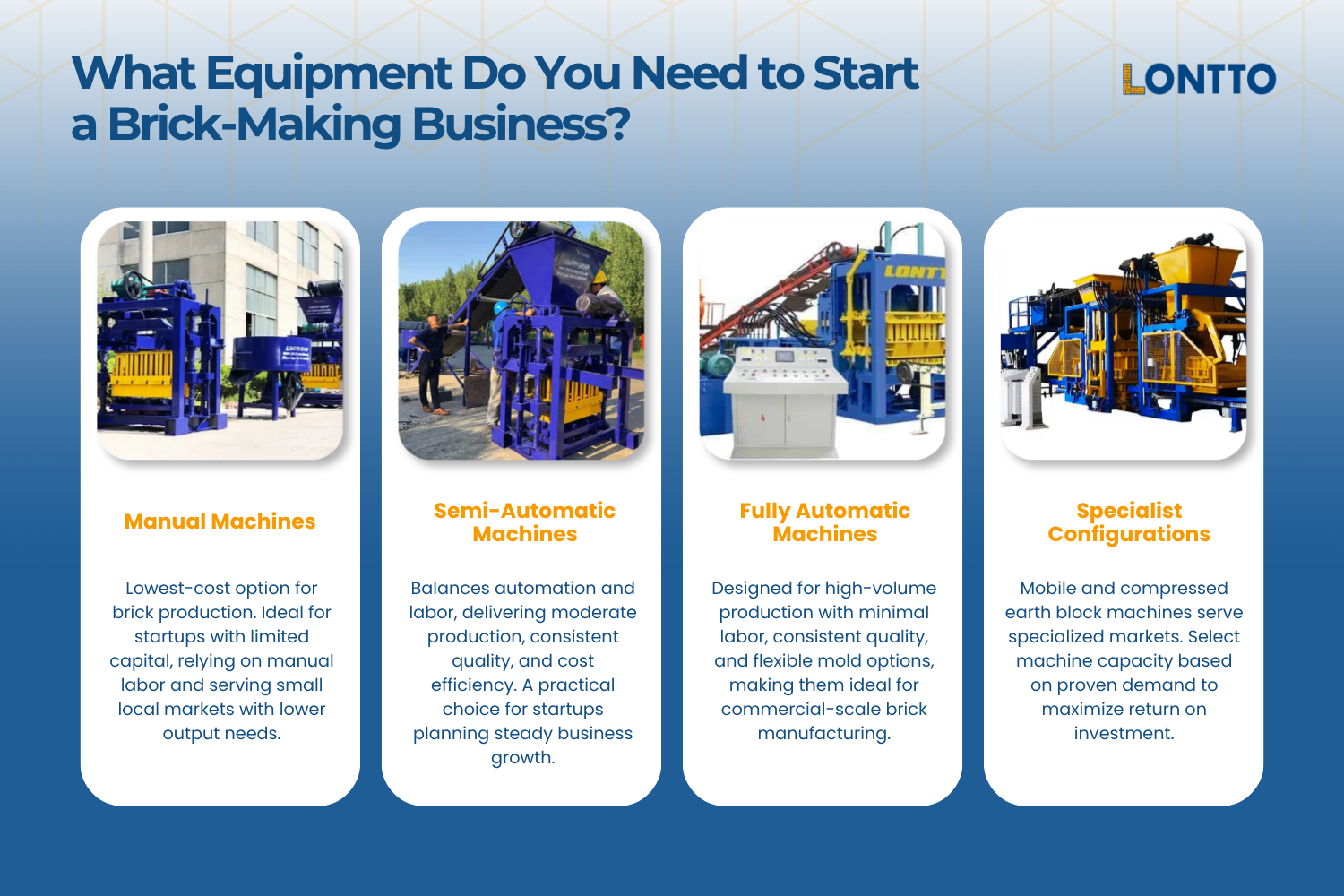
Machine selection determines your output ceiling, staffing model, and product range from day one. Three production tiers cover most startup scenarios, each with a different capital requirement and output potential.
Manual machines
Manual machines are the lowest-cost entry point into machine-pressed brick-making. More labor is required per unit, but initial costs remain low while you establish buyer relationships and validate local demand. Output volume is limited, making this configuration best suited to startups with modest capital and a tightly defined local buyer base.
Semi-automatic machines
A semi-automatic machine handles the pressing and ejection cycle mechanically, while operators manage material feeding and pallet handling. Around eight operators are typically needed to run a semi-automatic production line at full capacity. For most startups targeting moderate output, a semi-automatic block-making machine offers the best balance between product quality and operational cost.
Fully automatic machines
Fully automatic block production lines suit commercial-scale operations where output volume and consistent product quality are the primary objectives. At this tier, batching, mixing, pressing, and pallet handling integrate into a single production line that runs with around three skilled operators.
The higher initial investment is offset by lower per-unit labor cost and more stable output across long production runs. Concrete block making machines at this level support a wider product range through interchangeable molds. A single machine can cover hollow blocks, paving blocks, and curbstones.
Specialist configurations
Mobile configurations offer flexible deployment for sites with limited fixed infrastructure. A compressed earth block machine is also available for markets where soil-cement construction is in demand.
Match your machine capacity to your verified market volume, since over-investing in output you cannot sell delays your payback period without adding revenue.
Brick Making Business Startup Costs
A brick factory startup cost calculation covers more than the machine price. The core spending categories below apply across most markets and production models.
- Land and infrastructure: The right location reduces transportation costs and keeps your supply chain efficient. Your manufacturing plant needs space for a production area, raw material storage, a curing area, finished product stacking, and truck access. Leasing industrial land early preserves liquidity while you stabilize sales.
- Machinery: Your block machine or brick-making machine is your largest single startup expense. Manual setups carry the lowest initial cost. Fully automatic production lines require the highest initial investment but recover it faster through lower per-unit operating costs.
- Raw materials: Cement, fly ash, sand, and aggregate form the recurring input base. Proximity to reliable aggregate suppliers is one of the strongest cost advantages a manufacturing unit can have.
- Utilities: Three-phase electricity is standard for semi-automatic and fully automatic machines. Factor connection costs into your startup expenses if the site lacks existing infrastructure.
- Labor: Staff requirements vary directly with the level of automation. Plan your labor budget alongside your machine choice in the same calculation, not as a separate line item.
- Hidden costs: Business registration, permits, mold purchases, and working capital for the first production cycle are startup expenses that many detailed business plans underestimate. Register a business name early and set your business goals before committing to land. Treat building a factory as a full-budget exercise rather than a single equipment purchase.
How Much Profit Can You Make Per 1,000 Bricks?
Gross profit margins in brick manufacturing commonly range from 20% to 30%, with fly ash bricks and niche products reaching 40% to 50% in favorable markets. Production costs typically range from $0.35 to $0.90 per clay brick and from $0.70 to $0.90 per concrete brick, depending on region and input costs.
Using margin on selling price as the consistent measure, here is what those figures look like in practice:
- At a $0.50 cost per brick and a 25% gross margin, your selling price is $0.67, and your profit is roughly $170 per 1,000 bricks
- At a $0.70 cost per brick and a 30% gross margin, your selling price is $1.00, and your profit is roughly $300 per 1,000 bricks
- Machine-pressed production costs: Cement, aggregate, water, electricity, and labor form the variable costs. Raw material costs account for the largest share, meaning the gap between a well-sourced and a poorly sourced operation shows up directly in per-unit margin.
- Kiln-fired production costs: Fuel joins clay, labor, and maintenance as a recurring variable. Selling prices in traditional fired-brick markets can be higher than machine-pressed equivalents, but that premium shrinks when energy prices rise. The result is margin compression that overhead costs alone do not predict.
- Key margin lever across both models: Product mix shifts margin without changing your raw material base. Paving blocks and curbstones typically command higher selling prices than standard hollow blocks, so diversifying your mold range can improve revenue per production run and reduce per-unit costs.
Where to Sell Your Bricks
A brick manufacturing business can serve several distinct buyer categories, each with different order sizes, product preferences, and purchasing cycles.
- Construction contractors: Your primary buyers, purchasing hollow blocks, solid blocks, and cement bricks in volume for residential and commercial construction projects. Bulk orders from established contractors provide the revenue consistency a new brick factory needs in its early months.
- Building material distributors and hardware supply chains: A secondary channel that reduces your direct sales burden. Placing a product with an established distributor puts your bricks in front of smaller builders and individual buyers without requiring a dedicated outbound sales operation.
- Government and municipal programs: Infrastructure and affordable housing programs provide reliable volume for producers who meet specifications and delivery requirements. Municipalities purchasing curbstones and paving blocks for road development represent a separate buyer category with stable, recurring demand.
- Export markets: Viable for producers near border regions or with port access. Check whether your target market favors fired or machine-pressed product before committing to an export channel. Getting that wrong on the first shipment compresses your margin before you've built a buyer relationship.
How to Scale Your Brick Making Business
Scale when equipment utilization consistently exceeds 80% of rated capacity, not in response to a single large order. Demand stability is the correct trigger, not peak demand.
Machine-based scaling path:
- Upgrade from a manual or semi-automatic machine to a higher-output, fully automatic system
- Expand the curing area and raw material storage in parallel with any machine upgrade to avoid downstream bottlenecks
- Add block manufacturing capacity through machine investment rather than headcount, since machine upgrades increase throughput without new civil infrastructure
Kiln-based scaling path:
- Transition from batch kiln systems to continuous kiln production as volume justifies the investment
- Prioritize fuel efficiency improvements before expanding kiln capacity
- Expand your raw material sourcing network before output growth outpaces supply
Scaling triggers:
- Equipment utilization rate consistently above 80% of rated capacity
- Demand stability across at least two consecutive quarters
- Input cost control is holding steady at current output levels
- No signs of regional market saturation in your primary product category
Start Your Brick-Making Business With the Right Machine
The block-making machine you choose at launch determines your output per shift, your labor requirements, and how fast you recover startup capital.
Lontto has supplied brick-making machines to manufacturers in over 100 countries, with options from entry-level manual setups to fully automatic production lines. Whether you're building a small cement brick operation or a high-volume block factory, the right machine starts with your target output and budget.
Contact Lontto today for equipment pricing and a production capacity estimate.
How to Start a Brick Making Business FAQs
How long does it take to reach breakeven in brick manufacturing?
Most machine-pressed and kiln-fired plants reach breakeven within 18 to 36 months. Both figures assume 60% to 80% equipment utilization, stable input prices, and a consistent pipeline of bulk orders from contractors. Operations that fall below 60% utilization or face raw material cost spikes in the first year will sit toward the longer end of that window.
How often should molds be replaced?
For continuous concrete block production, plan for mold overhaul or full replacement every 150,000 to 300,000 cycles. Abrasive aggregates and high-frequency vibration systems increase wear, pushing replacement closer to the lower end of that range. Budget mold replacement as a recurring operational cost, not a one-time capital item.
How do you benchmark brick quality before selling?
Test random batches for compressive strength, water absorption, efflorescence, and dimensional accuracy before any product leaves the facility. Only release bricks that meet or exceed your national code minimum. A documented quality control log also strengthens your position when tendering for government or commercial contracts.
What insurance coverage does a brick factory need?
At a minimum, carry property and equipment cover, general and product liability, and workers' compensation. Add business interruption insurance tied to your main press line or kiln capacity. Product liability is important when supplying to commercial construction projects, where structural performance claims can arise years after delivery.
Back to Top: How to Start a Brick Making Business: Equipment, Startup Costs & Profit Guide (2026)

Speak To Our Brick Machine Expert
Get in touch with our nice team today to get a price estimate for a block machine.

I am Chao Zhang, I have been working in the brick making industry for over 10 years. I have a deep understanding and research on various models of block making machines, especially automatic brick machines, concrete block machines, compressed earth block machines, clay brick machines, cement brick machines. I have a special understanding of this industry. I can help my clients choose the suitable brick machine and assist them in designing and building a brick production factory. If you want to know everything about brick making machines, please contact me. I am happy to help you.
 Price Quote
 Call Us