
 EN
EN  FR
FR  RU
RU  ES
ES 

 Fast Delivery


 Get Machine Pricing
Autoclaved Aerated Concrete (AAC) block machines are increasing as urbanization expands and developers seek faster construction methods. Lightweight units reduce structural load and transport costs, while larger formats shorten build cycles and improve on-site efficiency.
Modern automated lines deliver higher output with tighter dimensional control and lower material waste, supporting high-volume project schedules. Despite this growth, AAC represents only about 6–8% of global building materials and roughly 5–6% within concrete and cement products, indicating expansion potential rather than market saturation.
What to Look for in AAC Block Machine Manufacturers in China
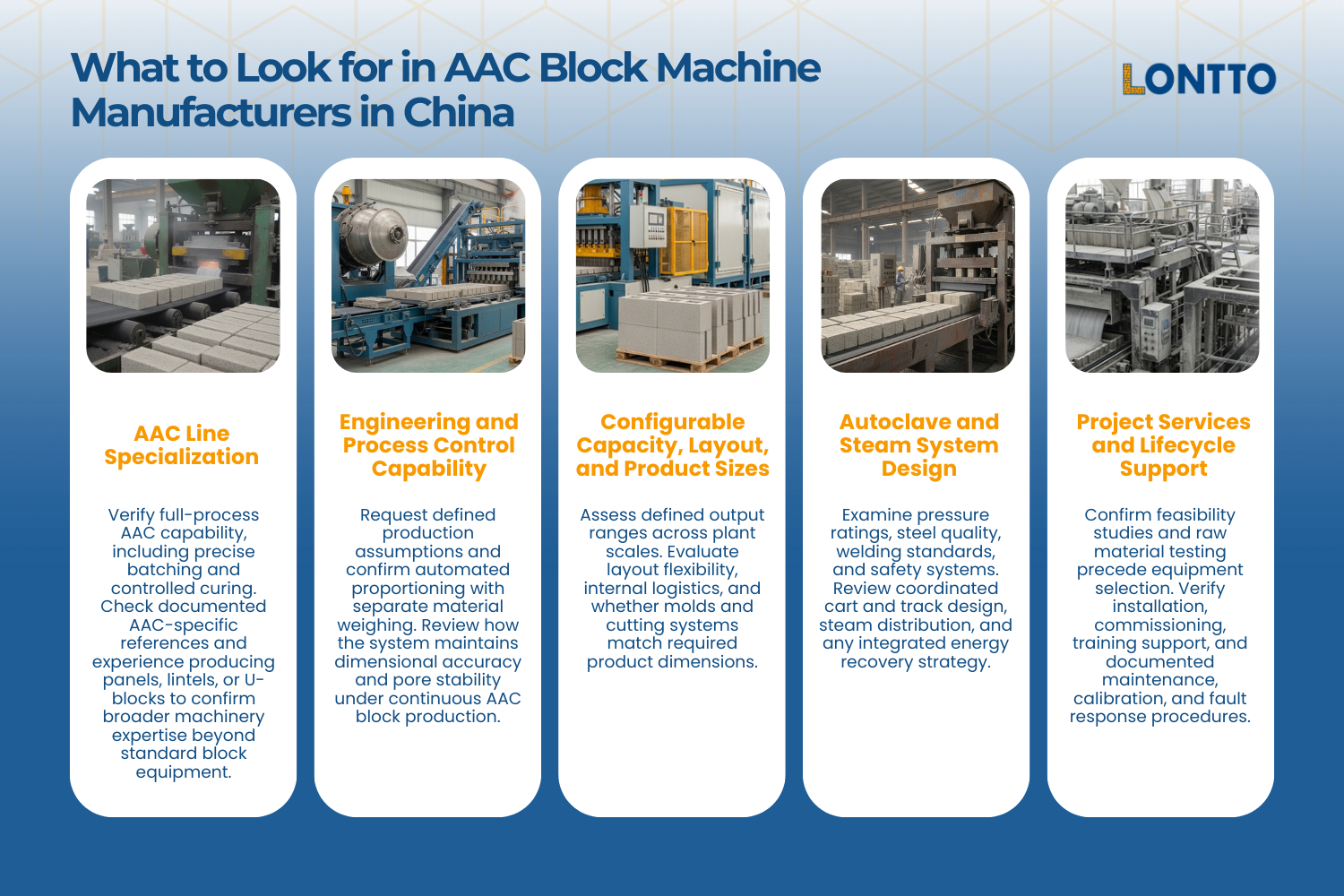
Selecting China AAC block suppliers requires reviewing documented installations and process data.
Confirm experience in AAC block manufacturing with defined capacity references, and verify that the system covers the complete AAC production process from raw material preparation through packing. If panels are required, ensure the layout supports integrated AAC block and panel production within the same line.
AAC Line Specialization
Assess whether the supplier covers the full process flow required for the production of autoclaved aerated concrete blocks, including batching accuracy and controlled curing. Verify documented project references specific to AAC rather than standard block equipment. Experience with panels, lintels, or U-blocks indicates broader capabilities in AAC machinery.
Engineering and Process Control Capability
Request a defined production basis showing hours per shift, shifts per day, and working days per year. Confirm PLC or microcomputer-controlled proportioning with separate weighing for powders, slurry, and aluminum. Review how the plant achieves dimensional precision and pore stability under automatic AAC block production conditions.
Configurable Capacity, Layout, and Product Sizes
Check for defined CBM per day or per year ranges across multiple plant scales. Evaluate layout flexibility based on land area, structural arrangement, and internal logistics. Ensure molds and cutting systems align with the required product dimensions.
Autoclave and Steam System Design
Examine autoclave pressure ratings, steel grade, welding methods, and safety interlock systems. Confirm coordinated design of carts, ferry systems, and track alignment. Review the steam distribution method and any energy recovery strategy.
Project Services and Lifecycle Support
Verify feasibility analysis and raw material testing before equipment selection. Confirm support for installation, commissioning, and operator training. Request documentation outlining maintenance schedules, calibration procedures, and fault response protocols.
Top 7 AAC Block Machine Manufacturers in China
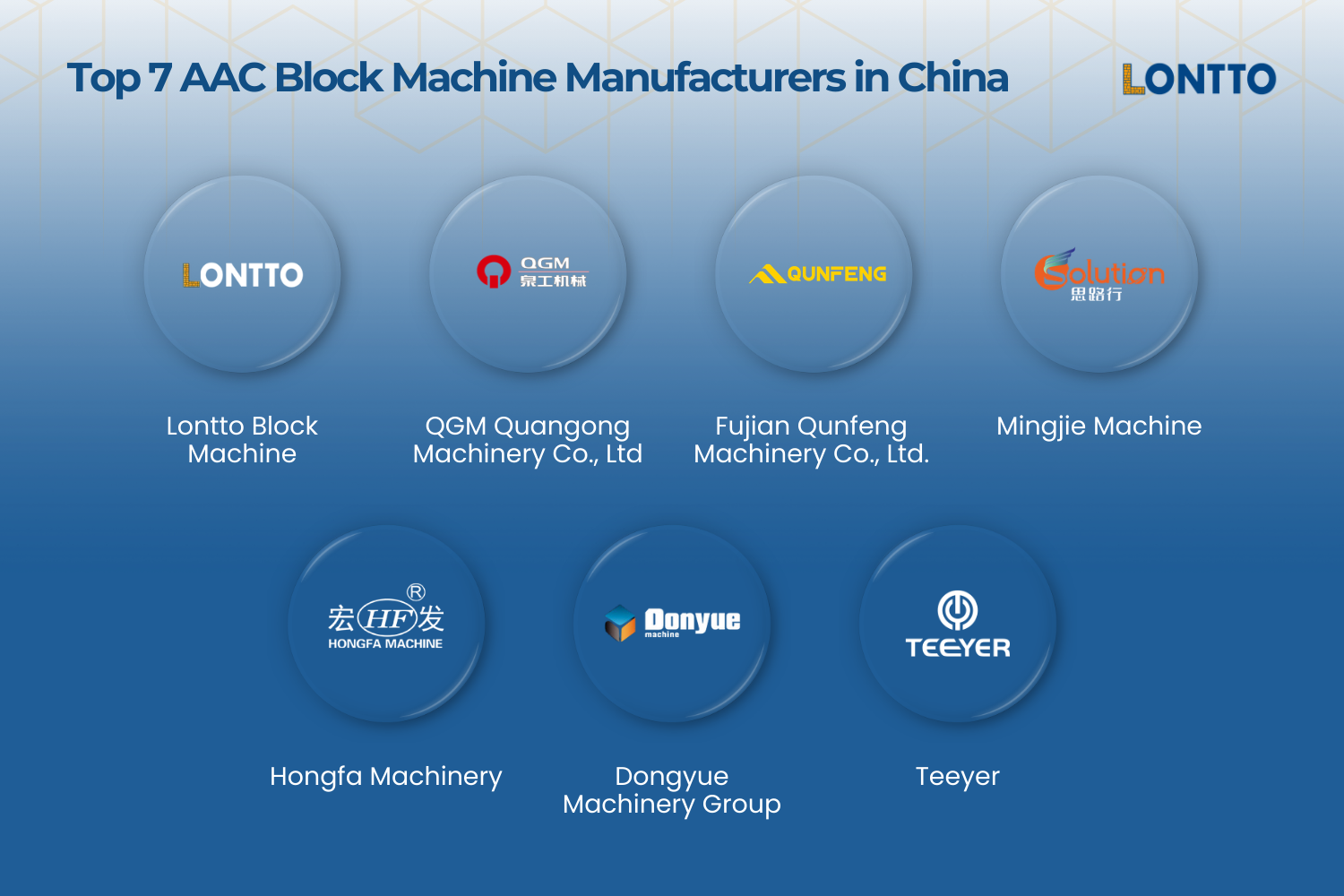
1. Lontto Block Machine
Lontto is a machine manufacturer that has been producing complete AAC block plant systems and other construction machinery for more than 30 years. The company operates three factories covering 3,587,970 sq. ft., with dedicated workshops for raw material processing and special block molds production.
Facilities also include heat treatment units, a brick-making machine assembly workshop, and a research center. Lontto exports brick machines and AAC block machines to over 60 countries worldwide, including markets in Africa and Southeast Asia.
ISO 9001 and CE certifications confirm compliance with international quality and safety standards, supporting procurement approval processes in regulated and export-oriented markets.
Each AAC production line controls AAC block production from material batching through final curing. The system processes fly ash or sand with cement, lime, gypsum, and aluminum powder as defined raw material inputs.
A cutting machine shapes the green cake before transfer to the autoclave. Inside the autoclave, high-pressure steam forms autoclaved aerated concrete blocks with specified density and compressive strength. These blocks suit load-bearing or non-load-bearing applications based on design requirements and local building codes.
Lontto offers the following AAC block machines within its automated production line configurations:
- 50,000 m³ AAC block-making machine for lower production capacity requirements.
- 100,000 m³ AAC block-making machine equipped with an AAC cutting machine and autoclave units.
- 150,000 m³ AAC block plant designed for mid-range output levels.
- 200,000 m³ block machine system integrating automation across the production line.
- 300,000 m³ AAC plant configured for expanded AAC block production.
- 400,000 m³ making machine line covering batching, cutting, and autoclave curing stages.
| Pros | Cons | ||
|---|---|---|---|
| ✅ Supports varied AAC block sizes and selected AAC panel formats through configurable molds. | ❌ Extends commissioning timelines due to staged installation and testing. | ||
| ✅ Applies more than 30 patent-protected refinements within selected machinery components. | |||
| ✅ Adjusts mix formulas to suit regional raw material conditions. | ✅ Provides installation, commissioning, and operator training support to reduce startup risk and shorten time to full production. |
2. QGM Quangong Machinery Co., Ltd
Quangong Machinery Co., Ltd. develops automated systems, including its AAC production line for the production of industrial building materials. Founded in 1979, QGM integrates German technology from Zenith Maschinenfabrik GmbH into its equipment design and process control systems.
The company holds more than 200 patents and supports operations in more than 120 countries and regions. Published production capacity calculations for selected systems reference 7.5 hours per shift, 3 shifts per day, and 300 working days per year.
QGM supplies the following AAC block-making machine and related equipment options:
- Lightweight Block Making Machine designed for lower-density AAC block output.
- AAC Brick Machine configured with pressure-rated autoclave curing systems.
- AAC Block Making Machine supports defined annual production capacity targets.
- AAC Block Machine equipped with 6 t/h steam capacity and 1.6 MPa boiler specifications.
- Automatic AAC Brick Machine integrating automated control architecture.
- AAC Brick Making Machine calibrated for fly ash, cement, lime, gypsum, and aluminum powder formulations.
- Mud AAC Block Making Machine is engineered for alternative raw material inputs.
- Lightweight AAC Block Machine requiring defined land and layout parameters.
- The Heat-Resistant AAC Block-Making Machine was developed to enhance thermal insulation performance.
- Mud AAC Brick Making Machine is aligned with standardized gypsum material requirements.
- Noise Absorption AAC Brick Machine incorporating compliant aluminum powder specifications.
| Pros | Cons |
|---|---|
| ✅ Provides mold development through Quangong Mould Co., Ltd. | ❌ Involves detailed steam and boiler commissioning. |
| ✅ Supports resource utilization devices for industrial byproducts. | |
| ✅ Offers environmental management compliance under ISO14001 frameworks. |
3. Fujian Qunfeng Machinery Co., Ltd.
Fujian Qunfeng Machinery Co., Ltd. is a manufacturer in China that produces integrated systems, including AAC block production lines for industrial AAC plants. The company operates large-scale manufacturing facilities totaling 215,000 m² and exports equipment to 120 countries and regions.
Qunfeng is a global supplier of plant systems designed to maintain stable throughput and coordinated process control. Its China AAC offering focuses on complete production configurations suited to large-scale manufacturing environments.
The AAC block production line includes the following equipment and process systems:
- Jaw Crusher for primary reduction of calcareous and siliceous materials.
- Ball Mill for fine grinding before slurry preparation.
- Lime and Cement Silos for bulk material storage.
- Weighing Hoppers and Dosing Systems for proportion control.
- Pouring Mixer for slurry blending before mold filling.
- Ferry Cart for transferring molds between stages.
- Vertical and Horizontal Cutting Machines for dimensional shaping.
- Autoclave vessel rated at 1.6 MPa and 204°C for steam curing.
- Finished-Block Clamp and Cuber Crane for automated stacking and final packing preparation.
| Pros | Cons |
|---|---|
| ✅ Integrates construction waste treatment systems alongside standard plant equipment. | ❌ Involves complex installation sequencing across multiple heavy units. |
| ✅ Supports resource recycling through waste-slurry recovery tanks. | |
| ✅ Offers automated pallet providing and tank-type conveying systems. |
4. Mingjie Machine
Mingjie Machine is a block machine manufacturer in China with 30 years of experience in developing aerated concrete systems. It operates 48,000 square feet of factory space and delivers integrated solutions from feasibility analysis through installation and commissioning.
The company positions its one-solution system as a complete plant framework for AAC production. Mingjie Machine supports projects producing AAC block and panel products across a range of scalable plant capacities.
The company structures the manufacturing process into five coordinated stages covering preparation, batching, cutting, curing, and packing. Modular configuration enables the production of blocks in various sizes using adjustable molds and calibrated cutting systems. Output scale and capital allocation vary according to selected plant size and equipment count.
The equipment scope covers crushing, grinding, batching, pouring, cutting, steam curing, and final packing systems. It includes material handling units, dosing systems, tilting and grouping cranes, pressure vessels, separating devices, and automated packing lines arranged within an integrated workflow.
The plant configurations include:
- Mini Plant rated at 200 to 500 CBM per day with 4 autoclaves, 1 cutting unit, 15 molds, and 3 cranes.
- Medium Plant rated at 600 to 1,000 CBM per day with 7 autoclaves, 1 cutting unit, 33 molds, and 4 cranes.
- Large Plant rated at 1,000 to 1,500 CBM per day with 11 autoclaves, 1 cutting unit, 53 molds, and 6 cranes.
| Pros | Cons |
|---|---|
| ✅ Supports automated pallet feeding and side plate cleaning systems. | ❌ Requires coordinated spare parts planning for specialized components. |
| ✅ Incorporates bubble removal equipment to improve pore uniformity. | |
| ✅ Provides modular crane configurations for internal material movement. |
5. Hongfa Machinery
Hongfa Group is an AAC block plant manufacturer founded in 1990 with 32 years of experience in wall panel and aerated concrete equipment. The company operates two machinery manufacturing plants and two environmental building materials production bases in Nanning and Linyi.
Hongfa supplies integrated AAC plant solutions for new installations and production line upgrades in more than 120 countries and regions.
The production systems support quality AAC block output across annual capacities from 50,000 CBM to 400,000 CBM. Engineering teams configure layouts according to raw material composition, plant location, and investment scope. Tooling systems adjust dimensions to produce the blocks you need for structural and panel applications.
Standard size options include:
- AAC block length of 600 mm.
- AAC block heights of 200 mm, 250 mm, or 300 mm.
- AAC block widths from 75 mm to 250 mm.
- External AAC wall panel lengths from 1,500 mm to 6,000 mm.
- External AAC wall panel thicknesses of 150 mm, 170 mm, 180 mm, 200 mm, 240 mm, or 250 mm.
- Internal AAC partition panel thicknesses of 75 mm, 100 mm, or 120 mm.
The machinery includes:
- Autoclaves in multiple pressure-rated specifications.
- AAC block and panel cutting lines with longitudinal and cross units.
- Sand ball mills for material grinding.
- Slurry storage tanks and pouring mixers.
- Powder and slurry weighing systems.
- Mold frames and side plates are manufactured from Q345 steel.
- Ferry cars, steaming cars, and carriers for transfer operations.
- Packaging and stacking lines for finished products.
| Pros | Cons |
|---|---|
| ✅ Offers installation, commissioning, and operator training support. | ❌ Requires dedicated storage space for molds and side plates. |
| ✅ Provides EPS cement wall panel and quartz slab production lines within the same corporate group. | |
| ✅ Supplies livestock and poultry manure treatment equipment alongside building systems. |
6. Dongyue Machinery Group
Founded in 1994, Dongyue Machinery Group Co., Ltd. includes subsidiaries that cover building materials, equipment, and pressure vessel fabrication. The group exports systems to 50 countries and regions, with overseas offices supporting installation and service coordination.
Dongyue develops production systems for autoclaved aerated concrete block and panel applications supported by internal equipment manufacturing capacity. The supplied AAC block plant machinery includes two primary configurations, depending on raw material selection: sand-based and fly ash-based systems.
Sand AAC Block Plant
The Sand AAC Block Plant is configured to prepare silica sand through crushing and fine grinding before batching and pouring. Process control emphasizes slurry consistency and dimensional stability during cutting and curing.
The machinery includes:
- Crushing and grinding units for sand powder preparation.
- PLC-controlled automatic batching system with interlocked feeding logic.
- Telescopic pouring mixer with pneumatic discharge valve.
- Chain-type cutting unit with mobile platform and cylinder-tensioned steel wire.
- Pressure-rated autoclave fabricated from Q345R steel with a quick-opening door and a safety interlock system.
Fly Ash AAC Block Plant
The Fly Ash AAC Block Plant is designed for fly ash utilization with deep grinding to achieve a specific surface area above 4,000 cm²/g. The process supports improved reaction activity and strength development during steam curing.
The machinery includes:
- Deep grinding systems for the preparation of lime, cement, gypsum, and fly ash.
- PLC automatic proportioning system with microcomputer control.
- Fixed casting pouring mixer with a telescopic arm structure.
- Mobile chain-cutting machine enabling combined cross- and longitudinal cutting.
- Autoclave curing system using submerged-arc-welded pressure components and safety valve protection.
| Pros | Cons |
|---|---|
| ✅ Maintains dedicated pressure vessel fabrication through an in-house subsidiary. | ❌ Requires periodic calibration of microcomputer-based batching systems. |
| ✅ Supports overseas offices for localized coordination and response. | |
| ✅ Integrates safety interlock logic within curing systems. |
7. Teeyer
Jiangsu Teeyer Intelligent Equipment Co., Ltd., founded in 1989 in Changzhou High-tech Zone, develops and manufactures complete production lines for AAC block and panel systems.
The company holds more than 90 patents related to complete AAC line equipment and participates in drafting industry standards such as the AAC cutting machine standard. Among AAC block machine manufacturers in China, Teeyer supplies standardized and customized full-line configurations for producing wall materials.
The curing section allows a single autoclave to accommodate up to 18 green cakes, depending on vessel size and plant capacity. Production lines can be configured with standardized layouts or customized to meet site conditions and capacity requirements.
The main equipment in the curing and finishing section includes:
- Autoclave vessels with matched autoclave carts.
- Ferry carts for transfer before and after curing.
- Automobile bridge systems for material movement.
- Automatic steam distribution and residual steam recovery systems.
- Traction mechanisms for controlled transport operations.
| Pros | Cons |
|---|---|
| ✅ Covers both block and panel product categories within the same production framework. | ❌ Requires coordinated alignment between cutting and curing sections. |
| ✅ Provides U-blocks, lintels, and integrated trunking board production options. | |
| ✅ Includes residual steam recovery systems to improve thermal efficiency. |
AAC Block Machine Manufacturers in China FAQs
How important is raw material testing before selecting an AAC line?
Raw material testing determines whether a plant can achieve its target density and strength. Chemistry and fineness directly affect mix behavior and steam curing performance. Laboratory analysis and trial batches confirm reaction stability before fixing capacity, autoclave count, and batching configuration.
Why does cutting technology matter in AAC plants?
Cutting technology controls dimensional accuracy and production efficiency. Wire tension control and motion precision affect surface quality and waste generation. Integration with pre-curing timing determines cycle stability and influences downstream curing performance.
What should be considered when choosing plant capacity?
Plant capacity must match market demand and raw material supply. Site area and capital allocation limit the practical scale. These constraints define autoclave quantity, mold circulation rate, and shift structure required for sustainable output.
Back to Top: Top 7 AAC Block Machine Manufacturers in China

I am Chao Zhang, I have been working in the brick making industry for over 10 years. I have a deep understanding and research on various models of block making machines, especially automatic brick machines, concrete block machines, compressed earth block machines, clay brick machines, cement brick machines. I have a special understanding of this industry. I can help my clients choose the suitable brick machine and assist them in designing and building a brick production factory. If you want to know everything about brick making machines, please contact me. I am happy to help you.

 Contact Us
 Price Quote
 Call Us