
 EN
EN  FR
FR  RU
RU  ES
ES 

 Fast Delivery


 Get Machine Pricing
An egg laying block making machine is a mobile unit that manufactures concrete blocks on-site and deposits them directly onto the ground. After every compression cycle, a finished block lands on the prepared slab below the frame.
Builders gain a completed row after each drop, eliminating the need for factory infrastructure entirely. Job schedules drive concrete block output rather than supplier lead times. The egg-laying name describes exactly how the machine operates in the field.
After each cycle, the block-making machine advances and lays a fresh row behind it. No permanent plant setup restricts where the egg-laying block unit can operate. On-site production removes minimum order constraints from the procurement chain.
How does an Egg Laying Block Machine Work?
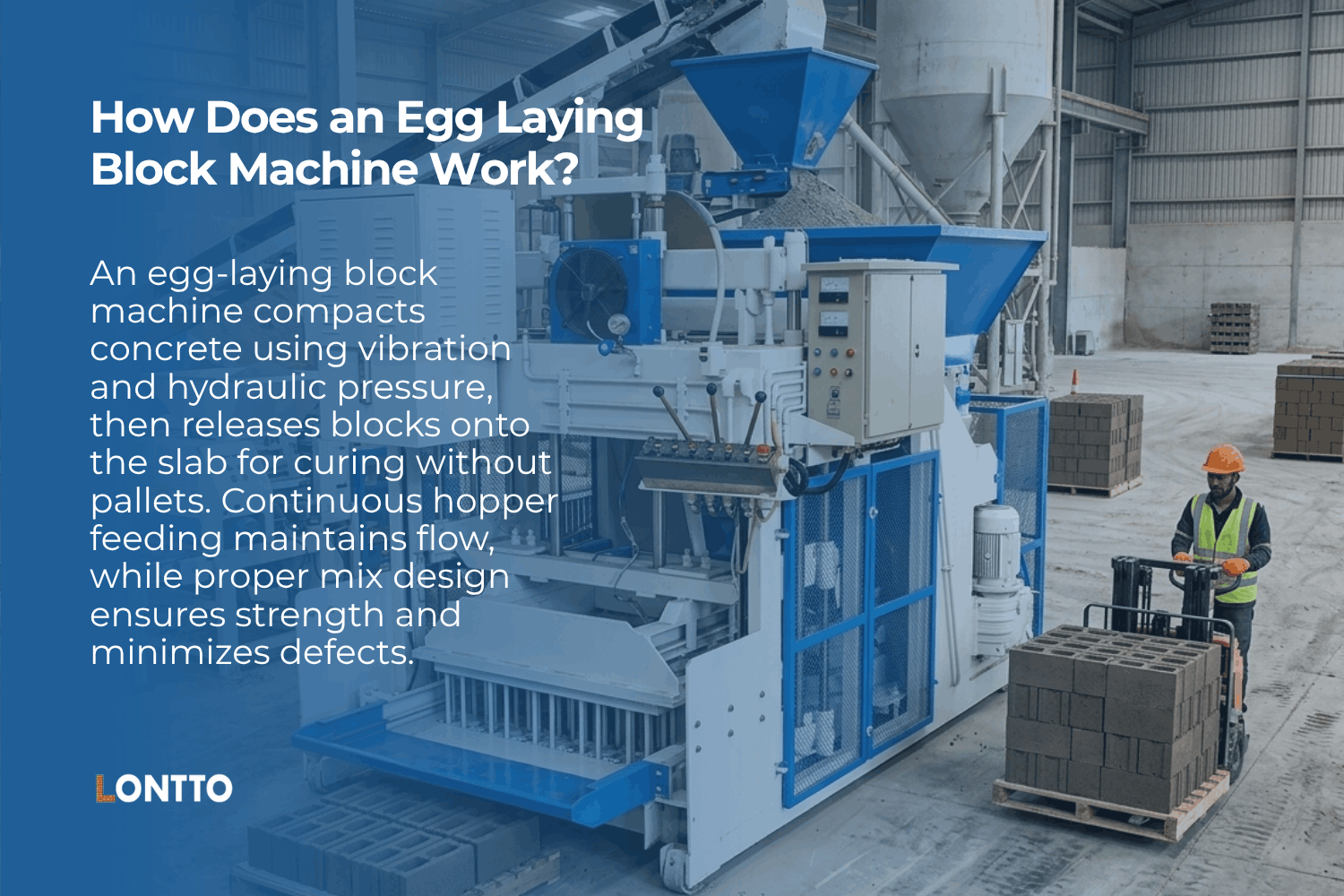
Before the mold releases, an egg-laying concrete block making machine applies hydraulic pressure to compact a prepared mix into a finished unit. Vibration motors clear air pockets from the mold cavity before final compression, locking each block's shape.
Once the cycle ends, the mold lifts, and the formed block stays on the prepared slab. The ground surface serves as the curing bed, removing pallet handling from the workflow entirely. The hopper feeds raw material into the mold at the start of each drop.
Correct aggregate grading and water-to-cement ratio govern the compressive strength of every unit the machine produces. During the previous drop, a second hopper charge was loaded to keep block production continuous. Poor mix calibration at this stage compounds reject rates across a full shift.
Features and Components
Interchangeable mold boxes enable egg-laying block-making machines to switch between blocks of different sizes on a single chassis. Steel frames rated at 3mm absorb constant vibration without structural fatigue across full production runs. Dual-power models maintain operational continuity at remote sites where the electricity supply is unreliable.
The machine ships with these components:
- Vibro forming motors: Industrial vibrators vibrate the filled mold cavity before compression, producing high-density units with uniform strength throughout.
- Hydraulic system: A dedicated ram drives both compression force and forward travel, delivering hydraulic pressure consistently across every drop cycle.
- Hopper assembly: A staged feed system keeps raw material queued so the block-making machine can move from one drop to the next without pause.
- Mobility frame: Robust wheels with locking mechanisms secure the machine during compression and allow repositioning between drops without tools.
Types of Egg Laying Machines
Matched to site power conditions and capital budgets, egg-laying block equipment is available in three distinct machine types. Manual models rely on hand-operated mechanisms for small-scale output without electricity.
At the mid-tier level, semi-automatic frames manage compression while operators control loading between drops. Fully automatic units run the complete production sequence without manual intervention.
The three configurations are:
- Manual: Hand-operated compression and mold release for remote sites or low-volume jobs without a reliable power supply.
- Semi-automatic: Mechanical compression and mold release with operator-controlled loading and forward movement between drops.
- Fully automatic: Programmable feed, compression and travel sequences that maximize productivity on large-scale contracts with continuous concrete block demand.
Production Capacity
Across residential and commercial contracts, small-scale egg-laying units produce 800 to 1,000 blocks per eight-hour shift. Large-scale configurations push daily output past 5,000 stock bricks or 2,000 hollow units. Cycle times run 45 to 90 seconds per completed drop. The rated output assumes the machine operates continuously across a full production shift.
For contractors who weigh capital cost against volume, lower production capacities offer a practical fit. Pre-batching material gives crews an edge over reactive block-making operations. Operator discipline at the batching stage determines whether the machine hits the rated daily output.
Sites that skip pre-batching consistently fall short of the egg-laying machine's rated daily block production capacity.
Block Types Produced
By swapping the mold box between job requirements, a single egg laying block making machine covers both structural and hardscape output. Each mold swap repositions the concrete block machine from wall units to paver profiles in minutes.
The machine produces these various types of concrete units:
- Hollow block: Units sized at 390mm x 190mm x 140mm for load-bearing wall systems across residential and commercial construction.
- Solid blocks: Maximum compressive-strength profiles for walls where structural load capacity takes priority over material weight.
- Paver blocks: Paver profiles that interlock under foot and vehicle traffic for hardscape and boundary applications without mortar.
- Interlocking units: Modular concrete profiles for retaining walls and quick-assembly boundary structures requiring no mortar bed.
Need to Produce Blocks at Scale?
Our block making machines are built for commercial and industrial production. Get expert advice and a custom price quote — we respond within 24 hours.
Advantages of an Egg Laying Block Machine
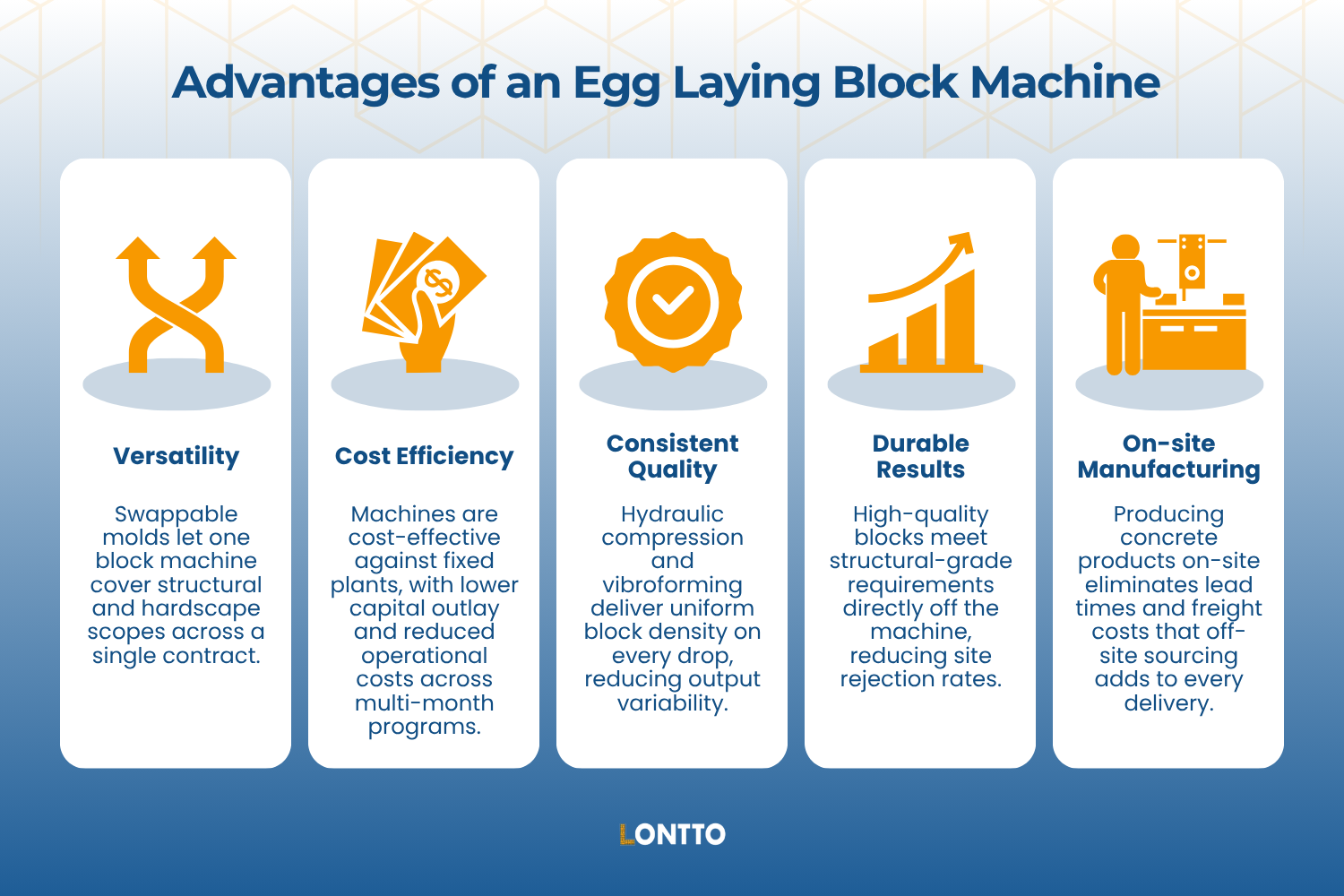
A builder running the best egg-laying block equipment controls on-site output timing, quality, and procurement costs. No external supplier dependencies interrupt scheduling or inflate the overall project cost. Cutting freight invoices and removing minimum-order constraints pays back the purchase price faster.
Advantages include:
- Versatility: Swappable molds let one block machine cover structural and hardscape scopes across a single contract.
- Cost efficiency: Machines are cost-effective against fixed plants, with lower capital outlay and reduced operational costs across multi-month programs.
- Consistent quality: Hydraulic compression and vibroforming deliver uniform block density on every drop, reducing output variability.
- Durable results: High-quality blocks meet structural-grade requirements directly off the machine, reducing site rejection rates.
- On-site manufacturing: Producing concrete products on-site eliminates lead times and freight costs that off-site sourcing adds to every delivery.
Applications
On projects where freight costs make off-site sourcing uneconomical, egg-laying-type equipment offers the strongest return on investment. Automatic configurations scale from residential builds to multi-story commercial projects on a single core machine.
Common project fits include:
- Residential construction: Homes and boundary walls where steady block demand doesn't justify a fixed, stationary plant investment.
- Remote sites: Locations beyond reliable building materials delivery networks where on-site concrete block output is the only practical option.
- Mixed-output contracts: Jobs spanning structural and hardscape scopes covered by one egg-laying block machine with swappable molds.
- Large-scale commercial work: Fully automatic units sustain the block production volumes that multi-story construction schedules demand.
Maintenance and Operation
Scheduled maintenance on a concrete block-making machine maintains output quality and extends service life during long project runs. After each session, mold cleaning stops concrete residue from hardening inside the cavity and distorting block dimensions.
Hydraulic system inspections at shift start catch loose ram seals before mid-run pressure loss. Trained operators cover mix ratios and controls before running any unsupervised production shift.
Recommended maintenance tasks include:
- Mold box care: Clear residue after every session to protect cavity dimensions and ensure block consistency on the next drop.
- Hydraulic line checks: Inspect ram seals and fittings each morning to prevent pressure loss during compression cycles.
- Vibration motor checks: Confirm mount integrity and motor function at shift maintain the compaction force the machine was calibrated to deliver.
- Operator certification: Cover mix ratios, machine controls, and emergency procedures before any crew member runs an unsupervised production shift.
Lontto manufactures egg-laying block-making machines for demanding production environments and ships equipment to over 100 countries worldwide. Every egg-laying machine leaves the factory tested against commercial-grade output standards, giving contractors reliable block-making performance from the first production shift.
Contact Lontto to discuss your egg laying block making machine needs so we can help you find the right one for your job.
Egg Laying Block Making Machine FAQs
How much does an egg laying block making machine cost?
Manual or portable egg-laying block models start around $2,000 to $3,000, making them accessible to small contractors and self-builders. Semi-automatic hydraulic units range from $5,000 to $10,000, depending on output capacity. Fully automatic configurations with high block output capacity reach $12,000 to $22,000 or more, depending on features and machinery brand.
Can an egg-laying block machine operate without electricity?
Manual models rely entirely on hand-operated mechanisms and require no power supply to run. Dual-power machines combine electric motors with diesel engines, keeping block production running during outages or on remote sites. Both configurations suit contractors who operate in areas where the electricity supply is unreliable or unavailable.
How long does it take to train an operator?
Basic egg-laying machine operator training typically takes one to two days to complete. Operators learn concrete mix ratios, machine controls, safety procedures, and routine mold cleaning. The straightforward design requires far less technical skill than a stationary block plant demands from its crew.
Back to Top: What is an Egg Laying Block Machine?

Speak To Our Brick Machine Expert
Get in touch with our nice team today to get a price estimate for a block machine.

I am Chao Zhang, I have been working in the brick making industry for over 10 years. I have a deep understanding and research on various models of block making machines, especially automatic brick machines, concrete block machines, compressed earth block machines, clay brick machines, cement brick machines. I have a special understanding of this industry. I can help my clients choose the suitable brick machine and assist them in designing and building a brick production factory. If you want to know everything about brick making machines, please contact me. I am happy to help you.
 Price Quote
 Call Us