
 EN
EN  FR
FR  RU
RU  ES
ES 

 Fast Delivery


 Get Machine Pricing
Concrete blocks are rectangular masonry units made from Portland cement, sand, gravel, and water. They are shaped in molds, compacted to remove air, and left to cure until they reach structural strength. Standard blocks measure 390 × 190 × 190 mm, though dimensions vary by region and application.
Concrete blocks serve as building blocks for walls, foundations, and load-bearing structures across residential, commercial, and infrastructure projects. The concrete block-making process follows the same core sequence whether you work by hand or with a machine.
Batch the materials, mix the concrete, mold the blocks, compact them, and demold before curing. The method you choose determines your output volume, consistency, and cost per block.
What Materials do You Need to Make Concrete Blocks?
The quality of your raw materials directly determines the strength of the finished product. Portland cement, aggregate, sand and gravel, and water make up the base of any concrete mixture. Optional chemical additives can improve workability or accelerate strength gain, depending on your production conditions.
| Material | Purpose | Typical Proportion | Quality Considerations |
|---|---|---|---|
| Portland cement | Acts as the binder | 1 part | Fresh, lump-free |
| Sand | Fine aggregate | 2–3 parts | Clean, well-graded |
| Aggregate | Bulk and strength | 3–6 parts (60–75% total) | Crushed stone or gravel, properly graded |
| Water | Activates cement hydration | 0.4–0.6 water-cement ratio | Clean, contaminant-free |
| Additives | Improve workability or strength | As needed | Use approved admixtures |
Aggregate accounts for 60–75% of the total concrete mixture, reducing the amount of cement paste required and keeping production cost-effective. The quality of your aggregate directly affects how well the finished product resists weathering and abrasion over time.
Concrete mix ratios
The water-cement ratio controls both workability and final strength. A ratio between 0.4 and 0.6 covers most concrete block production needs. Too much water weakens the block. Too little water produces a stiff mix that won't compact properly.
Common mix ratios for making concrete blocks include:
- 1:2:4 (cement:sand:aggregate) for load-bearing and structural blocks
- 1:3:6 for lighter-duty or infill applications
- 8:1 aggregate-to-cement ratio for practical small-batch production
The Concrete Block Making Process: Step by Step
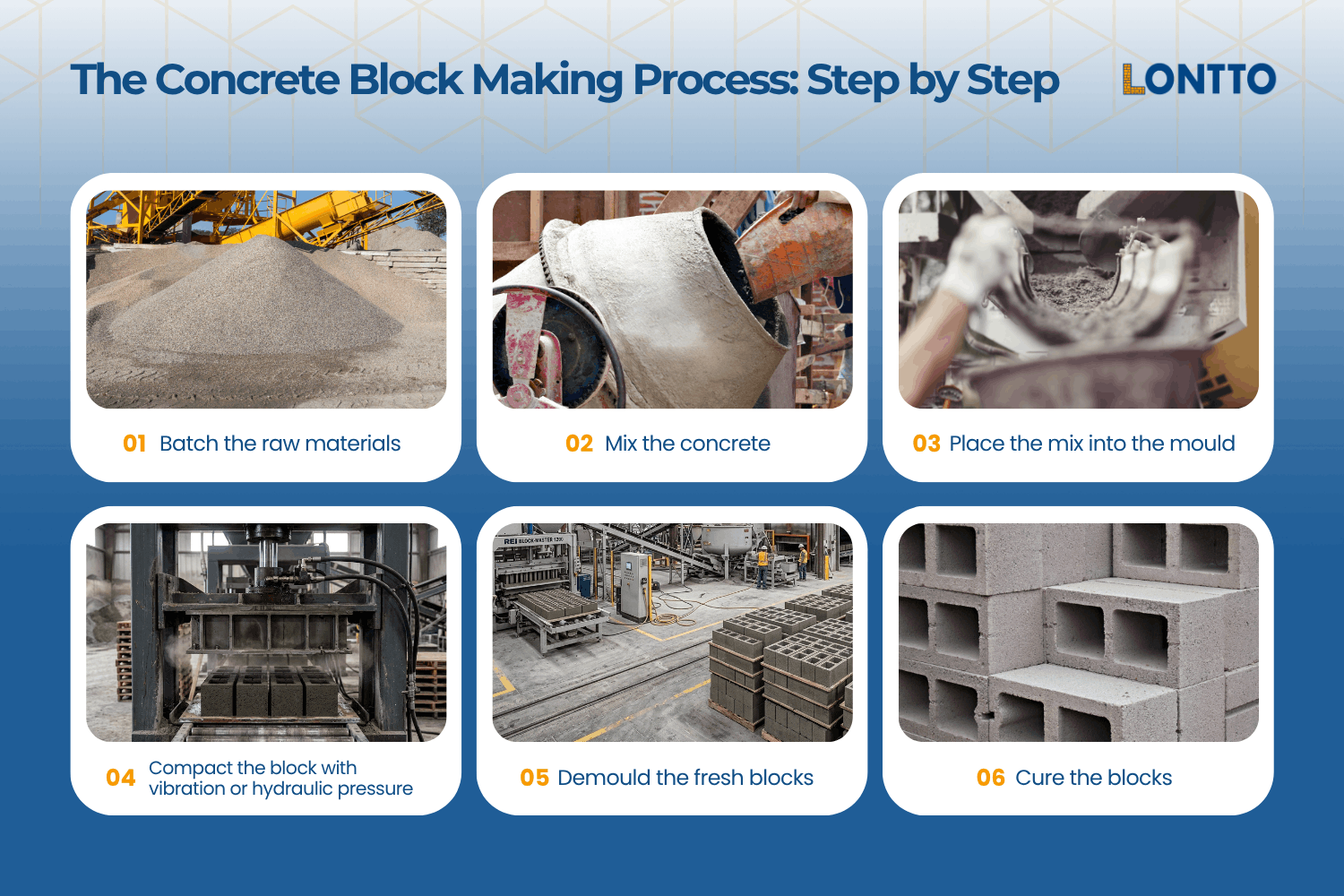
The process of making concrete blocks moves through six stages: batching, mixing the concrete, molding, compaction, demolding, and curing. Each stage builds on the previous one, and errors at any point carry through to the finished product.
Step 1: Batch the raw materials
Accurate batching is the foundation of consistent block quality. Measure cement, sand, gravel, and aggregate by weight using scales or by volume using calibrated containers. Calculate water quantities based on your target water-cement ratio before concrete mixing begins. Small variations in batching can shift compressive strength by a measurable margin across a production run.
Step 2: Mix the concrete
Add dry materials to a pan, mixer, or drum mixer first and combine them until the distribution is uniform. Introduce water gradually while the mixer runs, rather than adding it all at once. The target is a workable, cohesive concrete mix with no dry pockets or excess moisture. Run a slump test to confirm consistency before moving to the mold.
Step 3: Place the mixture into the mold
Block molds can be wooden, metal, or part of an automated machine system. Before filling, clean any concrete residue from previous runs and apply a release agent to all interior surfaces. A release oil or commercial concrete release compound prevents concrete from sticking and supports easy removal once the block sets. Fill block forms evenly, working the mix into corners to avoid weak spots.
Need to Produce Blocks at Scale?
Our block making machines are built for commercial and industrial production. Get expert advice and a custom price quote — we respond within 24 hours.
Step 4: Compact the block with vibration or hydraulic pressure
Compaction removes air bubbles and increases block density. To remove air bubbles manually, tamp the mix and vibrate the mold by tapping its sides with a mallet. Machine production uses a vibrator or hydraulic press to apply consistent pressure across the entire mold. Proper compaction directly affects the structural integrity of the block and the smoothness of the concrete surface.
Step 5: Demold the fresh blocks
Once compacted, lift or release the mold carefully to avoid cracking or deforming the block. Place fresh blocks on pallets or a flat surface for curing. The concrete block production process produces blocks that are firm but not yet fully strong, so handle them with care at this stage. Use a trowel or straight edge to trim any excess concrete from the edges before the block fully sets.
Step 6: Cure the blocks
Curing is when concrete blocks gain most of their structural strength. Cover fresh blocks with a plastic sheet or damp burlap to retain moisture and protect them from direct sun and wind. A minimum of seven days of moist curing is standard for adequate strength development. Environmental factors, including temperature and humidity, affect how quickly strength builds, so adjust your curing approach to local conditions.
Hand vs. Machine: Which Method is Right for You?
Choosing between hand production and machine production comes down to your output targets, available labor, and budget. Both methods follow the same sequence, but they differ significantly in consistency, daily capacity, and long-term cost per block.
| Factor | Hand production | Machine production |
|---|---|---|
| Daily output | 500–1,000 blocks per day per team | 4,000–46,000 blocks per day, depending on the model. |
| Labor requirements | High | Reduced |
| Consistency | Variable | Highly consistent |
| Quality control | Limited | Precise and repeatable |
| Startup cost | Low | Higher initial investment |
| Cost per block | Higher over time | Lower at scale |
| Scalability | Limited | Easily scalable |
Manual concrete block manufacturing works for small projects, DIY projects, and low-volume needs. A wooden mold or a simple plywood block mold is enough to make your own concrete blocks for a raised garden or landscape feature. For a do-it-yourself project, hand production keeps startup costs low.
Machine production changes the equation at any meaningful scale. Automated systems deliver consistent compaction, precise dimensions, and higher daily output with fewer workers. If you're producing blocks for sale or for a large construction project, the cost per block drops significantly once volume increases.
How to Cure Concrete Blocks
Curing controls the rate at which cement hydrates and concrete gain strength. Skipping or shortening this stage reduces compressive strength and increases the risk of surface cracking.
Water curing
Water curing keeps blocks moist by covering them with damp burlap or by watering them 2 to 3 times daily. Temperature and humidity determine how often you need to water. Most small-scale producers use water curing because it requires no specialized equipment. Keep blocks under a simple shelter on the first day to slow moisture loss.
Steam curing
Steam curing accelerates hydration by raising the temperature inside a curing chamber. Blocks reach adequate strength for most uses in approximately 24 hours under steam, compared to seven days with water curing. Industrial producers use steam curing to increase throughput and meet delivery schedules. The method requires a sealed chamber and controlled temperature management.
Air curing
Air curing requires no added moisture, as blocks are left to harden under ambient conditions. The process takes longer than water or steam curing and produces lower early strength, particularly in hot or dry climates where moisture evaporates quickly. It suits very low-volume production where curing time is not a constraint.
Recommended timeline
Keep blocks sheltered and moist for the first 24 hours to prevent surface cracking. Continue water curing for a minimum of seven days for standard applications. Compressive strength continues to develop beyond 28 days, so blocks intended for structural use benefit from longer curing periods before loading.
What Quality Tests Should Concrete Blocks Pass?
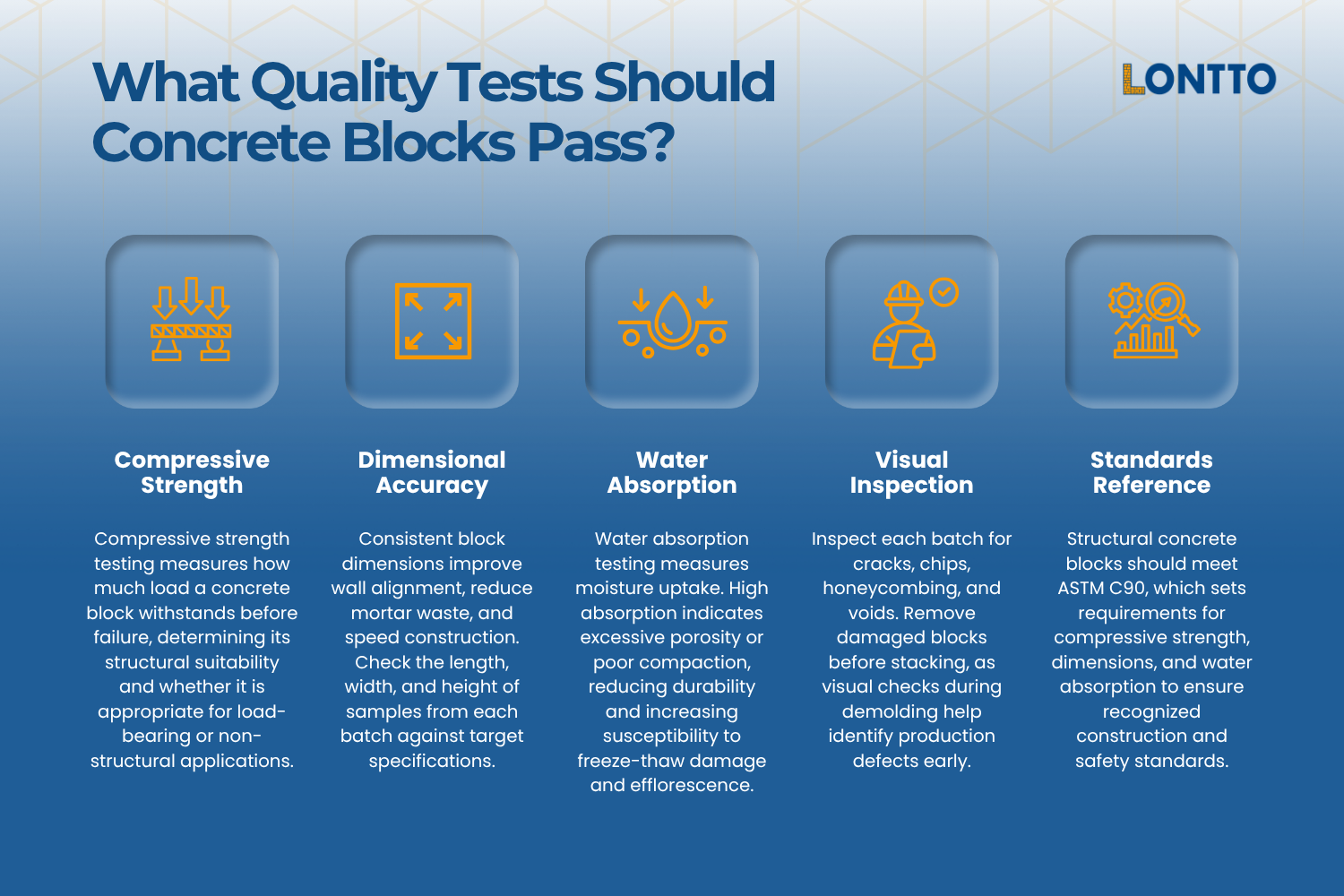
Quality control separates production-grade blocks from decorative blocks and low-strength fill. Standard testing covers strength, dimensions, and moisture resistance across each batch.
Compressive strength
Compressive strength testing measures the load a block can withstand before failure. It is the primary indicator of structural suitability and the most common test in concrete block manufacturing. Results determine whether blocks qualify for load-bearing walls or are limited to non-structural applications.
Dimensional accuracy
Consistent block dimensions keep wall courses aligned during masonry work. Machine production holds tighter tolerances than hand methods, reducing mortar waste and speeding up laying. Check length, width, and height against your target specifications on a sample from each batch.
Water absorption
Water absorption testing measures how much moisture a block takes in under standard conditions. High absorption indicates a porous mix or insufficient compaction, both of which reduce durability over time. Blocks with high absorption are more vulnerable to freeze-thaw damage and efflorescence.
Visual inspection
Inspect each batch for cracks, chips, honeycombing, and surface voids. Defects that look minor can compromise the integrity of the blocks under load, so remove damaged units before you stack the blocks. A consistent visual check at demolding catches most production faults early.
Standards reference
Concrete blocks intended for structural use should meet ASTM C90, the Standard Specification for Load-bearing Concrete Masonry Units. ASTM C90 sets minimum compressive strength, dimensional tolerances, and water absorption limits for load-bearing applications. Compliance confirms that your blocks meet recognized construction and safety benchmarks.
When Should You Invest in a Block Making Machine?
Concrete block manufacturing at volume requires more than scaled-up hand methods. A block-making machine becomes the practical choice when daily output targets exceed what manual labor can sustain. Maintaining consistent quality control across every block is difficult without mechanized compaction.
Machines reduce the cost per block as volume increases. Labor savings alone often offset the cost of equipment investment within the first year of full production. Every block gets the same compaction pressure, mold fill, and cycle time, which improves your reject rate and downstream concrete block production consistency.
If you're evaluating options, the right starting point depends on your target daily output and the block types you use.
Our concrete block making machine range covers entry-level manual-assist models through to fully automated production lines. Producers in North America can also review the block-making machine range in the USA for locally supported options.
For hollow unit production, the hollow block machine covers core-forming requirements across standard and custom mold configurations.
How to Make Concrete Blocks FAQs
How do I choose the right block machine capacity for my market?
Start with your target daily output and the block types you plan to produce, whether hollow, solid, or pavers. Size the machine to meet peak seasonal demand in a single shift. This allows enough headroom to absorb volume growth without adding a second production line immediately. A machine running at full capacity during your busiest month limits your ability to fulfill orders, so build in a realistic buffer when calculating your requirements.
What support should I expect during installation and commissioning?
A reliable supplier provides factory layout guidance, on-site installation supervision, test production runs, and hands-on operator training. The goal is to reach stable output and consistent block quality as quickly as possible after installation. Confirm before purchase that commissioning support is included in the contract rather than priced separately.
Can one machine produce different block types and sizes?
Yes, most modern block machines accept interchangeable molds, allowing you to switch between hollow blocks, solid blocks, and pavers on the same equipment. The machine's pallet size and vibration system must be compatible with each format you plan to run. Confirm mold availability and changeover time with your supplier before committing to a configuration.
How does the automation level affect staffing and skills?
Higher automation reduces the number of manual operators required per production line. It increases the need for at least one trained technician who can manage programmable logic controller (PLC) controls, diagnose faults, and schedule preventive maintenance. Factor in technician recruitment and training costs when comparing semi-automatic and fully automatic options.
What information should I prepare before requesting a quote for a block machine?
Prepare your target product types and sizes, required daily output, available factory floor space, local power supply specifications, raw material sources, and budget range. Suppliers use this information to recommend the right machine configuration for your operation. The more specific your input, the more accurate the quote.
Back to Top: How to Make Concrete Blocks: The Complete Step-by-Step Process (2026)

Speak To Our Brick Machine Expert
Get in touch with our nice team today to get a price estimate for a block machine.

I am Chao Zhang, I have been working in the brick making industry for over 10 years. I have a deep understanding and research on various models of block making machines, especially automatic brick machines, concrete block machines, compressed earth block machines, clay brick machines, cement brick machines. I have a special understanding of this industry. I can help my clients choose the suitable brick machine and assist them in designing and building a brick production factory. If you want to know everything about brick making machines, please contact me. I am happy to help you.
 Price Quote
 Call Us