
 EN
EN  FR
FR  RU
RU  ES
ES 

 Fast Delivery


 Get Machine Pricing
Pallets for block making determine whether your production process runs clean or collapses mid-shift. Poor pallet material choices cause warped blocks and curing failures that compound across every shift. Under high-frequency vibration and hydraulic pressure, every weakness in a pallet's construction gets exposed.
Choosing the right pallet from the start protects block quality, machine uptime, and long-term operating costs. Pallet selection isn't a procurement afterthought for block manufacturers. At the interface between the vibration table and the wet concrete mold, the brick machine pallet directly influences compaction quality.
High-performance pallet materials must transfer over 90% of vibration energy into the mix to achieve uniform density. A pallet that scatters that energy produces inconsistent blocks, which drive up rejection rates.
What Makes a Pallet “Durable” in Block Production?
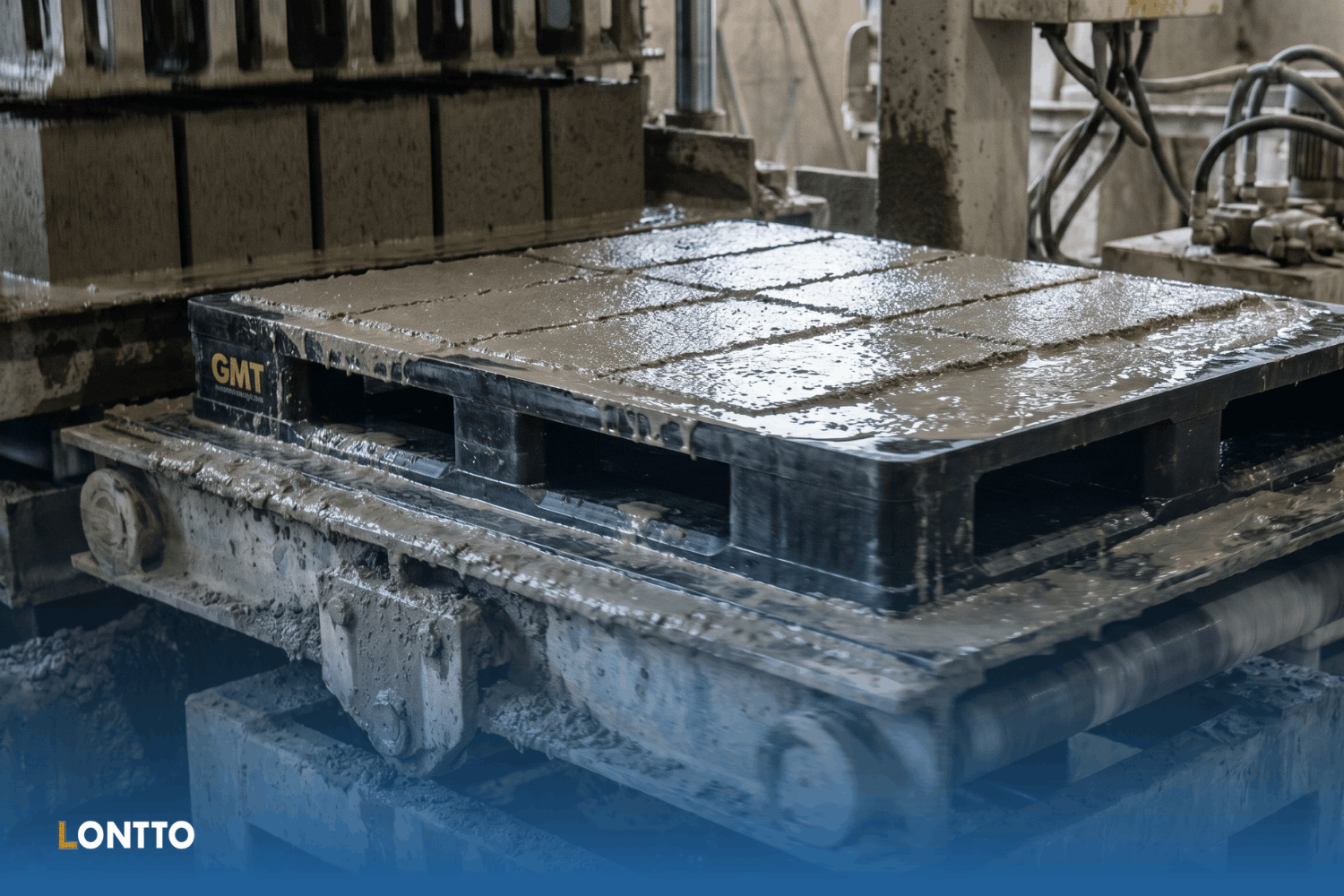
Durable pallets must hold a flatness deviation of no more than 0.3mm per 1000mm across the entire surface. Consistent tolerance keeps block height stable across every cycle and prevents cracking from uneven surfaces.
In the production of cement blocks at scale, dimensional accuracy isn't a quality preference; it's a structural requirement. Plants that treat pallet material as a structural input reduce replacement frequency and protect automated production lines.
Durability under wet concrete conditions separates a short-service pallet from a long-service one. Wet concrete hits every pallet material with moisture and chemical accelerators in the same cycle.
Without adequate moisture resistance, a failing pallet warps and splits, jamming automated stackers and disrupting curing cycles. For operations running heavy loads, that failure compounds quickly and cuts directly into the margin.
Common Pallet Materials for Block Machines
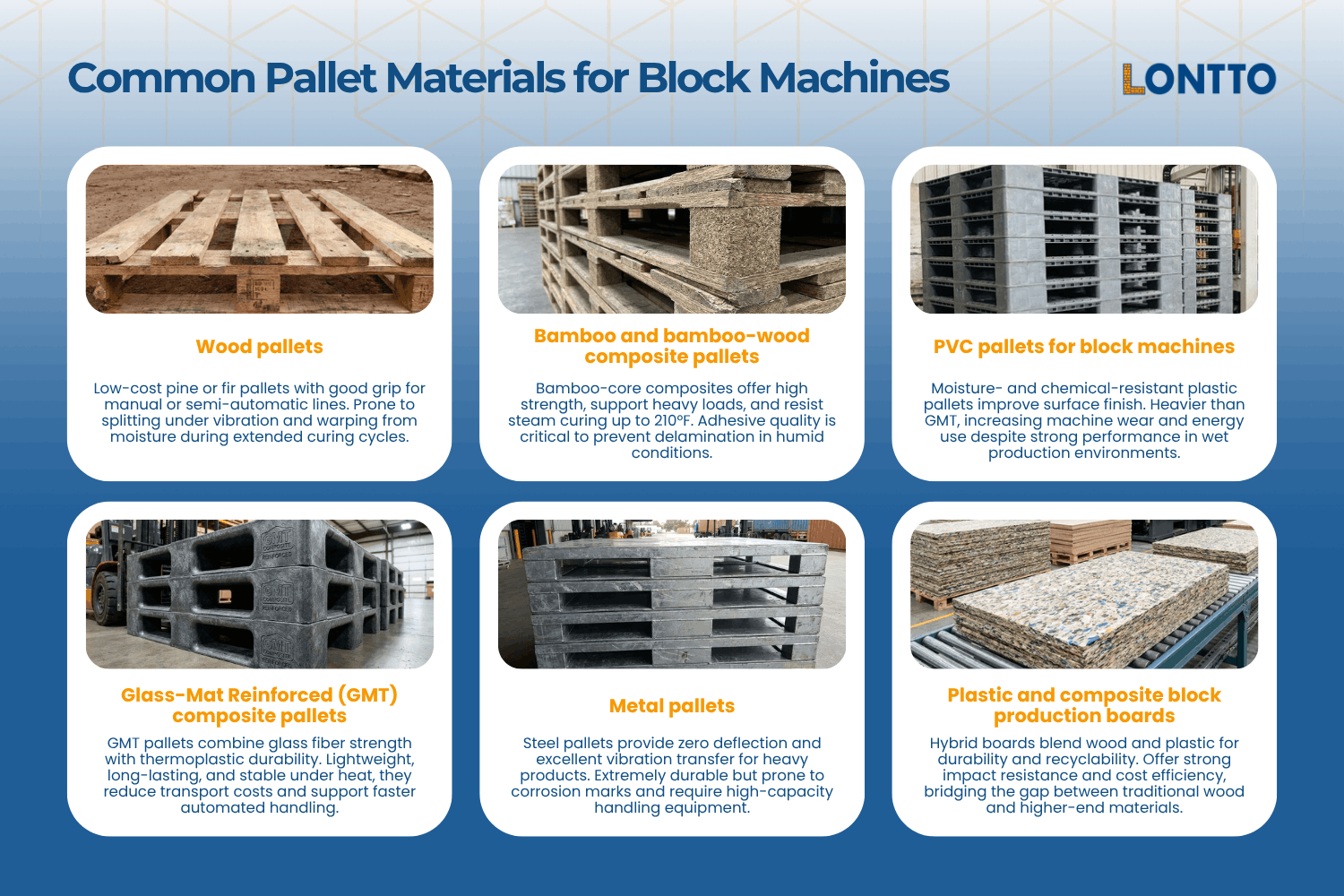
Material choice drives pallet performance across your plant's automation and curing conditions. Each option suits different production requirements, so matching the right one to your plant conditions matters.
Wood pallets
Wooden pallets are made from pine or fir softwood boards, joined with slot connections and through-bolts. Wood pallets have the lowest upfront cost and provide a high-friction surface that prevents product shifting during vibration.
On manual and semi-automatic lines with modest cycle rates, wood pallet performance holds up adequately. Edges split under sustained high-frequency vibration, and moisture absorption leads to warping and rot on longer curing cycles.
Bamboo and bamboo‑wood composite pallets
Bamboo-wood composite boards feature a crushed bamboo powder core hot-pressed to rubberwood surfaces. Longitudinal bending strength exceeds 90 MPa and the modulus of elasticity exceeds 9,000 MPa, supporting heavy curb stones without deflection.
Bamboo composite construction withstands steam-curing environments up to 210°F without structural degradation. Adhesive grade matters as much as board construction, since the delamination risk rises when low-quality adhesives meet sustained humidity.
PVC pallets for block machines
Plastic pallets made from high-density PVC have densities between 1.2 and 1.6 kg/cc, with board thicknesses ranging from 12mm to 45mm. Fully immune to moisture and the chemical accelerators common in cement block production, PVC outperforms wood in wet environments.
Plastic pallets deliver a smooth demolding surface that consistently improves block face finish on automated lines. At approximately 30% heavier than GMT pallets, PVC increases mechanical wear on handling machinery and raises energy consumption per cycle.
Glass‑Mat Reinforced (GMT) composite pallets
Glass Mat Reinforced Thermoplastic (GMT) is a thermoplastic matrix reinforced with continuous glass fiber mats. The internal fiber framework behaves like reinforced concrete, giving GMT composite pallets a service life that regularly exceeds 10 years.
Dimensionally stable in steam-curing rooms up to 176°F, GMT boards withstand conditions that degrade standard PVC formulations. Roughly 70% of the weight of PVC, GMT cuts freight costs and allows higher stacker speeds across the supply chain.
Need to Produce Blocks at Scale?
Our block making machines are built for commercial and industrial production. Get expert advice and a custom price quote — we respond within 24 hours.
Metal pallets
Metal pallets are built from heavy-duty carbon steel or galvanized plates with reinforced perimeter edge channeling. Under heavy concrete loads, steel delivers zero deflection and efficient vibration transfer for compaction.
For specialized industrial lines producing the heaviest infrastructure products, no other pallet material matches steel's load performance. Surface corrosion pitting transfers directly to the block face, and the weight of metal pallets demands high-capacity handling machinery.
Plastic and composite block production boards
Hybrid composite boards like Rhino Plastico densify hardwood cores with synthetic films or recycled plastic feedstocks. Plants can fully recycle end-of-life boards, reducing timber consumption and meeting corporate sustainability targets.
Impact resistance must clear between 12 and 20 KJ/m² to confirm long-term mechanical reliability under repeated loading. For businesses that need wood-level affordability without sacrificing durability, composite production boards reliably close that performance gap on automated lines.
How to Match Pallet Material to Your Block Plant
Before committing to any single pallet type, consider the operational and curing factors specific to your plant. Block weight and automation level each pull pallet selection in different directions.
The following criteria help block manufacturers identify the right pallet for their operation.
- Automation level: Manual and semi-automatic lines run well on wood or bamboo, while fully automatic lines need GMT or steel for dimensional precision.
- Curing environment: PVC, GMT, or treated steel handles high-humidity and steam-curing environments without the warping that standard wood develops.
- Block weight: Steel or high-density PVC prevents bowing under heavy solid concrete blocks, while lighter fly-ash blocks are compatible with wood or bamboo.
- Vibration efficiency: GMT and fiberglass boards transmit vibration more completely than wood, compacting concrete faster and more evenly across the mold.
- Handling method: PVC and composite boards weigh significantly less than steel, reducing fatigue and injury risk when staff handle pallet materials manually.
- Long-term ROI: Steel lasts 10+ years and GMT lasts 6-10, while wood needs replacement every 2-3 years on active lines.
- Chemical resistance: Plastic pallets and composite boards resist the corrosive effects of concrete accelerators and pigments that degrade wood over time.
Lontto manufactures composite and wood block pallets for every automation level and curing condition, with custom sizing shipped directly with your machine. With 24/7 service and competitive pricing, Lontto matches your plant's production requirements to the right pallet material.
Contact Lontto today to get a free quote and confirm the right pallet spec for your concrete block machine.
FAQs on How to Choose Durable Pallet Materials for Block Production
How often should pallet conditions be inspected in production?
Inspect pallets visually on every shift and run flatness checks weekly. On high-intensity lines, move flatness checks to every three days to catch warping before it causes rejects.
Can different pallet materials be mixed on a single line?
Mixing pallet materials on one line works only when the thickness and flatness match exactly across every board. Any deviation in flatness or thickness results in uneven compaction and inconsistent block height.
What pallet data should I track for performance benchmarking?
Track pallet lifespan and breakage rate per material type as your two baseline benchmarks. Against each pallet type, log maintenance hours and downtime to identify which material costs you the most.
Back to Top: How to Choose Durable Pallet Materials for Block Production

Speak To Our Brick Machine Expert
Get in touch with our nice team today to get a price estimate for a block machine.

I am Chao Zhang, I have been working in the brick making industry for over 10 years. I have a deep understanding and research on various models of block making machines, especially automatic brick machines, concrete block machines, compressed earth block machines, clay brick machines, cement brick machines. I have a special understanding of this industry. I can help my clients choose the suitable brick machine and assist them in designing and building a brick production factory. If you want to know everything about brick making machines, please contact me. I am happy to help you.
 Price Quote
 Call Us