
 EN
EN  FR
FR  RU
RU  ES
ES 

 Fast Delivery


 Get Machine Pricing
Egg-laying brick machines, also called mobile block-making machines, move on wheels across a prepared concrete surface. The units deposit freshly molded concrete blocks directly on the ground to cure.
Developers and independent block producers choose egg-laying machines over stationary alternatives for three reasons. Pallet costs are excluded from the budget entirely and fixed infrastructure requirements are removed from the project cost model.
On-site brick production eliminates the cost of transporting blocks. Diesel-powered models extend deployment to remote areas without stable grid access. Mold interchangeability allows a single unit to switch between hollow and solid formats without frame modification.
What to Consider Before Buying An Egg Laying Block Machine
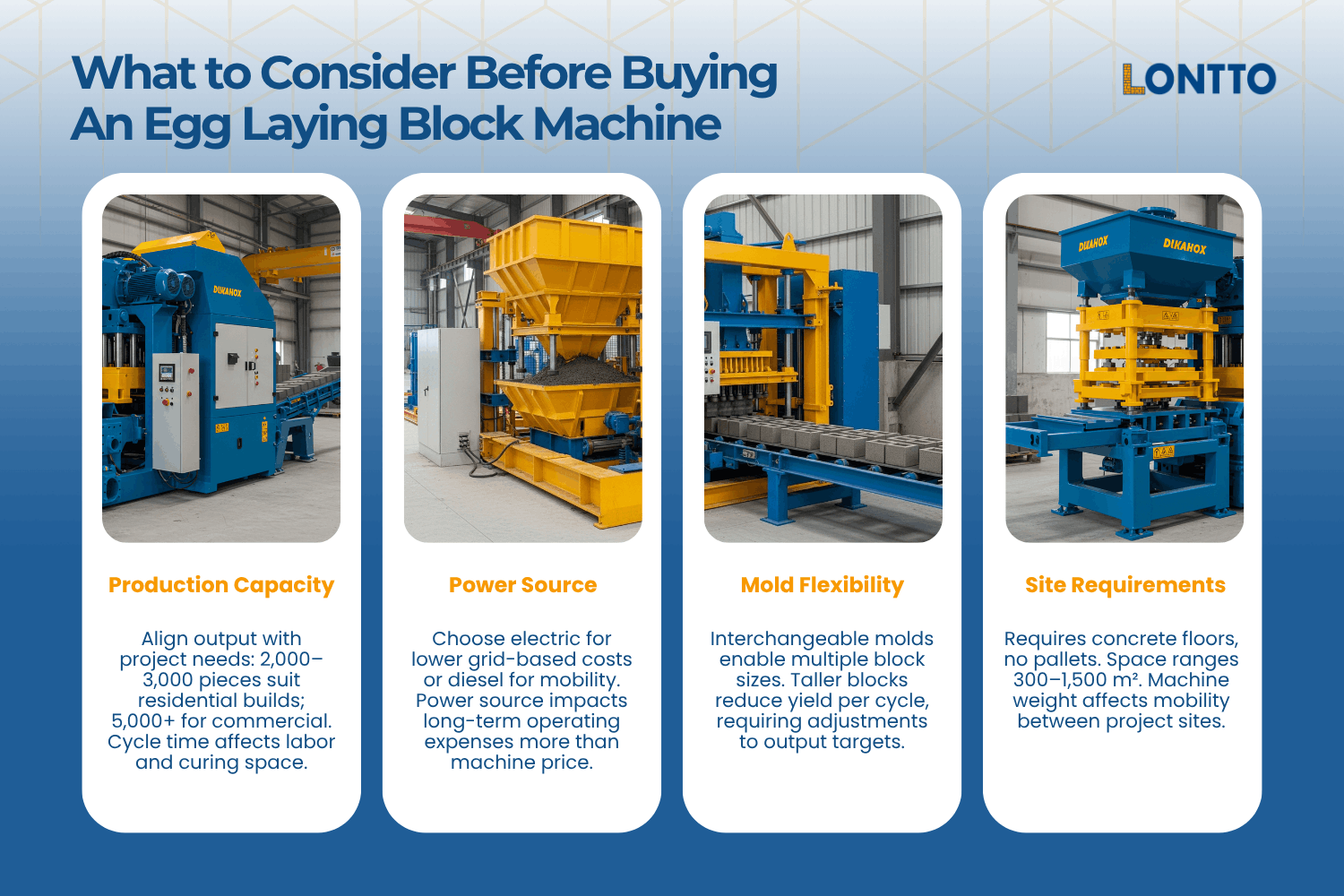
Choosing the right egg-laying block machine comes down to four factors. Each variable affects total project cost differently, and a machine that fits one site may create bottlenecks on another. The specs below break down what to evaluate before committing to a purchase.
Production capacity
Match daily output to project requirements. At 2,000 to 3,000 pieces per shift, the output suits residential block production, while commercial construction sites need 5,000 or more pieces. Longer cycles affect labor costs and ground space requirements for curing blocks. Cycle time ranges from 20 to 45 seconds, depending on the selected egg-laying block machine.
Power source
Electric block-making machines running 6.7 to 18.5 kW offer lower operating costs on grid-connected sites. Diesel units eliminate grid dependency but add fuel costs and engine maintenance services. Matching the power source to site conditions affects the total production cost more than the machine price alone.
Mold flexibility
Interchangeable molds let one egg layer block machine cover multiple block sizes without frame modification. Stroke yield drops as block height increases, from 9 pieces at 100 mm down to 5 pieces at 200 mm. Output targets shift accordingly across different concrete block formats.
Site requirements
Egg-laying machines cure blocks on concrete floors, eliminating pallet costs. Required space ranges from 300 m² to 1,500 m², depending on production capacity. Machine weight runs 800 to 2,300 kg across the segment, directly affecting repositioning ease between construction projects.
Our Top 6 Egg Laying Block Machine Suppliers' Picks
1. Fulang Machinery
Fulang Machinery has manufactured block-making machines since July 1999, building a catalog that spans mobile, automatic, and soil-interlocking formats.
The QTF40-3A sits in the company's mobile segment, designed for contractors who need block production without a fixed plant setup. Two workers can run a full shift, and the machine requires no pallets at any stage of output.
- The QTF40-3A can produce 2,880 to 3,840 pieces in an 8-hour shift.
- Each shaping cycle runs 30 to 40 seconds, driven by 35.5 kN of vibration force.
- Power draw holds at 6.7 kW across the full shift.
- The machine weighs 0.8 tons and measures 1,800 x 1,400 x 1,100 mm.
- Full setup fits within 1,500 m², with 500 m² of concrete ground required.
- Water consumption runs 2 to 3 tons per day.
Mold changeability gives crews the flexibility to switch between hollow and solid profiles without retooling the line. Crews skip complex tooling changes entirely, keeping downtime off the schedule.
Egg laying: blocks cure directly on the ground, reducing tray inventory and budget costs. Operator-controlled repositioning keeps the machine moving without pulling workers off the line.
| Pros | Cons |
|---|---|
| ✅ Conformité Européenne (CE) and ISO certifications cover the unit. ✅ No pallets are needed at any stage of block production. ✅ At 35.5 kN, the vibration force is high relative to the 0.8-ton frame size. |
❌ No tray system ties up ground space and limits how quickly crews can rotate production zones. |
Need to Produce Blocks at Scale?
Our block making machines are built for commercial and industrial production. Get expert advice and a custom price quote — we respond within 24 hours.
2. Lontto
Lontto manufactures the QCM4-30 for operations that need concrete hollow block output without a fixed plant setup. Both diesel and electric power inputs are supported across different site configurations.
With exports reaching over 100 countries across Africa and Asia, Lontto carries a proven track record in international block machine supply. Mold vibration and mechanical demolding handle compaction and release without manual intervention, keeping pallets out of the production process entirely.
A JW350 pan mixer pairs with the QCM4-30 to maintain consistent quality across each concrete batch. Finished blocks stack dry after output, with maintenance services in accordance with standard concrete practice.
- The QCM4-30 produces hollow blocks at a fixed size of 390 x 190 x 190 mm, with 4 pieces released per cycle.
- Daily production capacity ranges from 2,000 to 2,500 pieces during a standard shift.
- Each vibration cycle lasts 5 to 10 seconds, and a full demolding cycle completes in 30 to 40 seconds.
- Installed power draws 7.5 kW from the electric supply or 8.5 HP from diesel, depending on site configuration.
- Production requires approximately 300 m² of site area.
- Finished blocks stack dry after output, with maintenance requirements matching standard concrete practice.
| Pros | Cons |
|---|---|
| ✅ Spring-suspended components isolate vibration from the frame without sacrificing compaction force. ✅ The 480 mm wheel diameter allows repositioning across uneven terrain without assistance. ✅ Simple electrical control components let operators get up to speed quickly with minimal training. |
❌ Block curing depends on ambient conditions, with no controlled drying process. |
3. American Block Machinery
Hydraulic cylinders drive both the mold and ram on the SBS-105, separating it mechanically from vibration-only egg-laying machines in the same class.
Stronger compaction per stroke means operators can reduce cement content without compromising block density. Producers swap output formats by changing the mold, with no frame retooling required.
Running the 8" mold produces 4 blocks per stroke, clearing 2,000 pieces across a standard day at the lowest output tier, but the heaviest block format the machine handles.
- Stepping down to the 6" mold pushes stroke yield to 5 pieces, with daily output climbing past 2,400 pieces as cycle time stays consistent.
- The 4" mold delivers the highest return at 8 pieces per stroke, crossing 3,800 pieces per day without changing the machine's core cycle.
- At 1,000 to 1,200 kg, depending on the mold selection, the SBS-105 is heavier than most mobile egg-laying units.
- A 860 x 600 mm molding area accommodates the full mold range within a 2,000 x 1,500 x 2,000 mm machine footprint.
- Three separate motors handle distinct functions. Vibration draws 1.5 HP, hydraulic pressure draws 3 HP and travel draws 0.5 HP, all on a 440V, 3-phase supply.
- Custom molds extend output beyond the three standard configurations, covering non-standard block sizes without requiring a separate machine.
| Pros | Cons |
|---|---|
| ✅ Custom mold production is available, extending the machine beyond standard block sizes. ✅ Live international training and virtual support reduce startup risk for new operators. ✅ Three standard mold sizes cover 4", 6" and 8" output without requiring custom tooling. |
❌ Machine weight of up to 1,200 kg sits heavier than comparable mobile egg laying units, affecting repositioning effort. |
4. Reva Engineering
The RBME-07 operates at a different scale than lighter mobile egg laying units in this segment. An optional PLC control upgrade is available for sites that require higher automation without replacing the machine.
Reva Engineering built the machine around a fully automatic movement cycle, with push-button controls handling standard operation. Steel molds can be interchanged across all three block formats without frame modification.
- The RBME-07 yields up to 16 bricks per mold in standard configuration. Stroke output scales down as block height increases across the three mold options.
- Running the 4" mold at 400 x 200 x 100 mm delivers 9 pieces per stroke, making it the highest-volume format the machine supports.
- Dropping to the 6" mold at 400 x 200 x 150 mm reduces stroke yield to 6 pieces, reflecting the increased material volume per block.
- At the 8" mold size of 400 x 200 x 200 mm, the machine releases 5 hollow block pieces per stroke at maximum block height.
- Each egg-laying cycle lasts 20 to 25 seconds, with a production capacity of 500 to 1,000 kg per hour. Output varies depending on mold selection and material consistency.
- The block height spans 80 mm to 200 mm, providing the RBME-07 with coverage across standard block sizes within a single frame.
- The hydraulic system operates at a maximum pressure of 180 kN, backed by a 220-liter oil tank that supports extended runs between refills.
- A heavy-duty vibration system runs at 4,200 RPM, driving compaction force through the mold on each cycle.
- At 18.5 kW on a 380V three-phase electric supply, the power draw reflects the machine's heavier frame and higher output ceiling.
- The overall footprint of 5,600 x 2,200 x 2,500 mm requires more site clearance than compact mobile block units in the same class.
| Pros | Cons |
|---|---|
| ✅ Manual override mode keeps production running when automatic cycling needs intervention. ✅ Wheel-fitted mobility lets the machine advance between positions without crew repositioning. ✅ Overseas engineer service covers post-installation support at the buyer's location. |
❌ No diesel power option exists, limiting deployment where three-phase grid access is unavailable. |
5. Zhengchen Machinery
Raw material choice sets the QMC6-25 apart from block-making machines locked into a single mix formula. The QMC6-25 accepts a broad range of inputs, drawing from cement, sand, fly ash or slag, depending on local supply chains.
Volcanic ash and rubble qualify as additional raw material options, broadening sourcing flexibility for remote construction projects. At 2,300 kg and 12.2 kW, the unit sits mid-range in both weight and power draw among egg-laying units in its class.
- The QMC6-25 produces 7,680 pieces of 400 x 150 x 200 mm hollow block across an 8-hour shift, placing it among the higher-output egg laying units in its weight class.
- Combined hydraulic and vibration molding work together during each cycle, with pressure and compaction force applied simultaneously for denser block formation.
- Each molding cycle completes in 30 to 35 seconds, a faster turnaround than heavier block manufacturing units running comparable hydraulic systems.
- A JZC350 mixer handles material feeding, with the full brick-making process requiring a crew of three across the mixing, feeding, and pressing stages.
- Output scales across hollow and solid formats, with mold changes covering different shapes and custom block sizes available on request.
- The host machine measures 2,000 x 1,800 x 1,600 mm and needs only a prepared concrete floor for block output.
| Pros | Cons |
|---|---|
| ✅ The QMC6-25 suits mid-sized factory setups without requiring industrial infrastructure. ✅ Block clamping machine compatibility feeds finished output directly into mechanized stacking. ✅ Engineer dispatch for large units covers debugging alongside installation. |
❌ Requires periodic calibration of microcomputer-based batching systems. |
6. Shandong Henry Intelligent Machinery
The QMD4-45 egg-laying block machine runs on a 12 HP diesel engine, removing grid dependency from mobile brick making entirely. Weichai and Chang Chai supply the diesel units. Henry developed an in-house foot-stepping vibration switch, allowing operators to control concrete filling hands free during the brick molding stage.
At 1,200 kg, this mobile egg laying unit repositions between construction sites on wheels without crane support. The battery backup handles single-button diesel startup and provides power at critical moments during operation.
Blocks cure directly on the ground, eliminating the need for pallets or fiberboard and reducing civil works costs. For on-site concrete block-making projects, reduced setup time directly translates into lower project overhead.
- The QMD4-45 egg layer block machine produces 4 concrete hollow blocks of 400 x 200 x 200 mm per 45-second cycle, with no cement brick tray system required at any stage.
- At 1,450 x 1,400 x 1,200 mm, the mobile block frame stays compact enough for tight construction sites without sacrificing structural rigidity.
- Block production scales from family housing to large commercial facilities within the same hollow block mold configuration.
- The diesel drive system handles all mechanical functions of the brick-making machine without a secondary electric motor, maintaining consistent production capacity across shift lengths.
| Pros | Cons |
|---|---|
| ✅ The foot-stepping switch enables single-operator control at the compaction stage. ✅ Diesel power lets remote technicians service the unit without manufacturer intervention. ✅ No pallets or fiberboard removes two recurring consumable costs from the budget. |
❌ Battery dependency for startup introduces a failure point that purely mechanical diesel systems avoid. |
Egg Laying Block Machine Suppliers FAQs
What's the difference between egg laying and stationary machines?
Egg-laying machines are mobile units that cure blocks directly on the ground, eliminating pallets and fixed infrastructure from the cost model. Stationary machines require dedicated production lines with conveyors and stacking systems. Higher output makes stationary setups better suited to permanent factory operations.
How many workers does an egg-laying machine need?
Most egg-laying units require two or three workers per shift, covering the mixing, feeding, and pressing stages. Automated models with push-button controls can reduce crew size to one or two operators.
Can a single machine produce blocks of different sizes?
Interchangeable steel molds let a single egg-laying machine cover hollow blocks, solid formats, and custom heights ranging from 80 mm to 200 mm without modifying the frame. Stroke yield drops as block height increases, reducing the number of pieces per cycle on larger formats.
Back to Top: Top 6 Egg Laying Block Machine Suppliers

Speak To Our Brick Machine Expert
Get in touch with our nice team today to get a price estimate for a block machine.

I am Chao Zhang, I have been working in the brick making industry for over 10 years. I have a deep understanding and research on various models of block making machines, especially automatic brick machines, concrete block machines, compressed earth block machines, clay brick machines, cement brick machines. I have a special understanding of this industry. I can help my clients choose the suitable brick machine and assist them in designing and building a brick production factory. If you want to know everything about brick making machines, please contact me. I am happy to help you.
 Price Quote
 Call Us